Free vs Paid Fleet Maintenance Software: What's the Catch?


free-vs-paid-fleet-maintenance-software

A 45-bus transit authority switched from a "free" fleet maintenance app in 2023. Within six months they hit the user limit, couldn't export data, and faced a $15,000 migration bill to recover their maintenance history. Another fleet using a free spreadsheet-based system spent 120 hours per year manually syncing data across tools — time that would've cost $3,600 in labor. The catch with free fleet software isn't that it doesn't work initially. It's that it hits a wall. User limits. Export restrictions. No API. No support. No multi-vehicle features. By the time you realize the limits, you've invested time, trained staff, and stored months of critical data you can't access. Here's how to evaluate free vs. paid fairly.

Fleet Software 2026
Free vs Paid Fleet Maintenance Software: What's the Catch?

Free has limits. Paid has features. Here's the cost-benefit analysis that actually matters for fleet operations.

Free vs Paid — Real Comparison Data
Typical free fleet app user limit1–3 concurrent users
Typical paid CMMS user limitUnlimited within tier
Free app data export cost$5,000–$15,000 (migration)
Free spreadsheet annual labor waste80–150 hours (data sync)
Paid CMMS with integrations ROIBreak-even in 4–8 months
Free works until it doesn't. Paid scales with your fleet and data.
01Why Free Fleet Software Hits a Wall

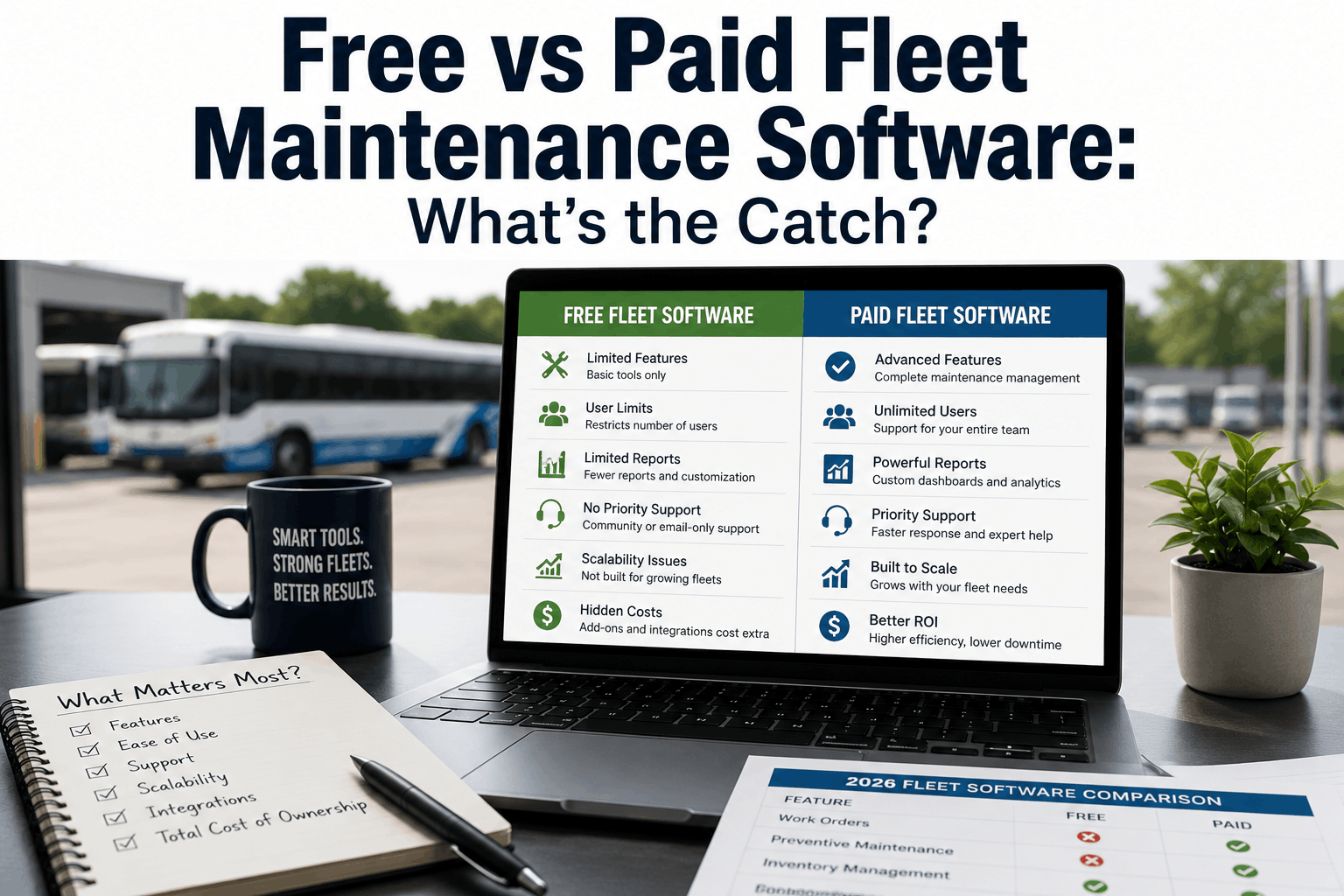
Free fleet software exists in two categories: stripped-down commercial tools with usage limits, and consumer-grade apps adapted for fleet use. Both have structural limits that appear harmless until they don't. The user limit is real. A free app supporting 1–3 concurrent users works fine for a dispatch office and one or two mechanics. Add a second shift, a remote technician, a driver reporting from the road, and you hit the wall. Usage metering is hidden. Many free apps log data quota or feature throttling — "only 100 maintenance records" or "up to 10 buses tracked." The numbers are reasonable until you realize you hit them after 6 months. Export is blocked. Free apps rarely allow data export without purchasing a "professional" version — which means months of maintenance records become inaccessible or cost thousands to migrate. Support is non-existent. A free app has no phone support, no SLA, and no guarantee of feature updates. When something breaks, you get a forum post or you're stuck.

Free Fleet Software — Typical Limits
Concurrent users1–3. Multi-shift operations immediately hit wall.
Vehicle limitUsually 5–10. Upgrading to 30+ requires paid version.
Mobile accessOften limited or disabled. Desktop-only common.
Data exportRarely allowed. Blocks migration to better tools.
API / integrationsNone. Spreadsheet bridges required for data sync.
SupportForums only. Vendor has no SLA or responsibility.
Free is cheap until the limits cost you more than paid would.
Paid CMMS — What You Gain
Concurrent usersUnlimited. Full fleet + office + remote access.
Vehicle capacityScales to 100+ buses. Same software, no upgrade wall.
Mobile-firstNative apps for drivers and technicians. Works offline.
Data exportAlways available. Open formats. No vendor lock-in.
API + integrationsTelematics, fuel, accounting, compliance seamless.
SupportDedicated, SLA-backed. Onboarding, training, troubleshooting.
Paid removes the hidden cost of free. 4–8 month ROI typical.
02The True Cost of Free: Spreadsheets and Manual Sync

Many fleets don't use "free" software at all. They use Excel. A spreadsheet is free, flexible, and feels like it scales. Until it doesn't. A 50-bus fleet maintaining records in spreadsheets creates a hidden labor tax: data entry, formula maintenance, manual sync with fuel reports and accounting, duplicate entries across multiple sheets, and no audit trail when data gets overwritten. A typical scenario: maintenance records are logged in one spreadsheet, fuel purchases in another (from the fuel card vendor's export), and hours in a third (from timesheets). Reconciling these three data sources manually takes 8–12 hours per month — or roughly $96–$180 per month in labor, $1,150–$2,160 per year. A mid-tier CMMS with fuel and accounting integrations costs $50–$150 per month. The spreadsheet "saves" $600 per year but costs $1,500+ in hidden labor. And that's before counting mistakes, missed maintenance records, and the time spent recovering from data corruption.

Annual Hidden Cost — Spreadsheets vs. Integrated CMMS
Data entry labor
$1,200–$1,800/year
Manual fuel reconciliation
$400–$800/year
Duplicate entry fixes
$200–$600/year
System downtime from errors
$300–$900/year
Total annual hidden cost
$2,100–$4,100/year
Integrated CMMS costs $600–$1,800/year. Spreadsheets cost $2,100–$4,100 in labor alone.
03Freemium Traps: The Upgrade Treadmill

Freemium software is free software with a built-in upgrade path. You start free. At some point — usually when you've trained staff, stored months of data, and built workflows around the tool — you hit the paywall. The upgrade is then expensive because leaving means losing your data. This is not a conspiracy; it's deliberate product design. Freemium providers know that the true cost of switching increases the longer you use their free tier. A 30-bus fleet hitting a freemium vendor's 10-vehicle limit faces a choice: pay for upgrade (often $200–$500 per month) or migrate to a new system (costing $8,000–$15,000 in data migration plus retraining). Most choose to pay. The pricing model also discourages feature use on the free tier. Reporting features are locked. API is locked. Mobile apps are locked. So users stay on spreadsheets and workarounds — defeating the purpose of the software.

Freemium Treadmill — Real Example
Month 1–3: Free tier, 5 buses, feels good
Month 4: Add 10th bus, hit limit, cannot add more
Month 5: Vendor says "upgrade to Pro: $300/month"
Month 6: Lock-in complete, data trapped in system
Total cost: $1,800/year + migration risk + no exit option
Paid CMMS — Predictable Path
Month 1: Pay $100/month, get full software
Months 2–12: Add buses, users, integrations — no upgrade walls
Data always exportable. No surprise tiers.
Can cancel anytime without losing historical data
Total cost: $1,200/year, full feature access from day one
"We used a freemium app for 8 months. Free tier covered 5 buses fine. At month 9, we added our 6th bus and got a paywall. They wanted $250/month for Pro. We were trapped — our data was in their system, staff knew the tool, and leaving meant $10,000 to migrate. We paid. Should've done paid CMMS from day one."
— Fleet Manager, 15-bus charter operation, California
04When Free Makes Sense (And When It Doesn't)

Free fleet software has legitimate use cases. It doesn't make sense for the majority of bus fleets, but it's worth being honest about when it works. Free software makes sense if: you have under 5 buses, one or two mechanics, no regulatory requirements (no ELD tracking, no fuel audits), and no integration needs. In this case, spreadsheets or a basic free app genuinely cover the need and the hidden costs are manageable. Free software doesn't make sense if: you're scaling beyond 10 buses, you have regulatory compliance requirements (ELD, fuel tracking, driver hours), you need technician or driver mobile access, you require reporting or audit trails, or you plan to grow. In these scenarios, the hidden costs of free — limited users, no integrations, no API, no support — exceed the software cost within 6–12 months. The decision matrix is straightforward: calculate your fleet's hidden labor cost in spreadsheet management. If it's under $800 per year, free might work. If it's over $1,200 per year, paid CMMS is cheaper.

Don't let "free" become "trapped in freemium." If you're evaluating free software, ask one question: can I export all my data if I leave? If the answer is no or unclear, walk away.
Free Works If:
Fleet sizeUnder 5 buses. Spreadsheets manageable at this scale.
UsersOne or two mechanics. No remote access needed.
ComplianceZero regulatory requirements. No ELD, fuel, or driver hour tracking.
IntegrationsNone. You don't track fuel, accounting, or telematics separately.
Paid Makes Sense If:
Fleet size10+ buses or growth expected within 12 months.
UsersDrivers, technicians, dispatch in multiple locations.
ComplianceELD tracking, fuel audit, or driver hour requirements.
IntegrationsConnect telematics, fuel, accounting, or dispatching.
05Choosing Paid: What to Look For

If you've decided that free doesn't fit, paid CMMS requires different evaluation criteria. Don't choose based on lowest cost. Choose based on feature fit, scalability, and support.

Paid CMMS Evaluation Framework
Scalability
Will the same software handle 50 buses? 100? No upgrade walls.
User model
Per-user pricing (bad for multiple shifts). Flat-rate licensing (good).
Integrations
API available? Telematics, fuel, accounting connectors built-in?
Mobile
Native iOS/Android apps? Works offline? Or web-only?
Data ownership
Can you export all data? In open formats? Without penalty?
Support
Phone support included? Training? Onboarding? SLA?
Pricing transparency
What's included in your tier? What costs extra? No surprise paywalls.
Fleet Expert Review

Free fleet software is a myth for most operators. It's either a spreadsheet dressed up as an app with artificial limits, or a freemium trap that upgrades you once you're locked in. Paid CMMS costs 20–35% less per year than the hidden labor cost of spreadsheet management — and includes mobile access, integrations, support, and scalability. The fleets that resist paid CMMS are often the ones who've already spent $2,000–$4,000 per year in manual data entry and haven't realized it. BusCMMS pricing is simple: one flat rate that includes unlimited users, unlimited vehicles, full API, mobile apps, and integrations. No per-user surcharges. No upgrade walls.

The Bottom Line

Free fleet software doesn't exist for most bus fleets. Either it's a spreadsheet you manage yourself (costing $1,500–$3,000 per year in labor), or it's freemium software that traps you in an upgrade cycle once you've built workflows around it. Paid CMMS breaks even within 4–8 months when you account for labor savings, integrations, and scalability. The choice isn't between free and expensive. It's between $2,000–$4,000 per year in hidden labor costs (spreadsheets) versus $1,200–$1,800 per year in actual software that scales and supports your fleet. BusCMMS offers 14-day free trial with no credit card, full feature access, and transparent pricing so you can compare the real cost difference yourself.

Stop Paying With Hidden Labor Hours
Paid CMMS costs less than spreadsheet management and includes mobile apps, integrations, and support. See the real numbers. Free 14-day trial.
Frequently Asked Questions
Is there any truly free CMMS that scales for medium fleets?
Not realistically. Open-source CMMS exists but requires self-hosting, IT setup, and ongoing maintenance — which costs more than paid SaaS in labor. Commercial free options hit limits at 5–10 vehicles. Plan for paid CMMS if you're scaling beyond 10 buses.
How much does a typical CMMS cost for a 50-bus fleet?
Mid-market CMMS typically costs $1,500–$3,000 per year for 50 buses (flat-rate pricing). Some charge per-user or per-vehicle, which can inflate costs. Always ask for total cost of ownership before committing.
Can I really export my data if I leave a paid CMMS?
With reputable vendors, yes. Ask explicitly: "Can I export all records in CSV/Excel?" If they hedge or say "contact sales," that's a red flag. BusCMMS allows full data export anytime, no penalty.
What's the hidden cost of spreadsheet fleet management?
For a 30-bus fleet: 8–12 hours per month of manual data entry and sync, plus formula maintenance, duplicate fixes, and error recovery. That's $1,500–$2,500 per year in labor. Paid CMMS typically costs $100–$150 per month — a 50% savings.
Is freemium CMMS ever a good choice?
Freemium works as a trial to evaluate software fit. Use the free tier for 30–60 days with no intention to scale on free. Once it's proven useful, switch to paid. Never plan to stay on free tier indefinitely — that's where the trap closes.
How long does it take to break even on paid CMMS?
Most fleets break even within 4–8 months when accounting for labor saved from spreadsheet management, integrations reducing manual sync, and time freed from support interactions. ROI accelerates as team size grows.
The Math Is Simple. Free Costs More.
Spreadsheet management: $2,000–$4,000/year in labor. Paid CMMS: $1,200–$1,800/year with full features. Try BusCMMS free for 14 days.


Share This Story, Choose Your Platform!