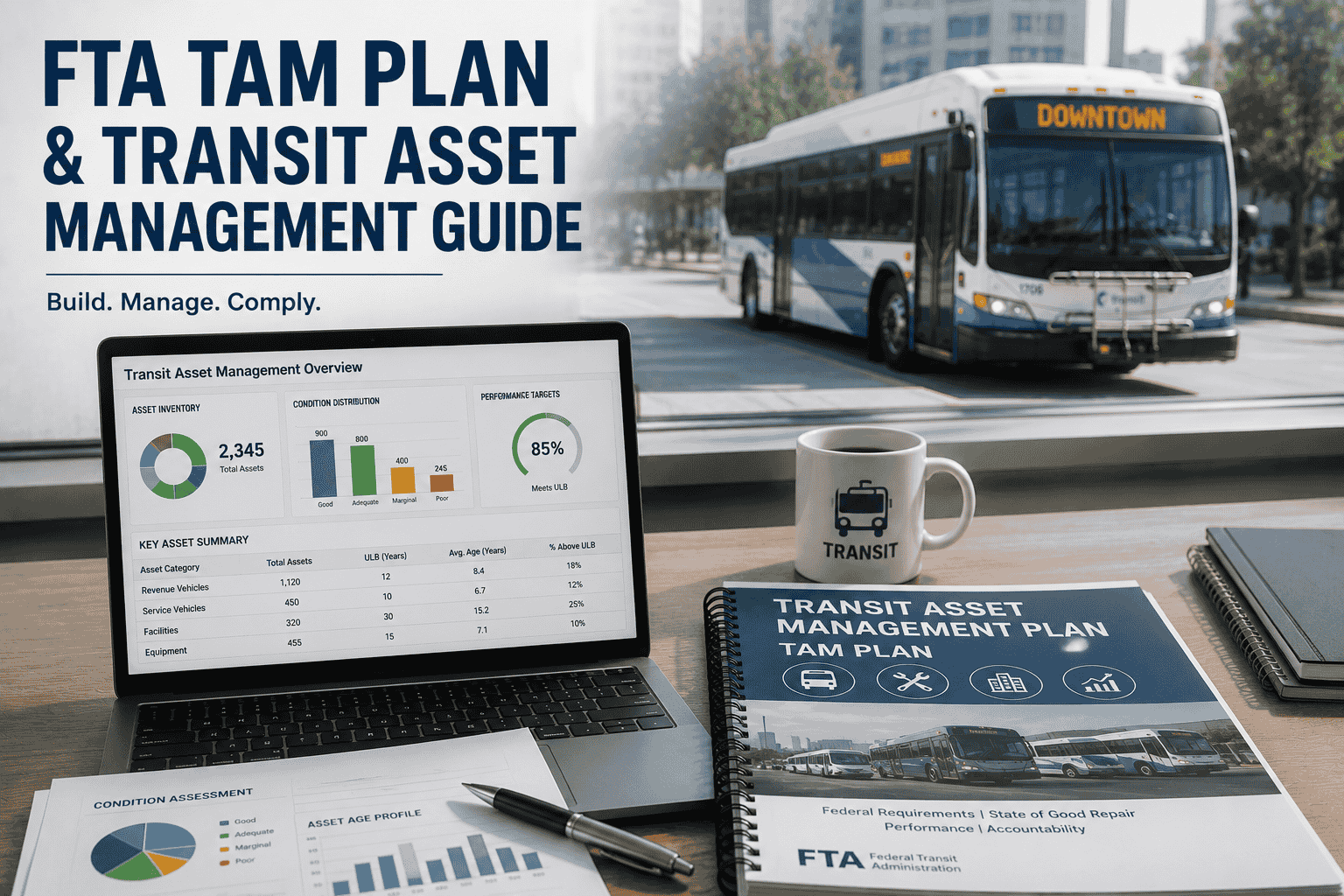
Every transit agency receiving FTA funding must have a Transit Asset Management (TAM) plan. This plan documents how the agency manages its assets — buses, facilities, infrastructure — to maintain them in a "state of good repair" (SOGR). The TAM plan must address: (1) Asset inventory and condition, (2) Useful life benchmarks (ULB) for each asset class, (3) Capital replacement schedules, (4) Maintenance strategies to extend asset life. The FTA uses TAM plans to evaluate funding requests and agency financial health. An agency with a credible TAM plan and strong compliance is viewed as well-managed and receives favorable grant treatment. One without a TAM plan or with a weak plan faces scrutiny. The challenge: building and maintaining a TAM plan requires accurate asset data, realistic condition assessments, and disciplined capital planning. Most agencies do this with spreadsheets and manual processes. With a CMMS configured for TAM compliance, the process becomes systematic and continuous.
FTA TAM Plan & Transit Asset Management Guide
Federal rules require a TAM plan. Learn how to build and maintain a Transit Asset Management plan that meets FTA requirements and ULB targets.
FTA requires transit agencies to develop and implement a TAM plan that includes: (1) Inventory of all capital assets. For vehicles: VIN, acquisition date, purchase price, current status, condition rating. (2) Condition assessment using a standardized scale (similar to NTD 1–5 ratings). (3) Useful Life Benchmarks (ULB) for each asset class. Example: a diesel bus typically has a ULB of 12 years or 500,000 miles. (4) Capital replacement needs based on assets reaching or exceeding ULB. (5) Maintenance strategy to extend asset life and minimize replacement costs. State of Good Repair (SOGR) means assets are maintained at a level that prevents deterioration and supports safe, reliable service. An agency at 85% SOGR is maintaining 85% of its fleet within condition rating 1–3 (excellent to fair). An agency at 60% SOGR has 40% of its fleet in poor/beyond ULB condition. FTA performance targets vary by agency size and type, but most agencies aim for 80%+ SOGR. Falling below 80% triggers scrutiny and potential loss of discretionary funding.
A CMMS configured for TAM provides: (1) Real-time asset inventory with ULB tracking. Every asset tracked with acquisition date, cost, ULB. System flags assets approaching or exceeding ULB. (2) Maintenance history linked to condition. A bus with $200k in repairs over 10 years is in poor condition. A bus with $50k is in good condition. (3) PM effectiveness tracking. High PM compliance correlates with better asset condition. Low compliance leads to premature failures. (4) Capital planning support. The CMMS projects which assets will exceed ULB in the next 5 years, allowing for capital requests. (5) SOGR reporting. The CMMS can calculate the % of fleet in each condition category (1–5), showing current SOGR and trend. With this data, agencies can make evidence-based decisions: "We're at 72% SOGR. To reach 80%, we need to replace 40 buses in the next 3 years. That requires $24M in capital funding." This kind of data-driven argument is compelling in grant applications. Without CMMS, agencies rely on estimates and hope. With CMMS, they have data.
TAM planning is a strategic tool for long-term fleet management. Agencies that use data-driven TAM plans maintain higher SOGR (80%+), achieve better capital planning accuracy, and receive more stable funding. Those without formal TAM plans struggle to explain asset replacement needs and often find themselves reactive (asset fails, scramble for emergency repair funding). The difference is not complexity — it's discipline and systems.
FTA TAM plans are required, but they're also an opportunity. Agencies that use CMMS to build TAM plans have accurate asset data, realistic condition assessments, and credible capital plans. They achieve SOGR targets, receive favorable grant treatment, and maintain reliable service. CMMS automates TAM planning: continuous asset tracking, condition assessment, ULB monitoring, and SOGR reporting.