A city council member asked the transportation director: "Why do we need software that costs $30,000 per year? We've been managing buses fine for 20 years with spreadsheets." The director had numbers but no business case. She showed maintenance costs ($2.4M annually for 200 buses) but didn't show how CMMS would reduce them. She mentioned time savings but didn't quantify it. The council voted no. A year later, the same director had to hire an additional administrative staff member (cost: $65,000 salary + benefits) because spreadsheet management had become unmanageable. She finally built a business case: CMMS at $30,000/year saves $85,000 in labor and prevents $120,000 in maintenance waste through better planning. Net benefit: $175,000 per year. ROI: 583%. The council approved it. Government budgets demand justification. You can't just say "we need software." You must build a financial case that shows return on investment. This guide explains how to build a CMMS business case that survives council and board scrutiny.
Build a financial case that survives board scrutiny. Show ROI, risk mitigation, and long-term savings.
Government budgets require financial justification. You can't sell software by saying "it's better" or "other cities use it." You must show money. A CMMS saves money through four mechanisms: labor efficiency, maintenance optimization, compliance risk reduction, and data visibility for better decision-making. Labor efficiency is easiest to quantify. A 200-bus fleet with a manual spreadsheet-based system spends 20–30 hours per month on reporting, data entry, and reconciliation. That's one full-time person (2,400 hours/year). A CMMS reduces this to 2–3 hours per month (automated reporting). Labor savings: $65,000–$85,000 annually. Maintenance optimization comes from preventive maintenance scheduling based on real data. Without proper tracking, maintenance happens reactively (emergency repairs cost 50–300% more than preventive). A CMMS enables preventive maintenance, reducing reactive maintenance cost by 15–25%. On a $2.4M maintenance budget, that's $360,000–$600,000 in savings. Compliance risk reduction avoids audit fines ($15,000–$50,000) and litigation costs from accidents that might have been prevented with proper maintenance documentation. Data visibility enables better budgeting and asset decisions. When you know which buses cost most to maintain, you can replace them earlier or address design issues. These quantifiable benefits far exceed the software cost ($30,000–$50,000 annually).
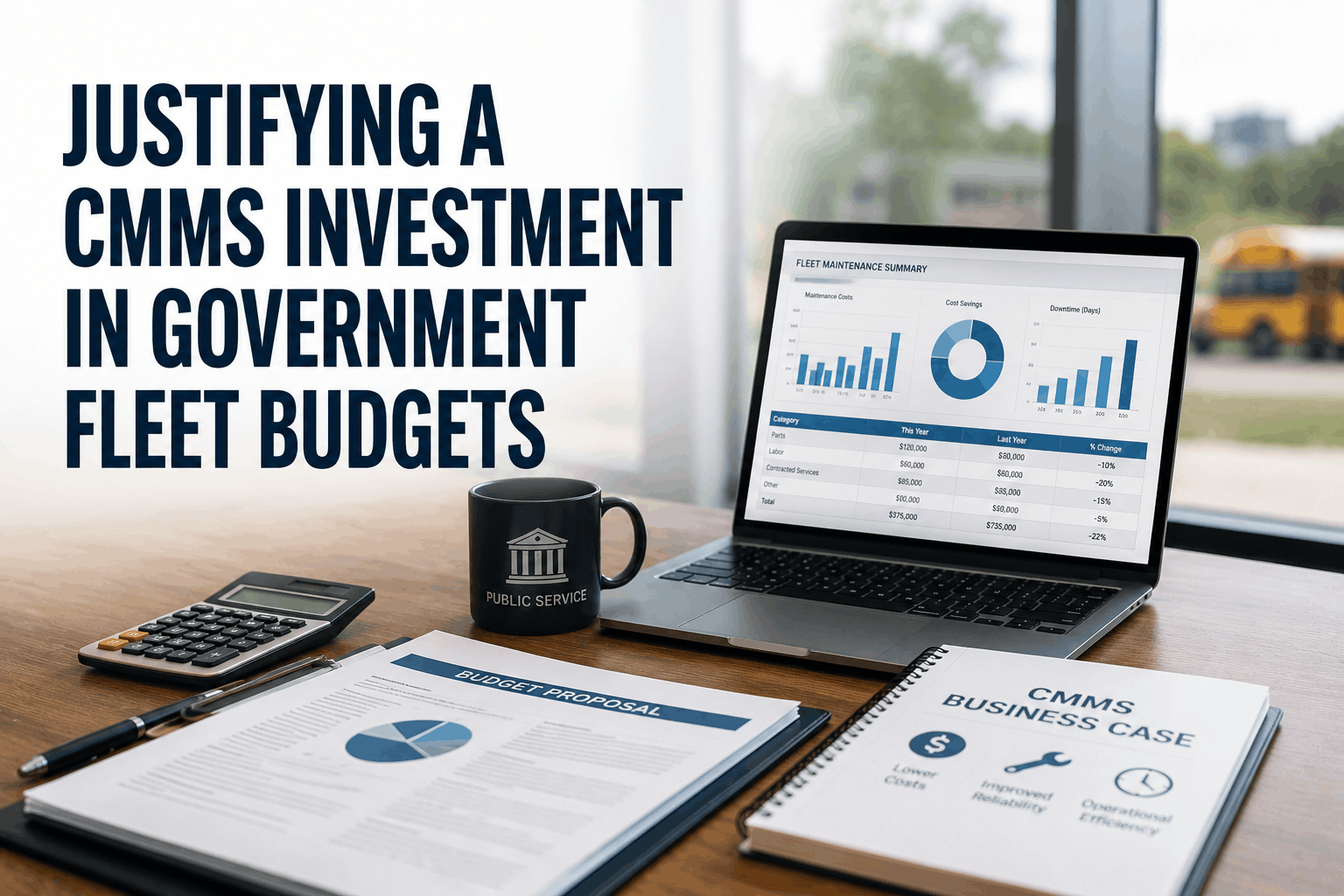
The business case is a one-page (or two-page) financial summary, not a 50-page proposal. Government decision-makers are busy. They want bottom-line numbers. The business case should include: Executive summary (1 paragraph on what you're asking and why), current state description (how fleet maintenance is managed now), costs of current state (labor hours, software costs, reactive maintenance waste), proposed state (CMMS implementation), costs of proposed state (software license, implementation, training), benefits (labor savings, maintenance savings, compliance risk reduction, with specific numbers), ROI calculation (annual benefit / annual cost), payback period (how long until benefits exceed costs), risk mitigation (what compliance risks are reduced), and recommendation (approve or deny, with justification). The entire document should be 2–3 pages. Longer documents don't get read. Charts showing labor savings and maintenance reduction are helpful. A simple line graph showing "cost per bus per month" before and after CMMS is powerful. Numbers that fit on a single page are what survive council presentations. A 50-page proposal with detailed vendor capabilities will be set aside — council doesn't care about feature lists, only financial impact.
Council members will raise objections. Prepare responses. Objection #1: "This seems expensive for software." Response: It costs less than one employee you're already paying. It replaces that labor and prevents $120K+ in maintenance waste. Objection #2: "What if we can't implement it on schedule?" Response: Implementation risk is real but manageable. A 3–6 month implementation timeline is typical. Worse risk is not addressing current manual system problems (audit exposure, data errors, staff turnover). Objection #3: "Why can't we use spreadsheets?" Response: Spreadsheets are fine for small operations but break at scale. A 200-bus fleet managing schedules, compliance, and budgets in spreadsheets means errors, duplicated work, and audit risk. A CMMS eliminates that risk for less cost than additional staff. Objection #4: "Have other cities adopted this?" Response: Yes. Reference similar-sized cities that have implemented CMMS and achieved measurable cost savings. Provide case studies or testimonials. Objection #5: "What's the risk if we don't do this?" Response: Largest risk is compliance violation (audit fines $15K–$50K), maintenance waste ($120K+/year from reactive repairs), and staff burnout from manual systems. These costs far exceed CMMS cost. Prepare for these objections. Have numbers ready to support your case.
Government budgets don't approve software based on features or vendor reputation. They approve based on financial impact. A CMMS business case must show: what you're spending now (labor, waste, risk), what you'll spend with CMMS, and what you'll save. The math must be clear: CMMS cost $40K, saves $200K, ROI 400%. Numbers that dramatic survive council scrutiny. Weak business cases focus on software capabilities ("has mobile access," "generates reports automatically") rather than financial impact. Strong cases focus on money: labor hours eliminated, maintenance waste prevented, compliance risk reduced. Build your case on financial impact. Numbers sell. Features don't.
A CMMS investment requires a business case that shows financial return. For a 200-bus fleet, typical annual benefit is $200K–$300K (labor savings + maintenance optimization + compliance risk reduction), against a cost of $40K–$50K. ROI is 400–600%. Payback is 1–3 months. Build a two-page business case with executive summary, current-state costs, proposed-state benefits, financial projection, and risk mitigation. Focus on measurable financial impact, not soft benefits like "better decision-making." Address council objections with specific numbers. A weak business case gets rejected. A strong case with clear financial justification gets approved. Invest time in building a solid case. It's the difference between project approval and budget denial.