A municipal transit authority managed 200 buses across three cities. They used Excel spreadsheets for maintenance tracking, separate telematics portal for vehicle data, and manual filing for compliance documentation. When the state auditor asked for maintenance compliance records across the fleet for the past two years, they had a problem. The Excel files were inconsistent (different formats across cities). The telematics data wasn't connected to work orders. Compliance documentation was scattered across filing cabinets. It took 120 hours to compile the records, and the auditor found discrepancies. The city was cited for non-compliance on three vehicles. Cost: $15,000 in fines plus overtime hours compiling records. A CMMS designed for government fleets would have eliminated the discrepancies, automated the compliance report, and provided audit-ready documentation instantly. Government fleet maintenance software isn't luxury — it's regulatory requirement. Public agencies face audit pressure that private fleets don't. This guide explains what government fleet software must do and how to choose the right platform.
Audit-ready compliance tracking. Real-time fleet visibility. Built for public-sector requirements.
Government agencies have compliance obligations that private fleets don't. State auditors, federal oversight agencies, and city council committees demand documentation. A municipal transit authority must prove that every bus received required maintenance at required intervals. A school district must show that buses passed state inspections. A government contractor must document work performed and costs incurred. Standard CMMS software handles maintenance tracking. Government CMMS must handle audit-ready reporting. When an auditor asks for "all maintenance performed on Bus 47 from January to June 2025," the system must generate that report in seconds, not hours. When the city council asks for "cost per bus per month," the system must calculate it automatically. When federal compliance officers ask for "DVIR compliance status," the system must show which buses have filed DVIRs and which are non-compliant. Government fleet software must be designed around these reporting and compliance needs, not as an afterthought.
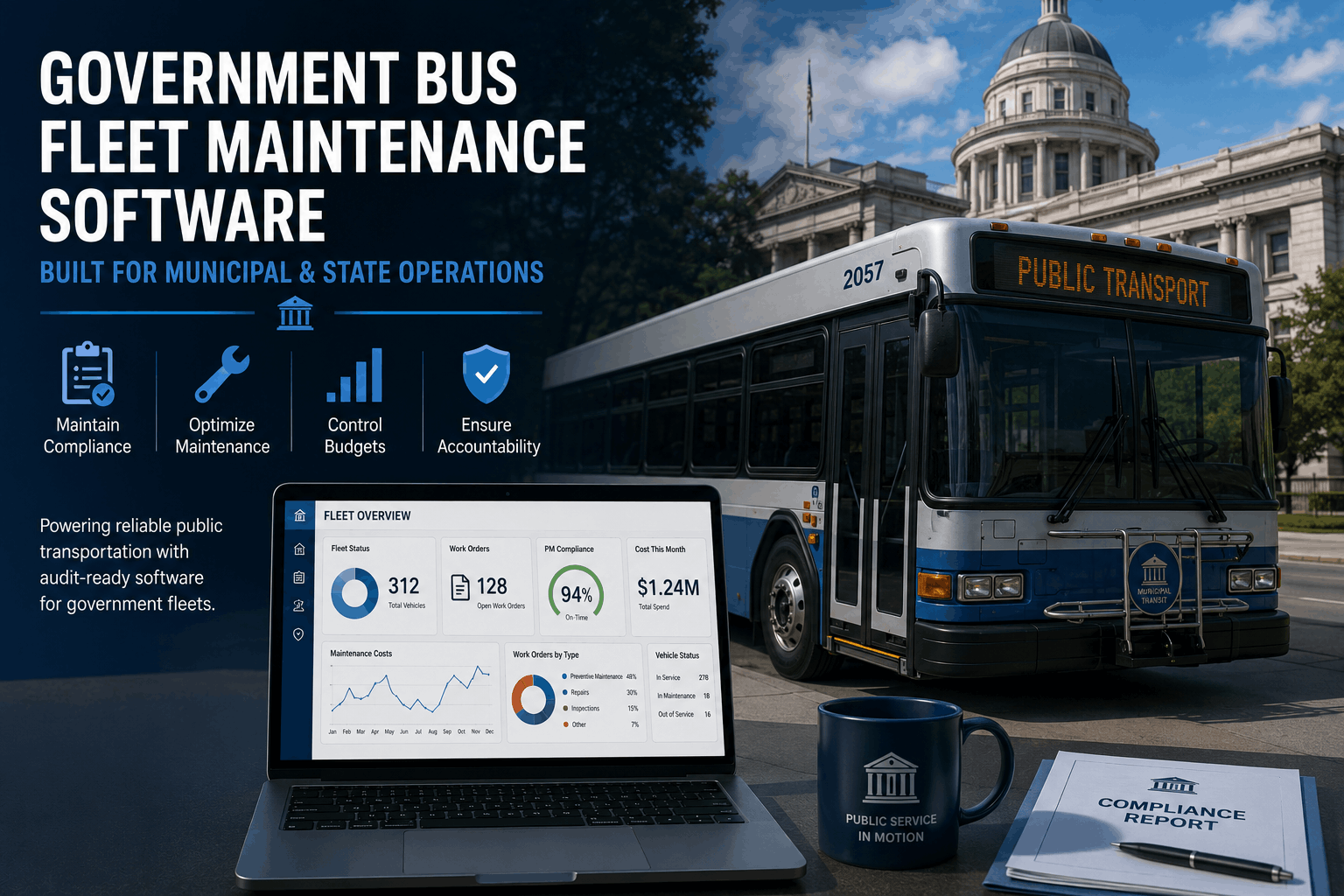
Most government agencies operate buses across multiple locations. A city transit authority may have buses stationed at three or four depots. A school district operates buses from individual schools and central maintenance. A state transportation agency operates vehicles across regions. Managing multiple locations creates complexity: each depot has its own mechanic, its own spare parts inventory, its own inspection schedule. Without a unified CMMS, each location operates in isolation. Headquarters doesn't know real-time fleet status. Budget decisions are made without complete cost visibility. Compliance reporting requires collecting data from multiple depots manually. A government CMMS must consolidate all locations into a unified view. The system shows: all buses across all depots with current status, all pending maintenance across all locations, all costs broken down by location and component, compliance status across the entire fleet. When the director needs a real-time fleet health dashboard showing which buses are operational and which are in maintenance, the system provides it in one view. When the budget committee asks for cost per vehicle, the system aggregates across all locations.
When an auditor or compliance officer asks for documentation, government agencies must provide it instantly. They ask: "Show me all buses that had inspections within the required interval." "Prove that DVIR was filed for every operating day." "Provide cost allocation showing maintenance spend per vehicle." A government CMMS must have pre-built compliance reports that answer these questions automatically. When the state auditor arrives on Monday morning, the fleet manager runs three reports, prints them, and provides audit-ready documentation. No data compilation. No discrepancies. No explanations needed. The reports are sourced from live data in the CMMS. They show: inspection dates vs required intervals (all buses), DVIR filing status (all vehicles, all dates), maintenance costs (all buses, all periods). Non-compliance jumps out immediately. A bus that's overdue for inspection shows as non-compliant. A gap in DVIR filing shows as non-compliant. Automated reporting eliminates manual errors and proves compliance instantly. Most government fleet software fails because it lacks this audit-ready reporting. A CMMS is only valuable to government if it makes audits easier, not harder.
Government fleet software is fundamentally different from private fleet software. It must be audit-ready by design. Multi-location consolidation isn't optional — most agencies operate across multiple depots or cities. Budget tracking and cost allocation aren't nice-to-have — they're required for public budget justification. Automated compliance reporting saves hundreds of hours per year. Choose a CMMS built for government fleets, not adapted from commercial fleet software. The difference is audit readiness, multi-location consolidation, and compliance reporting.
Government fleet maintenance software must do more than track work orders. It must provide audit-ready compliance reporting, consolidate multi-location data, track budgets for public accountability, and integrate with existing agency systems. A municipal transit authority managing 200 buses across three depots spends 30+ hours per month compiling fleet reports without proper software. A unified CMMS does it in 15 minutes. Labor savings alone (36,000/year) justify the investment. Choose software specifically designed for government fleets, with audit-ready reporting as a core feature, not an afterthought.