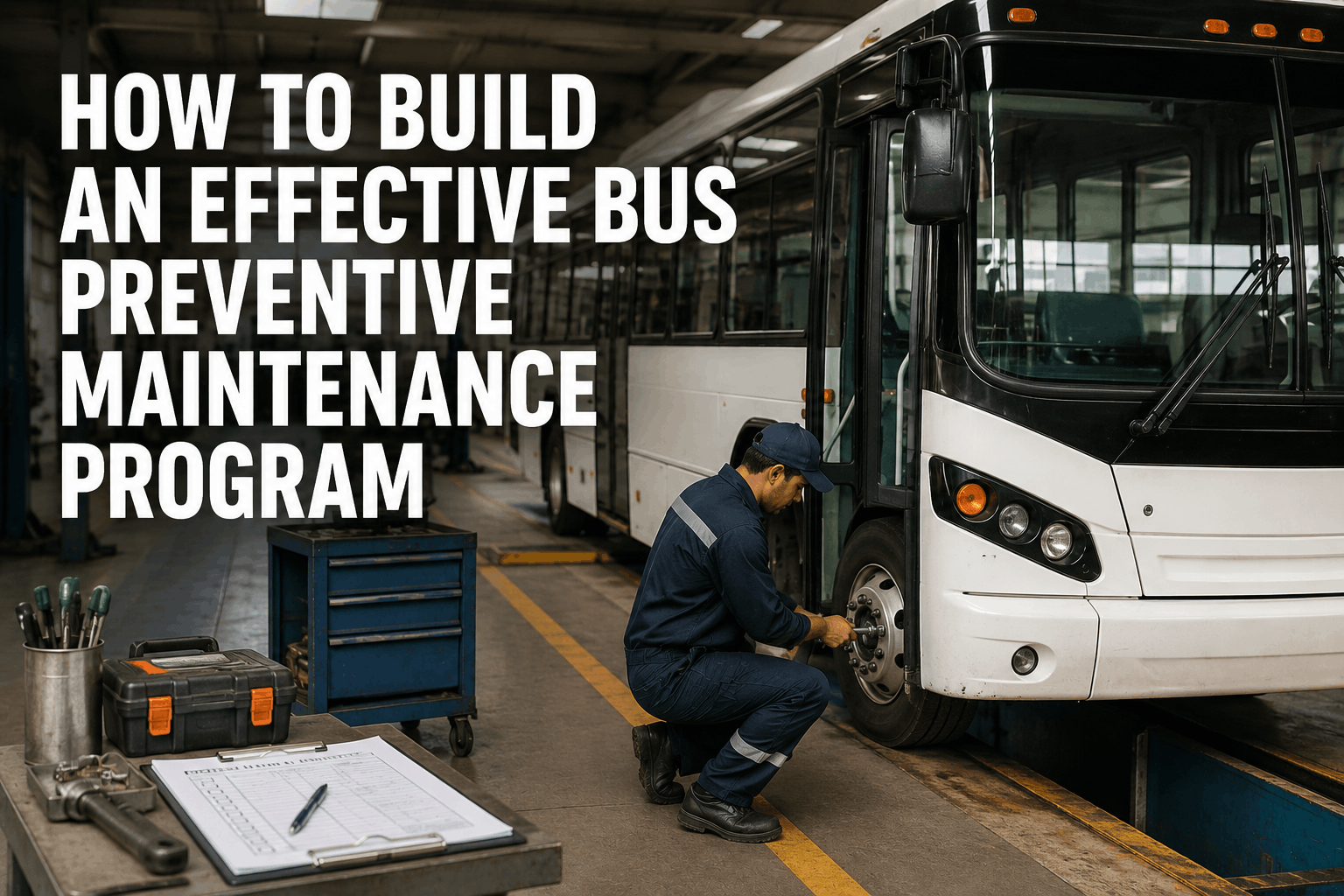
An effective preventive maintenance (PM) program is the foundation of fleet reliability and cost control. Buses that receive regular, properly scheduled maintenance last longer, break down less often, and operate more efficiently. This guide walks you through building a PM program from scratch — asset inventory, OEM schedules, mileage/hour triggers, technician assignment, KPI tracking, and audit preparation.
PM Program Builder 2026
How to Build an Effective Bus Preventive Maintenance Program
Build an effective bus PM program from scratch. Asset inventory, OEM schedules, mileage/hour triggers, technician assignment, KPI tracking, audit prep.
PM Program Impact: The Cost of No Plan
Fleets without a structured PM program experience 40-50% more breakdowns and 30% higher maintenance costs. A well-designed PM program reduces failures by 50%, extends vehicle life by 30%, and lowers total cost of ownership by 25%.
50%
Fewer breakdowns
30%
Longer vehicle life
25%
Lower TCO
6
Program building steps
Six Steps to Build Your PM Program
Step 1: Asset Inventory
Action: Catalog all buses, engines, transmissions, and major components. Record VINs, model years, and current mileage. Establish a complete asset database.
Step 2: OEM Schedules
Action: Gather manufacturer maintenance schedules. Document recommended intervals for oil, filters, brakes, transmission, and inspections. Customize for your operation.
Step 3: Trigger Definition
Action: Set triggers for each PM task — mileage, engine hours, calendar days, or usage metrics. Define A, B, C service levels based on complexity.
Step 4: Technician Assignment
Action: Assign specific PM tasks to qualified technicians. Define skill requirements. Create workflow for scheduling, assignment, and completion tracking.
Step 5: KPI Tracking
Action: Define KPIs: PM compliance rate, average completion time, cost per PM, and breakdown frequency. Establish targets and reporting cadence.
Step 6: Audit Preparation
Action: Create PM documentation standards. Ensure all records are complete and accessible. Prepare for DOT, FTA, and internal audits.
PM Program Building Timeline
Month 1-2: Asset inventory and OEM schedule collection (15% complete). Month 3-4: Trigger definition and CMMS setup (25%). Month 5-6: Technician assignment and training (35%). Month 7-8: PM program rollout and monitoring (45%). Month 9-10: KPI tracking and optimization (55%). Month 11-12: Audit preparation and continuous improvement (65%).
PM Program Implementation Roadmap
Phase 1: Foundation
Build asset inventory. Collect OEM schedules. Set up CMMS system. Define PM trigger points.
Phase 2: Design
Create PM task checklists. Assign technician skills. Establish workflow and approval processes.
Phase 3: Launch
Train technicians. Schedule initial PMs. Monitor compliance. Adjust as needed.
Phase 4: Monitor
Track KPIs weekly. Report monthly. Identify improvement opportunities. Celebrate wins.
Phase 5: Optimize
Adjust intervals based on data. Refine checklists. Update schedules. Continuous improvement.
Phase 6: Audit
Prepare for audits. Maintain complete records. Demonstrate PM program effectiveness.
PM Program Requirements
Asset Inventory
Complete inventory of all buses with VINs, model years, engine types, transmission models, and current mileage. Include major component serial numbers.
OEM Documentation
Manufacturer maintenance schedules for each bus model. Include recommended intervals, procedures, and fluid specifications. Update annually.
CMMS Platform
Computerized Maintenance Management System to schedule, track, and document all PM activities. Essential for program scalability and compliance.
Technician Training
Train technicians on PM procedures and documentation. Ensure skill levels match task complexity. Document certifications and training records.
KPI Dashboard
Real-time dashboard tracking PM compliance, completion time, cost per PM, and breakdown frequency. Monthly reports for management review.
Audit Readiness
Complete documentation for all PM activities. Store records for DOT and FTA compliance. Regular internal audits to identify gaps.
PM Program Maturity Trends
PM compliance improves from 40% in Year 1 to 95% by Year 7. Breakdown reduction follows a similar trajectory, from 10% reduction in Year 1 to 55% reduction by Year 7. Consistent execution and continuous improvement drive PM program maturity.
PM Program KPIs
Track these five metrics to measure your PM program effectiveness:
PM Compliance Rate
Target: 100% of scheduled PMs completed on time. Track weekly. This is the most important PM metric.
Average PM Completion Time
Target: Decreasing or stable trend. Track monthly. Longer times indicate training or resource issues.
Cost Per PM
Target: Decreasing or stable trend. Track monthly. Rising costs indicate inefficiency or scope creep.
Breakdown Frequency
Target: Decreasing trend. Track monthly. Fewer breakdowns indicate PM program effectiveness.
PM Schedule Attainment
Target: 90%+ of scheduled work completed on schedule. Track monthly. Low attainment indicates planning issues.
Our transit agency built a comprehensive PM program from scratch in 2024. Within 12 months, PM compliance reached 95% and breakdowns decreased by 45%. The structured approach — asset inventory, OEM schedules, CMMS implementation, and KPI tracking — transformed our maintenance operations. Annual maintenance costs decreased by 22%.
Build Your PM Program with BusCMMS
BusCMMS provides everything you need to build and manage an effective PM program — asset inventory, OEM schedule library, automated triggers, technician assignment, KPI dashboards, and audit-ready documentation. Book a demo to see how BusCMMS helps fleets build world-class PM programs.
PM Program FAQs
How do I start building a PM program?
Start with a complete asset inventory of all buses and major components. Gather OEM maintenance schedules for each model. Establish a CMMS platform to track and schedule PM activities. Define trigger points for each PM task based on mileage, hours, or calendar days.
What should a PM program include?
A comprehensive PM program includes: asset inventory, OEM-based schedules, trigger definitions, technician assignments, KPI tracking, audit preparation, and continuous improvement processes. Documentation is essential for compliance and program effectiveness.
How do I measure PM program effectiveness?
Measure PM program effectiveness through KPIs: PM compliance rate, average completion time, cost per PM, breakdown frequency, and schedule attainment. Track these metrics monthly and report to management. Use data to drive continuous improvement.
What is a good PM compliance rate?
Target 100% PM compliance. This means every scheduled PM is completed on time. Realistically, top-performing fleets achieve 95-100% compliance. Lower compliance indicates scheduling, resource, or cultural issues that need addressing.
How do I prepare for a PM audit?
Maintain complete documentation for all PM activities. Store records in a CMMS with audit trails. Ensure all work orders, checklists, and signatures are complete. Run internal audits quarterly to identify gaps. DOT and FTA audits require thorough record keeping.
The Bottom Line
Building an effective bus preventive maintenance program is essential for fleet reliability and cost control. The six-step framework — asset inventory, OEM schedules, trigger definition, technician assignment, KPI tracking, and audit preparation — provides a structured approach to PM program development. The implementation roadmap phases the work over 12 months, starting with foundation building and progressing through design, launch, monitoring, optimization, and audit readiness. PM program maturity grows over time, with PM compliance improving from 40% to 95% over seven years of consistent execution. The results are compelling: 50% fewer breakdowns, 30% longer vehicle life, and 25% lower total cost of ownership. When combined with CMMS technology and continuous improvement, a well-designed PM program transforms fleet maintenance from reactive to proactive — catching issues before they cause breakdowns, downtime, or compliance violations.