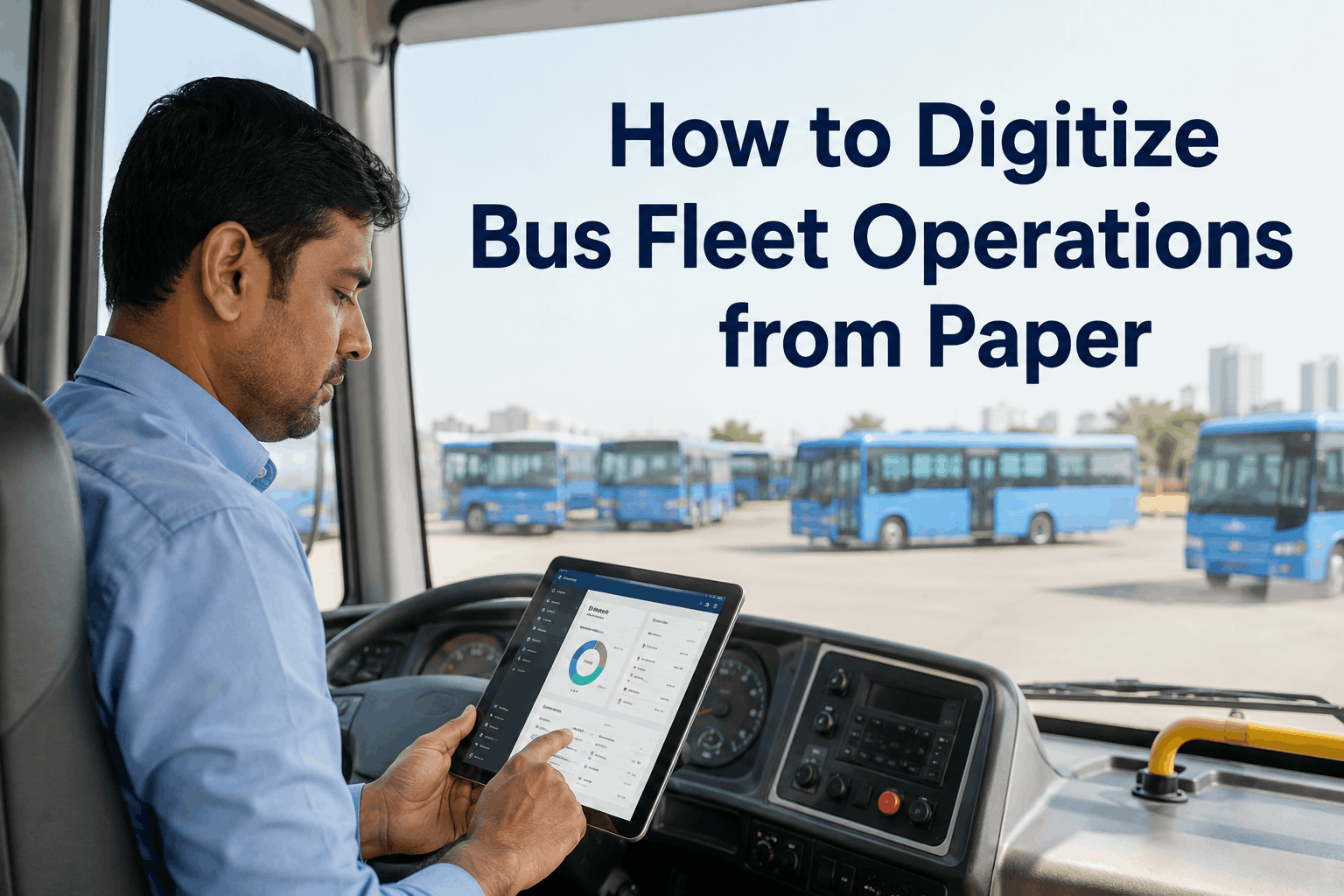
Transitioning from paper-based maintenance logs to digital fleet operations is one of the most impactful changes a bus operator can make. This guide covers the complete digitization journey—module sequence, data migration, driver adoption, change management, and a proven 90-day rollout plan for school, transit, and motorcoach fleets.
Digital Fleet Transformation Guide 2026
How to Digitize Bus Fleet Operations from Paper
Complete guide to digitizing bus fleet operations. Module sequence, data migration, driver adoption, change management — proven 90-day rollout plan for school, transit, and motorcoach fleets.
The Digital Transformation Imperative: Moving Beyond Paper
Paper-based fleet maintenance is costly, error-prone, and inefficient. A typical 100-bus fleet spends 2,000+ hours annually on manual paperwork. Digital transformation reduces this by 75% while improving compliance and safety.
2,000+ hours
Annual paperwork for 100-bus fleet
75% reduction
Time savings with digital systems
90 days
Proven rollout timeline
40% fewer
Compliance issues after digitization
The 6-Phase Digital Rollout Sequence
1
Assessment & Planning
Audit current paper processes. Identify pain points. Define success metrics. Build implementation team.
2
Data Migration
Digitize vehicle records, maintenance history, parts inventory, and driver qualifications.
3
System Configuration
Set up PM schedules, inspection forms, user roles, and notification workflows.
4
Pilot Program
Roll out to 2-3 vehicles. Train pilot users. Gather feedback. Refine processes.
5
Full Deployment
Phased rollout across all vehicles. Comprehensive user training. Go-live support.
6
Optimization
Monitor adoption metrics. Gather feedback. Continuous improvement. Scale best practices.
Digitization Requirements Checklist
Infrastructure
Tablets or smartphones for drivers and mechanics. Reliable internet connectivity. Secure data storage. Backup systems.
Data Standards
Vehicle identification standards. Part numbering system. Maintenance code taxonomy. Inspection form templates.
User Training
Role-based training programs. Quick reference guides. Video tutorials. Super-user identification. Ongoing support.
Change Management
Executive sponsorship. Clear communication plan. Incentive structures. Feedback channels. Resistance management.
Paper vs Digital: Operational Impact Comparison
Digital fleet operations consistently outperform paper-based systems. PM compliance improves from 68% to 96%. Inspection completion rises from 72% to 98%. Digital compliance reaches 99% compared to 78% for paper.
Digital Adoption & Time Savings Trends
User adoption increases from 18% in week 1 to 92% by week 16. Time savings follow a similar trajectory, reaching 85% as users become proficient with the digital system. The first six weeks show the steepest improvement curve.
Digitization Impact by Fleet Type
Mixed fleets show the highest digitization impact at 85% improvement. School buses follow at 82%, transit buses at 78%, motorcoaches at 74%, and paratransit at 70%. Standardization benefits are most pronounced in diverse fleet operations.
Digital Fleet Transformation KPIs
Track these six metrics to measure your digitization program effectiveness:
User Adoption Rate
Target: 90%+ by week 12. Track weekly. Low adoption indicates training or change management gaps.
Time Savings Realized
Target: 60%+ reduction. Track monthly. Compare paper vs digital processing time.
Data Accuracy
Target: 99%+ accuracy. Track monthly. Digital systems virtually eliminate transcription errors.
PM Compliance
Target: 95%+ compliance. Track monthly. Auto-scheduling eliminates missed services.
Inspection Completion
Target: 98%+ completion. Track weekly. Digital forms ensure all items are checked.
Paper Reduction
Target: 90%+ reduction. Track monthly. Environmental and efficiency benefits.
Driver & Mechanic Adoption Barriers
Our midwest school district operates 120 school buses with 180 drivers and 25 mechanics. We implemented this 90-day digital rollout plan and achieved 94% user adoption by week 14. Paper usage decreased by 92%, PM compliance improved from 65% to 97%, and inspection completion reached 99%. The digital transformation saved over 2,500 administrative hours annually.
Start Your Digital Fleet Transformation Today
BusCMMS provides the complete digital platform for bus fleet operations. Automate PM scheduling, digitize inspections, track maintenance history, and monitor driver compliance. Our proven 90-day rollout plan includes data migration support, user training, and change management guidance.
Digital Fleet Transformation FAQs
How long does it take to digitize a bus fleet?
A typical 50-200 bus fleet can be fully digitized in 90 days using a phased approach. Assessment and planning take 2 weeks. Data migration requires 2-3 weeks. System configuration takes 2 weeks. Pilot program runs for 2 weeks. Full deployment takes 4 weeks. Optimization is ongoing.
What data needs to be migrated from paper?
Essential data includes vehicle records (VIN, make, model, year), maintenance history (all past services), parts inventory (part numbers, quantities, suppliers), driver qualifications (licenses, certifications, training records), and compliance documentation (inspections, safety checks).
How do you get drivers to adopt digital systems?
Successful driver adoption requires executive sponsorship, early adopter programs, peer mentoring, hands-on training, simple user interfaces, and clear communication about benefits. Incentive programs and leadership by example are also effective strategies.
What infrastructure is needed for digital fleet operations?
Basic requirements include tablets or smartphones for drivers and mechanics, reliable internet connectivity (WiFi or cellular), secure cloud storage, backup systems, and devices appropriate for field use. Many fleets use rugged tablets designed for vehicle environments.
How does digitization improve PM compliance?
Digital systems auto-schedule preventive maintenance based on mileage, engine hours, or calendar dates. Automated alerts notify fleet managers and mechanics of upcoming services. Digital checklists ensure all maintenance items are completed. Complete audit trails improve accountability.
Can BusCMMS help with data migration from paper?
Yes. BusCMMS provides data migration support including templates for digitizing vehicle records, maintenance history, parts inventory, and driver qualifications. Our team provides guidance on data validation and system configuration to ensure a smooth transition from paper.
The Bottom Line
Digitizing bus fleet operations from paper is one of the most impactful investments any operator can make. The 6-phase rollout—assessment, data migration, configuration, pilot, deployment, and optimization—provides a proven path to digital transformation. Paper-based operations achieve 68-78% compliance metrics, while digital operations consistently reach 96-99%. User adoption reaches 92% within 16 weeks when supported by proper training and change management. School, transit, motorcoach, and mixed fleets all benefit significantly from digitization. This guide provides the step-by-step process your organization needs to transition from paper-based operations to a fully digital fleet management system. When combined with BusCMMS digital inspection forms, automated PM scheduling, complete maintenance tracking, driver compliance monitoring, and data-driven decision support, your fleet operations become more efficient, compliant, and cost-effective.