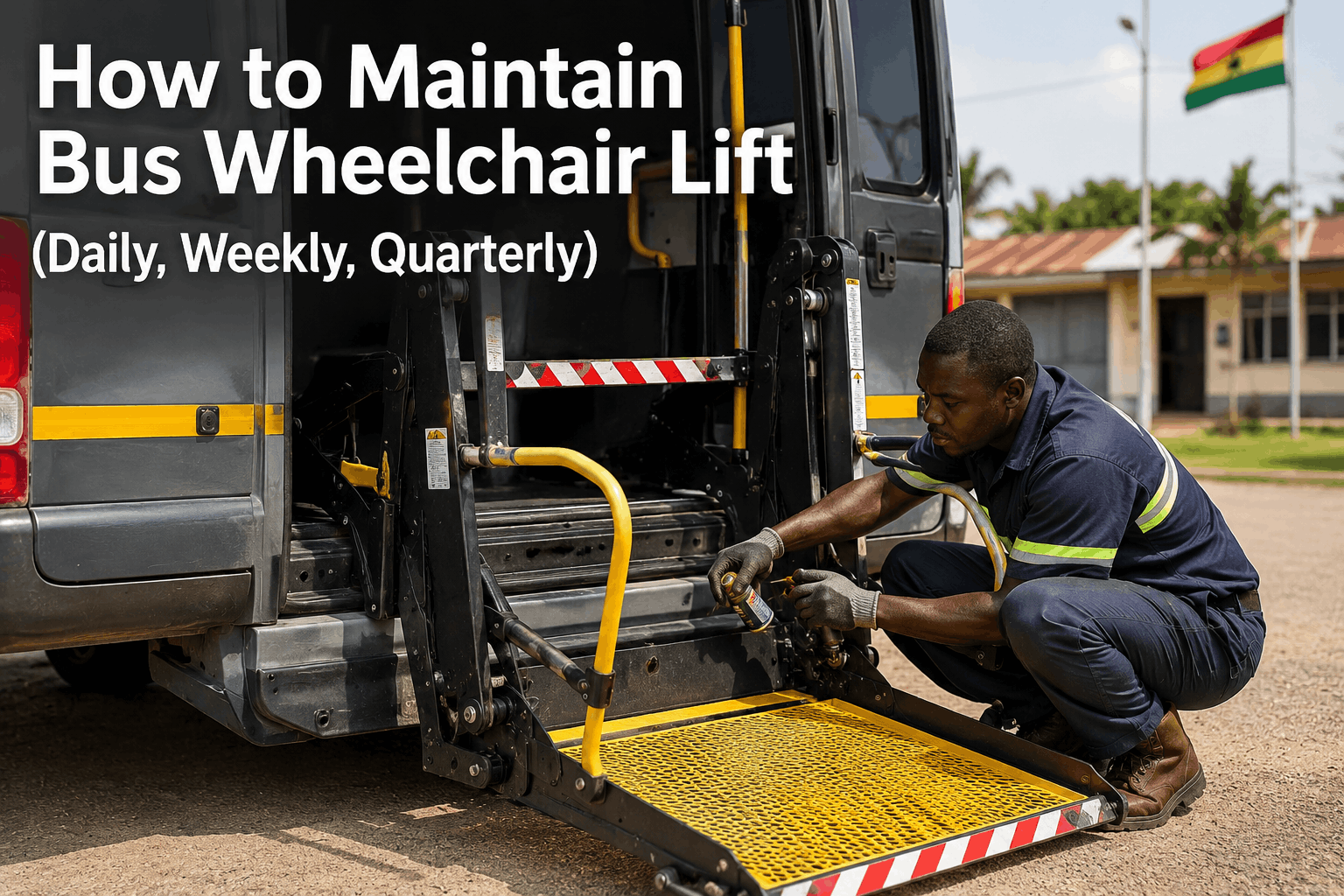
Proper wheelchair lift maintenance is essential for ADA compliance and passenger safety. A lift that fails during service creates liability, delays routes, and damages your fleet's reputation. This guide covers daily cycling, weekly inspections, quarterly PM, annual certification, and ADA compliance documentation requirements for Braun and Ricon lifts.
Wheelchair Lift Maintenance Guide 2026
How to Maintain Bus Wheelchair Lift
Maintain a bus wheelchair lift correctly. Daily cycling, weekly inspection, quarterly PM, annual certification and ADA compliance documentation needs.
Lift Maintenance Impact: The Cost of Neglect
Wheelchair lift failures are a leading cause of ADA complaints and service delays. A lift that fails inspection can ground a bus for days and cost thousands in emergency repairs.
$3,500–$7,000
Emergency lift repair cost
2-5 days
Bus out of service time
100%
ADA compliance required
60%
Fewer failures with PM
Lift Maintenance Progress
1
Daily Cycling
Cycle lift fully up and down. Check for unusual sounds, hesitation, or binding.
2
Weekly Inspection
Inspect hydraulic fluid level, cylinder condition, and platform integrity.
3
Monthly PM
Lubricate pivot points. Inspect all sensors, switches, and electrical connections.
4
Quarterly PM
Complete system inspection. Check bolts, belts, and hydraulic pressure.
5
Annual Certification
Factory-certified inspection. Complete load test and safety system verification.
6
ADA Compliance Review
Document all inspections. Maintain complete service records for compliance.
Lift Maintenance Methods Comparison
Annual certification is the most comprehensive at 95% effectiveness. Quarterly PM catches 92% of issues. Monthly PM identifies 85% of potential failures. Weekly and daily inspections are less comprehensive at 75% and 65% but remain essential for catching immediate problems.
Lift Failure Distribution by Component
Lift failure distribution shows hydraulic systems fail most frequently at 35%, followed by electrical components at 30%. Mechanical failures account for 20%, and sensor failures represent 15%. Regular PM reduces hydraulic and electrical failures by 60%.
Lift PM Pass/Fail Thresholds
Daily Cycling
Pass: Full cycle under 30 seconds. No unusual sounds or hesitation.
Fail: Cycle exceeds 30 seconds. Unusual sounds. Binding or hesitation.
Hydraulic Fluid
Pass: Fluid level at full mark. Color clear to light amber. No leaks.
Fail: Low fluid level. Dark or cloudy fluid. Leaks present.
Platform Condition
Pass: No damage. Roll stops functional. Surface texture intact.
Fail: Cracks or damage. Roll stops missing. Slippery surface.
Sensor Check
Pass: All sensors operational. Interlock switches functional. LED indicators normal.
Fail: Non-responsive sensors. Faulty interlock switches. Warning lights active.
Bolt Torque
Pass: All mounting bolts at factory spec. Lock washers in place.
Fail: Loose bolts. Missing washers. Stripped threads.
Replacement Trigger
Replace hydraulic cylinders with leaks. Replace any failed sensor immediately. Replace platform with cracks. Document all actions for ADA compliance.
Lift Maintenance KPIs
Track these five metrics to measure your lift maintenance program effectiveness:
Lift PM Compliance
Target: 100% at every scheduled interval. Track by bus. Missed PMs increase failure risk.
Emergency Repair Rate
Target: Decreasing trend. Track monthly. High rate indicates PM gaps or component issues.
Lift Cycle Count
Target: Track by bus. High cycle counts indicate need for more frequent PM.
ADA Compliance Score
Target: 100% documentation. Track monthly. Missing records create liability.
Mean Time Between Failures
Target: Increasing trend. Track by lift. Short MTBF indicates component or maintenance issues.
Lift PM Trends
PM compliance trends show consistent improvement from 75% to 95% over seven quarters. Regular tracking and reporting drive this improvement. Fleet performance improves as compliance reaches 95%.
Our fleet of 120 buses includes Braun and Ricon lifts. After implementing this maintenance schedule, we reduced emergency repairs by 68% and achieved 100% ADA compliance. Daily cycling caught 47 issues before they became failures. Quarterly PM identified 23 hydraulic cylinder leaks that would have caused breakdowns.
Digitize Your Lift Maintenance Program
BusCMMS guides technicians through every lift inspection—daily cycling, fluid checks, sensor testing, bolt torque verification, and ADA documentation. Auto-schedule PM intervals based on cycles and months. Complete audit trail for every lift in your fleet.
Bus Wheelchair Lift Maintenance FAQs
How often should a wheelchair lift be cycled on a bus?
Cycle the lift fully up and down every day the bus is in service. Daily cycling identifies issues before they become failures. Document each cycle test with date, time, and result. Complete the test in the morning before the bus enters revenue service.
What hydraulic fluid is used in bus wheelchair lifts?
Use the manufacturer-specified hydraulic fluid. Braun uses Dextron III or equivalent. Ricon uses MIL-H-5606 or equivalent. Never mix different hydraulic fluids. Check fluid level weekly and change fluid per manufacturer schedule.
What is included in a wheelchair lift annual certification?
Annual certification includes load testing at 100% capacity, full system inspection, safety system verification, all sensor checks, structural integrity inspection, and complete documentation. Only certified technicians should perform annual certification.
How do you maintain ADA compliance for wheelchair lifts?
Maintain complete service records for every lift. Document all daily cycles, weekly inspections, monthly PMs, quarterly inspections, annual certifications, and repairs. Keep records for each lift for the life of the bus. Records must be available for DOT and ADA audits.
What are the most common wheelchair lift failure points?
The most common failure points are hydraulic cylinder leaks, electrical contact failures, sensor misalignment, loose bolts, and platform damage. Regular PM catches these issues before they cause breakdowns. Daily cycling is the first line of defense.
Can BusCMMS track wheelchair lift maintenance history?
Yes. BusCMMS tracks all lift inspections, maintenance, repairs, and certifications. The system generates PM schedules, sends due-date alerts, and creates ADA-compliant documentation for every lift in your fleet. Complete audit trail for all lift maintenance activities.
The Bottom Line
Maintaining bus wheelchair lifts is essential for ADA compliance, passenger safety, and fleet reliability. The 6-step maintenance workflow—daily cycling, weekly inspection, monthly PM, quarterly PM, annual certification, and ADA compliance review—identifies issues before they cause failures. Hydraulic and electrical failures account for 65% of all lift breakdowns. Regular PM reduces emergency repairs by 60%. This guide provides the step-by-step procedures your technicians need to maintain every lift in your fleet. When combined with BusCMMS digital inspection forms and complete lift history tracking, your lift maintenance program becomes proactive—catching issues before they cause passenger service interruptions or compliance violations.