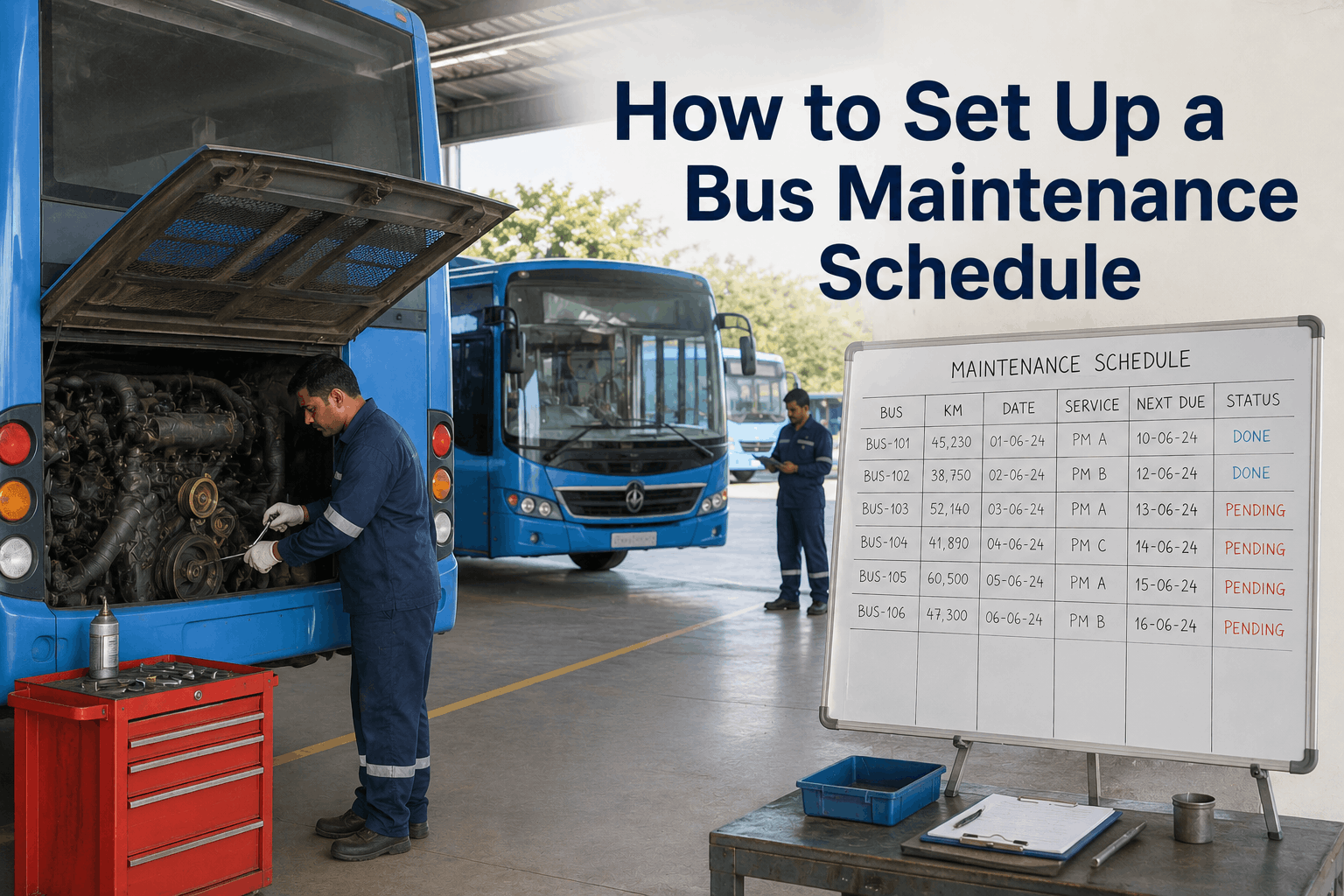
Setting up a bus maintenance schedule that actually runs requires careful planning and execution. This guide covers OEM intervals, mileage and time triggers, technician assignment, downtime planning, and KPI rollup for school, transit, and motorcoach fleets.
Bus Maintenance Schedule Guide 2026
How to Set Up a Bus Maintenance Schedule
Complete guide to setting up a bus maintenance schedule that actually runs. OEM intervals, mileage and time triggers, technician assignment, downtime planning, and KPI rollup for school, transit, and motorcoach fleets.
The Scheduling Imperative: Why Structure Matters
A well-structured maintenance schedule reduces breakdowns by 40%, extends vehicle life by 25%, and lowers repair costs by 30%. Fleets with structured PM schedules achieve 95%+ compliance compared to 60-70% for reactive maintenance approaches.
40%
Reduction in breakdowns
25%
Extended vehicle life
30%
Lower repair costs
95%+
PM compliance with structure
The 6-Step Schedule Setup Process
1
OEM Interval Review
Review manufacturer recommended intervals. Identify mileage and time-based triggers. Document service requirements.
2
Trigger Definition
Define mileage triggers for each service. Set calendar triggers for time-based services. Establish condition-based triggers.
3
Technician Assignment
Assign qualified technicians to services. Build skill-based routing. Establish backup assignments. Create shift coverage.
4
Downtime Planning
Schedule maintenance windows. Coordinate with operations. Minimize service disruption. Plan for parts availability.
5
Implementation
Roll out schedule. Train staff. Monitor compliance. Adjust as needed. Document procedures.
6
KPI Rollup & Review
Track PM compliance. Monitor completion rates. Analyze cost trends. Continuous improvement.
Schedule Setup Requirements Checklist
OEM Documentation
Manufacturer maintenance manuals. Service interval specifications. Fluid specifications. Torque requirements. Inspection checklists.
Data Collection
Vehicle odometer readings. Engine hour tracking. Service history. Parts inventory. Technician availability.
Planning Tools
PM scheduling software. Maintenance calendars. Resource planning tools. Parts ordering systems. Downtime coordination tools.
KPI Dashboard
Compliance tracking. Completion rates. Cost per mile. Schedule adherence. Technician performance.
PM Schedule Types & Frequency
PM schedules include daily walkarounds, Service A at regular intervals, Service B with more comprehensive checks, Service C with major component inspections, Service D with full system reviews, and major overhauls at defined intervals. Each service type has specific frequency and trigger requirements.
PM Compliance & Technician Productivity Trends
PM compliance improves from 62% to 95% over seven months with structured scheduling. Technician productivity increases from 72% to 96% as schedules become more predictable and efficient. Regular monitoring and adjustment drive these improvements.
Schedule Types by Fleet Category
Mixed fleets require the most schedule types at 7 due to diverse vehicle types. School buses require 6 schedule types, transit buses 5, motorcoaches 4, and paratransit 3. Fleet diversity significantly impacts schedule complexity.
Schedule Components & Triggers
Mileage Triggers
Service A at 5,000 miles. Service B at 10,000 miles. Service C at 20,000 miles. Service D at 40,000 miles. Major overhaul at 300,000 miles.
Time Triggers
Monthly oil checks. Quarterly inspections. Semi-annual brake services. Annual full vehicle inspections. Bi-annual major services.
Condition Triggers
Brake pad wear indicators. Tire tread depth. Battery health monitoring. Fluid quality analysis. Component lifespan tracking.
Technician Assignment
Skill-based routing. Certification requirements. Workload balancing. Shift coverage. Cross-training programs.
Schedule Setup Success Factors
OEM Compliance
Following manufacturer recommendations ensures warranty compliance and optimal vehicle performance. Document all service intervals and procedures.
Data Accuracy
Accurate odometer readings, engine hours, and service history are essential for effective scheduling. Automated data collection ensures accuracy.
Resource Planning
Proper technician assignment, parts availability, and downtime planning ensure schedule execution. Regular reviews identify resource gaps.
Performance Tracking
Regular KPI monitoring ensures schedule effectiveness. Track compliance, completion rates, costs, and technician performance for continuous improvement.
Our 120-bus school district fleet implemented this structured maintenance schedule and achieved 97% PM compliance within 6 months. Technician productivity improved by 35%, maintenance costs decreased by 28%, and vehicle availability increased by 22%. The schedule setup process was straightforward and effective.
Set Up Your Maintenance Schedule with BusCMMS
BusCMMS provides comprehensive PM scheduling tools for bus fleets. Set up OEM-based intervals, define triggers, assign technicians, plan downtime, and track KPIs. Automated scheduling and alerts ensure consistent schedule execution.
Bus Maintenance Schedule FAQs
How do I determine the right PM intervals?
Start with OEM recommendations for your specific bus models. Consider fleet operating conditions, duty cycles, and historical performance data. Adjust intervals based on wear patterns and component life data. Document all interval decisions and review annually.
What triggers should I use for PM scheduling?
Use mileage triggers for primary scheduling. Implement calendar triggers for time-based services. Use condition-based triggers for components with wear indicators. Most fleets use a combination of mileage and time triggers to ensure comprehensive coverage.
How do I assign technicians to PM services?
Assign technicians based on skill level and certification requirements. Use skill-based routing for complex services. Build backup assignments for coverage. Balance workloads across shifts. Cross-train technicians for flexibility.
How do I plan for maintenance downtime?
Schedule maintenance during off-peak hours. Coordinate with operations for vehicle availability. Build buffer time into schedules. Plan parts availability in advance. Use predictive scheduling to minimize service disruption.
What KPIs should I track for PM scheduling?
Critical KPIs include PM compliance rate, schedule completion rate, maintenance cost per mile, technician productivity, schedule adherence, and breakdown frequency. Track these metrics monthly for continuous improvement.
Can BusCMMS help with PM scheduling?
Yes. BusCMMS provides comprehensive PM scheduling tools including interval setup, trigger definition, technician assignment, downtime planning, and KPI tracking. Automated scheduling and alerts ensure consistent execution and compliance.
The Bottom Line
Setting up a bus maintenance schedule that actually runs requires careful planning and execution. The 6-step setup process—OEM interval review, trigger definition, technician assignment, downtime planning, implementation, and KPI rollup—provides a proven path to scheduling success. A well-structured maintenance schedule reduces breakdowns by 40%, extends vehicle life by 25%, and lowers repair costs by 30%. PM compliance improves from 62% to 95% with structured scheduling, while technician productivity increases from 72% to 96%. Different fleet types require different schedule structures, with mixed fleets needing the most schedule types at 7. This guide provides the interval definitions, trigger types, assignment strategies, and KPI metrics your organization needs to set up effective maintenance schedules. When combined with BusCMMS PM scheduling tools, automated triggers, and compliance tracking, your maintenance program becomes more efficient, cost-effective, and reliable.