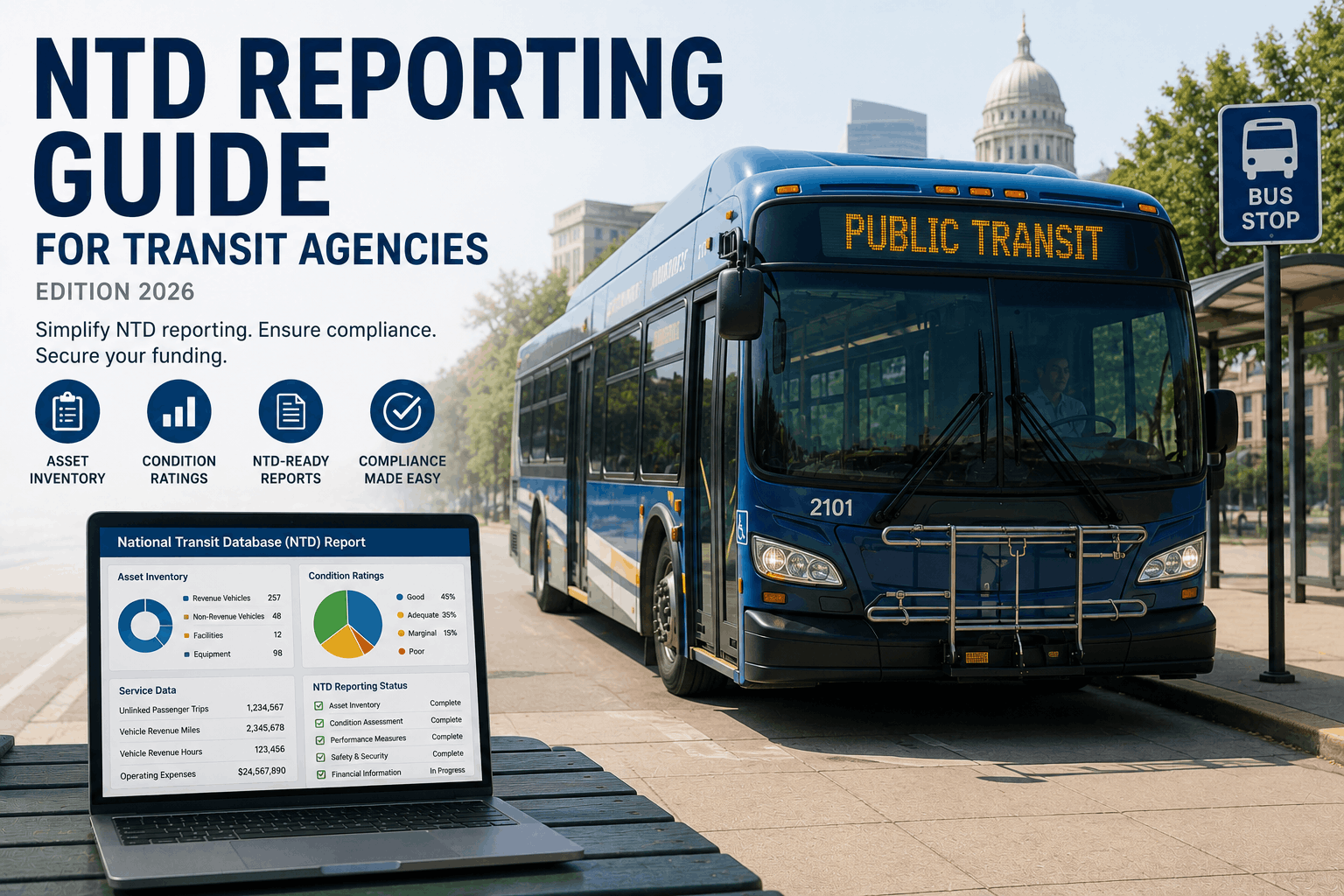
The National Transit Database (NTD) is the FTA's annual reporting system. Every transit agency receiving federal funding must submit NTD reports covering asset inventory, maintenance costs, fleet condition, and operational metrics. These reports drive funding decisions. An agency with poor asset condition ratings or high maintenance costs faces scrutiny during grant reviews. One with accurate, timely NTD reports gets favorable funding treatment. The challenge: NTD reporting requires precise data on every asset — acquisition dates, current condition, maintenance history, useful life benchmarks. Most transit agencies compile this from spreadsheets, CMMS systems, and tribal knowledge. The process is manual, error-prone, and time-consuming. A typical mid-size agency (150 buses) spends 4–6 weeks per year on NTD reporting — extracting data, validating it, reconciling discrepancies, and submitting. With a proper CMMS configured for NTD compliance, the same agency can generate NTD-ready reports in hours. Here's the guide.
NTD Reporting Guide for Transit Agencies
NTD data drives your funding. This 2026 guide explains asset inventory, condition ratings, and how CMMS produces NTD-ready reports automatically.
NTD reporting requires agencies to submit: (1) Asset inventory: every vehicle owned by the agency (VIN, acquisition date, manufacturer, model, purchase price, current status). (2) Condition ratings: each asset rated on a 1–5 scale (1=excellent, 5=poor). These ratings drive funding discussions. An agency with 60% of buses rated 4–5 (poor/fair condition) is a candidate for capital grants. (3) Maintenance costs: annual operations and maintenance spending broken down by asset type. (4) Useful life benchmarks (ULB): the expected lifespan of each asset type (e.g., diesel buses typically 12 years). When assets exceed ULB, they're flagged for replacement. Most agencies struggle with condition ratings. The FTA's guidance is vague: a rating of 3 (fair) means "minor defects visible," but what counts as "minor"? A bus with one broken window is minor. A bus with failing brakes is not. Agencies interpret this inconsistently, leading to data quality issues. The solution: a CMMS that tracks condition systematically. Every time a bus is serviced, the technician records observations: "Transmission fluid dark/contaminated — recommend monitoring." Over time, these observations build a picture of condition. CMMS can then auto-generate NTD condition ratings based on defect history and maintenance costs.
To automate NTD reporting, your CMMS must track: (1) Asset master data: every vehicle with VIN, acquisition date, cost, class (e.g., "40-foot articulated bus" vs "30-foot diesel bus"). This is the foundation. Without accurate asset records, NTD reports are garbage. (2) Maintenance history: every work order, repair, and service linked to an asset. NTD uses maintenance cost data to inform condition ratings. A bus with $50k in repairs in one year is obviously in poor condition. (3) Defect tracking: every defect discovered during maintenance. A bus with 15 active defects (failed transmission, brake wear, electrical issues) is rated differently than one with zero defects. (4) Condition assessment: a regular (annual or biennial) formal condition assessment. A technician performs a full inspection and rates the asset 1–5. The CMMS stores this assessment. Once these data elements are in place, NTD-ready reports can be generated automatically. The CMMS queries the asset inventory, pulls maintenance history and defects, compares against useful life benchmarks, and auto-generates condition ratings. The agency reviews, adjusts if needed, and submits. This takes hours instead of weeks.
Mistake 1: Inconsistent condition ratings. One staff member rates buses one way, another rates them differently. Solution: standardize the rating process. Use CMMS defect data + maintenance cost history as inputs. A formula-based approach (e.g., "if defects > 10 OR annual maintenance > $X, rate 4 or 5") ensures consistency. Mistake 2: Incomplete asset inventory. Some agencies discover "missing" buses during NTD reporting — vehicles still operating but not in the asset register. Solution: audit the asset inventory annually against actual fleet. Add discovered assets immediately to CMMS. Mistake 3: Stale maintenance data. Maintenance records are recorded in paper forms, then entered into CMMS weeks later (if at all). By NTD reporting time, the data is outdated. Solution: real-time work order entry in CMMS. Technicians log work orders on tablets or mobile devices immediately. Data is current. Mistake 4: Mixing capital and operating costs. NTD distinguishes between capital costs (major repairs or replacements) and operating costs (routine maintenance). Misclassifying one major repair can skew the entire report. Solution: establish clear classification rules in the CMMS. Train staff on what counts as capital vs. operating. Use work order categories to enforce the distinction.
NTD reporting is a compliance requirement but also a strategic opportunity. Agencies with clean, accurate NTD data make better capital planning decisions. They know which assets are truly in poor condition and need replacement. They can justify capital grant requests with data. Agencies that wing it — manually compiling data, making up condition ratings, submitting sloppy reports — face FTA scrutiny and may lose funding. The difference is process and systems. A CMMS configured for NTD compliance makes accurate reporting automatic.
NTD reporting drives federal funding for transit agencies. Accurate condition ratings, reliable asset inventory, and defensible maintenance cost data are essential. A CMMS configured for NTD compliance automates the process: asset master data, work order history, defect tracking, and formal condition assessments feed automated report generation. Instead of 4–6 weeks of manual compilation, agencies generate NTD-ready reports in hours. The data is more accurate, the process is repeatable, and compliance risk is lower.