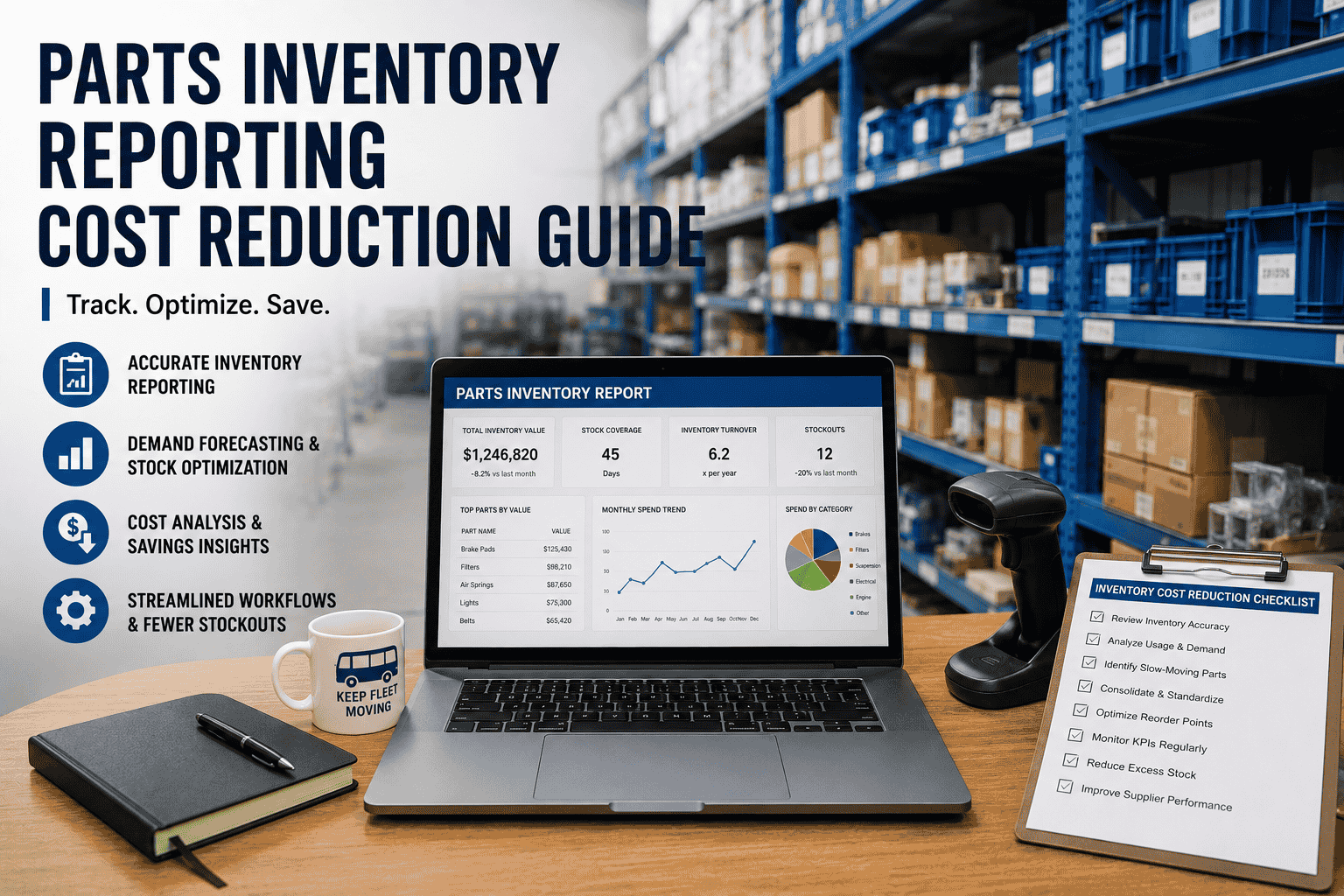
Parts inventory reporting directly affects fleet uptime, maintenance cost, technician productivity, and budget control. When parts data is incomplete, buses wait in the shop, technicians lose time searching shelves, emergency purchases increase, and managers cannot explain where inventory money is going. Many transit and school bus fleets still rely on spreadsheets, manual stock counts, vendor invoices, and disconnected work orders. That creates hidden costs: duplicate stock, obsolete parts, stockouts on critical components, slow repairs, and poor cost visibility by vehicle. A stronger parts inventory reporting process connects parts usage, work orders, technician activity, vendor purchasing, reorder points, and vehicle maintenance history in one system. This guide explains practical ways to improve parts inventory reporting, reduce operating costs, and increase fleet reliability with CMMS-driven inventory workflows.
Use inventory reporting, min-max levels, parts usage trends, and work order data to reduce stockouts, control spend, and improve bus availability.
Parts inventory cost is not only the money spent on parts. It also includes downtime caused by missing parts, labor hours wasted searching for inventory, emergency freight charges, duplicate purchases, obsolete stock, and slow work order completion. A bus can enter the shop for a planned preventive maintenance service, but if filters, brake components, sensors, belts, or lighting parts are unavailable, planned work becomes avoidable downtime.
Good parts inventory reporting gives managers visibility into what is used, what is sitting idle, what needs reorder, which buses consume the most parts, which vendors are slow, and which parts are driving maintenance cost. Instead of waiting for technicians to say something is out of stock, the system should show demand patterns before shortages happen.
Before reducing inventory cost, fleet managers need a baseline. That baseline should include current parts spend, inventory value, stockout frequency, emergency purchase count, obsolete parts value, reorder cycle time, vendor lead time, and parts used per work order. Without these numbers, teams may cut inventory blindly and accidentally increase downtime.
A CMMS should connect every part to a work order, vehicle, technician, vendor, and cost center. This makes reporting practical. If one bus consumes three times more brake parts than similar units, the issue may be route severity, driver behavior, brake system condition, or poor parts quality. Inventory reporting helps reveal those patterns.
Min-max inventory control is one of the simplest ways to reduce stockouts without overbuying. Minimum level is the reorder trigger. Maximum level is the quantity you do not want to exceed. The correct level depends on usage rate, vendor lead time, safety stock, and how critical the part is to bus availability.
Critical parts like brake components, filters, lighting parts, sensors, belts, coolant hoses, tire valves, and emergency exit components should not be managed casually. If these parts are out of stock, buses wait. A CMMS should automatically alert the parts manager when quantity drops below minimum and should show recommended reorder quantity based on historical usage.
Parts reporting becomes powerful when every part issued from inventory is linked to a work order and a bus. This gives managers cost per vehicle, cost per repair type, repeat part usage, technician usage patterns, and vendor performance insight. Without linking, parts disappear into general expense and leaders cannot explain why maintenance cost is rising.
When parts are linked properly, the maintenance team can answer important questions: Which buses are consuming the most parts? Which PM services require the most inventory? Which vendors cause repair delays? Which technicians frequently substitute parts? Which parts should be stocked at higher levels before peak service periods?
Technician selects part from CMMS inventory.
Part is attached to repair task and vehicle.
Quantity reduces automatically in real time.
Cost rolls into vehicle and KPI dashboards.
Inventory reporting should be proactive. Weekly reports help managers identify fast-moving parts, slow-moving stock, items below reorder point, upcoming PM parts demand, vendor delays, and abnormal usage. If reporting happens only during quarterly audits, the fleet is already reacting too late.
The best weekly parts report includes inventory accuracy, stockouts, parts below minimum, emergency purchases, obsolete inventory value, top 20 consumed parts, vendor lead time, and parts spend by vehicle. This gives leadership a clear view of how inventory affects uptime and cost.
Parts inventory reporting should not be treated as a warehouse task only. It is a fleet reliability workflow. The strongest fleets link parts to work orders, vehicles, vendors, technicians, and cost centers. That connection helps managers reduce stockouts, avoid overbuying, lower emergency purchases, and explain maintenance spend with confidence.
Parts inventory reporting reduces cost by making stock levels, demand patterns, vendor performance, and vehicle-level parts usage visible. Start with a baseline, set min-max levels for critical items, link every part to a work order, review inventory reports weekly, and use CMMS data to forecast upcoming PM demand. Better reporting means fewer repair delays, less emergency buying, stronger budget control, and higher bus availability.