A transit operator with a 40-bus fleet had a passenger slip and fall on a wet floor. The bus had just been cleaned that morning. Investigation revealed: the driver never documented the cleaning (no checklist completed), the wet floor warning sign was missing (not included in pre-trip), and the incident report took 3 weeks to file (no system in place). Injury claim: $85,000. Legal defense cost: $45,000. The fix would have cost $200: a documented safety checklist, a wet floor sign, and a same-day incident reporting system. Most transit operators know passenger safety matters. Few have systems to prove it. When an accident happens, you need documentation: pre-trip safety checks, maintenance records, training logs, incident reports filed within 24 hours. Without this, you lose lawsuits and liability exposure balloons. This guide shows how to build passenger safety systems that protect riders and your operation's legal exposure.
An accident without documentation is an undefended lawsuit. Learn the inspection, maintenance, and compliance systems that protect riders and your operation.
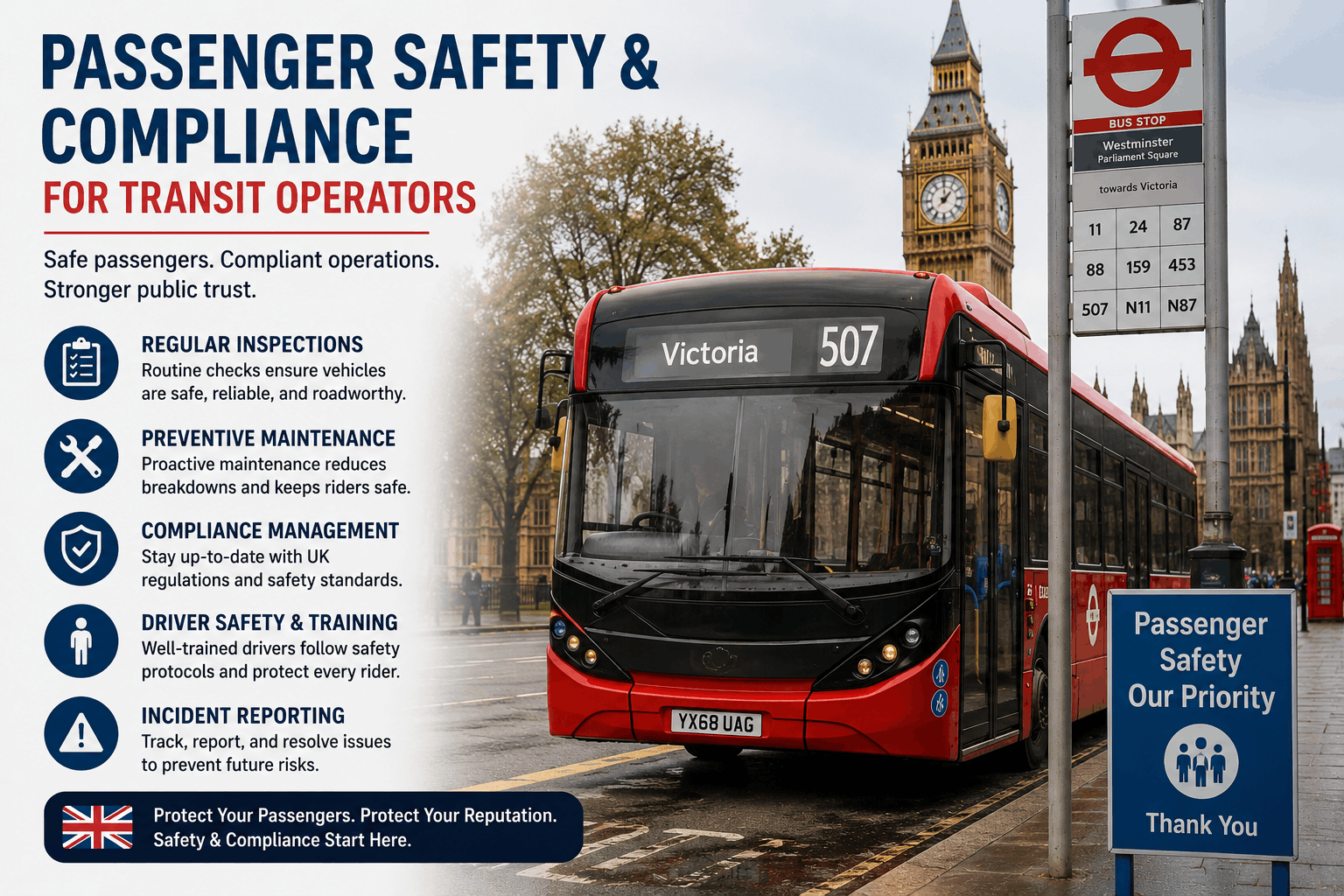
Passenger safety rests on three pillars. (1) Inspection: daily pre-trip checks catch problems before passengers board. (2) Maintenance: preventive maintenance (not reactive) eliminates failures that harm riders. (3) Documentation: every inspection, repair, and incident is recorded with dates and signatures. If any pillar is weak, the system fails. Example: A door mechanism fails mid-route, trapping passengers. Lawsuit. Discovery asks: "Did you have a PM schedule for door mechanisms?" You don't. Judgment against you. Another operator: same failure. They show a documented PM schedule (door checked every 10,000 miles), maintenance records (last check was 3,000 miles ago, passed inspection), and incident report filed same day. Negligence claim dismissed. The difference: documentation. Transit agencies and for-profit operators often skip documentation thinking it's overhead. It's not — it's insurance against catastrophic liability. A single undefended lawsuit costs $300K–$1M. One properly documented incident report costs $50 (forms and labor). The ROI is infinite. Here's how to build these three pillars.
An incident occurs: passenger falls, property damage, near-miss. Most operators file a report "when they get to it" — days or weeks later. Mistake. The incident report is your legal record. Delayed reporting implies attempted concealment (damages your defense). Same-day reporting proves you took it seriously. What goes in an incident report? (1) Date, time, location. (2) Passenger(s) involved (name, contact, injury level). (3) Witness(es) (names, contact). (4) Detailed description of what happened (objective facts, no opinions). (5) Immediate action taken (first aid, emergency call). (6) Driver observations (was the bus clean? Maintenance issue?). (7) Weather/road conditions. (8) Driver and supervisor signature. (9) Photos (if safe to take). File it same day. Send a copy to your insurance company within 24 hours. Have a legal template (consult your attorney) so all reports follow the same format. A properly documented incident report turns a lawsuit liability into a defensible claim. A missing report turns routine injury into punitive damages (courts assume you're hiding something).
When an accident occurs, the defense often hinges on: "Was the driver trained?" If yes, with documented proof, you have a strong defense (the driver knew the safety protocols and failed to follow them). If no, you're liable (you put an untrained driver behind the wheel). Minimum training: (1) Passenger safety procedures (how to assist elderly/disabled passengers, emergency evacuation). (2) Pre-trip inspection (how to identify issues). (3) De-escalation techniques (managing disruptive passengers safely). (4) First aid / CPR (ability to respond to medical emergencies). (5) Emergency procedures (what to do if brakes fail, fire, collision). Training should be documented: completion certificate, date, trainer name, passenger signatures (they acknowledge they read the safety briefing). Recertify annually (refresher training). A driver with documented annual safety training is significantly less liable in an incident. A driver without training documentation is indefensible. The training cost: $300–500 per driver per year. The litigation cost if you lack training records: $500K+. The ROI is 1000x. Yet most operators skip it.
The Americans with Disabilities Act (ADA) requires transit operators to provide accessible service to passengers with disabilities. This means: (1) Wheelchair lifts / ramps must work (tested monthly, documented). (2) Securement systems must hold wheelchairs safely (inspected every 25K miles). (3) Audio and visual announcements must function (next stop announced, illuminated display). (4) Drivers must know how to assist disabled passengers (trained annually). (5) Accessible seating must be available (priority seating, not obstructed). Failure to maintain ADA compliance is not just liability — it's federal non-compliance. The Department of Transportation can levy fines ($1K–$10K per violation). ADA lawsuits also award damages. A wheelchair user injured by a faulty lift: $100K+ claim. The cost to maintain ADA compliance: $200–300 per bus per year (lift maintenance, training, testing). The cost of non-compliance: federal fines + litigation + reputational damage. Yet many operators operate with non-functional lifts and broken announcement systems. They assume no one will notice. They will. An accessibility advocate will file a complaint. Or a disabled passenger will be injured. Then you're liable.
Passenger safety isn't about luck or driver skill — it's about systems. Every passenger accident that occurs reveals a gap in your system: a maintenance item that wasn't scheduled, a pre-trip inspection that wasn't done, a training gap, or a driver who wasn't held accountable. The operators with the fewest incidents aren't the ones with the best drivers — they're the ones with the best documentation systems. They have pre-trip checklists that are actually completed and audited. They have maintenance schedules they actually follow. They file incident reports same-day, not weeks later. They train drivers and keep training records. And when litigation comes (it always comes eventually), they have documentation that proves due diligence. That documentation doesn't prevent all lawsuits — but it dramatically improves your defense. It transforms a "they were negligent" verdict into a "they were doing their best" settlement. The gap between a $500K judgment and a $50K settlement is often just documentation. Build the systems. Do the work. Keep the records.
Passenger safety rests on three pillars: inspection, maintenance, and documentation. Pre-trip safety checks catch 80% of issues before passengers board. Preventive maintenance eliminates failures that harm riders. Same-day incident reporting proves you take safety seriously and improves your legal defense. Driver training with documented records protects your operation from negligence claims. ADA compliance is both a legal requirement and a moral imperative. A 40-bus transit operator spends $50K–100K annually on these systems. A single prevented incident (reduced liability) or a single improved litigation outcome (better settlement) pays for the entire system. Most operators skip these systems thinking they're overhead. They're not — they're insurance. Build them. Maintain them. Audit them. Your passengers and your legal team will thank you.