A regional transit authority runs 85 buses. Their maintenance operation is fragmented: driver defect reports go to a paper logbook, mechanics write on clipboards, parts orders are phoned in, DVIR compliance is tracked on spreadsheets, and nobody knows which buses are losing money. A breakdown happens on a Tuesday morning. The dispatcher doesn't know if it's related to the DVIR filed two days ago. Maintenance doesn't know if spare parts are in stock. Finance doesn't know the cost impact. The bus stays out of service for 18 hours because communication is broken. Total cost: $4,000 in lost revenue plus $1,200 in emergency repairs. This happens once every two weeks. Across a year, that's $312,000 in preventable loss from a single operational problem: fragmented maintenance software. Passenger transit fleets need unified systems that connect drivers, maintenance, compliance, and finance. Not because it's modern or trendy, but because passenger safety and operational reliability depend on integrated information. A single system where defects are reported, tracked, prioritized, and closed creates visibility that prevents both safety incidents and operational losses.
Transit Technology 2026
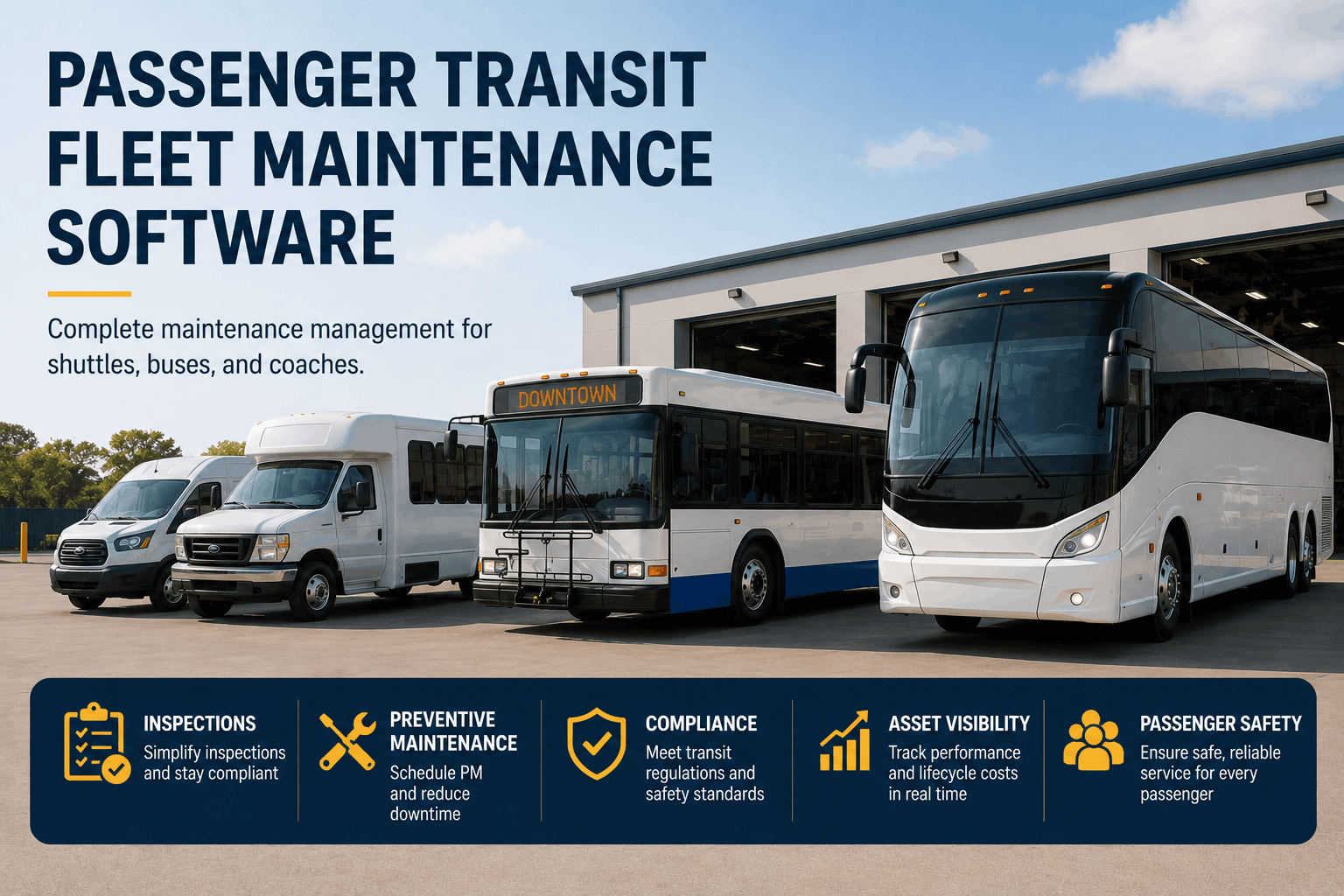
Passenger Transit Fleet Maintenance Software
Unified platform for drivers, maintenance, compliance, and operations. Safety and efficiency in one system.
Passenger Transit Operations Snapshot
Buses in typical regional fleet50–150 vehiclesDaily passenger impact: 10K–50K
Preventable breakdowns annually8–15% of fleetCost: $150K–400K per year
DVIR compliance gap (most fleets)20–35% non-compliantLiability & fines risk
Data silos (disconnected systems)4–6 separate toolsNo integrated visibility
Passenger transit is fundamentally different from logistics or specialty transport. A bus breaking down in revenue service doesn't just cost the fleet money — it impacts hundreds of passengers, schedule reliability, and public trust. A logistics truck late is an operational problem. A transit bus late is a public service failure. This means transit maintenance must be predictive, not reactive. A tire that might be acceptable on a logistics truck should be replaced on a transit bus before it becomes a liability. An electrical fault that a truck driver might tolerate should never occur on a transit vehicle. The maintenance software for passenger transit must enforce this higher standard: predictive PM, aggressive PM intervals, DVIR compliance by design, safety-critical item tracking, and real-time visibility into vehicle condition. Most generic fleet CMMS systems are designed for logistics or specialty fleets. They're not purpose-built for the safety and compliance demands of public transportation.
Driver Safety Reporting
Drivers must report defects pre-trip (DVIR). System must enforce daily filing, capture defect severity, and auto-route critical issues to maintenance immediately. A soft brake pedal needs same-day inspection, not queued in a backlog.
Passenger Safety Compliance
Certain components (brakes, steering, emergency equipment) have zero-tolerance for defects. Software must tag safety-critical items, prevent non-compliant buses from leaving the yard, and audit compliance automatically.
Schedule Impact Minimization
Maintenance scheduling must consider service schedules. A PM window of "sometime next month" doesn't work. System must identify route gaps and schedule maintenance during lowest-impact periods.
Regulatory Compliance (FTA, FMCSA)
Federal Transit Administration and FMCSA inspection standards require specific maintenance documentation. Software must generate compliant records automatically and flag non-compliant vehicles before inspections.
See transit-specific features — book demo
A transit-optimized CMMS integrates five functional areas that are often siloed: driver reporting, maintenance scheduling and execution, compliance tracking, parts inventory, and cost analysis. The integration creates closed loops: a driver files a DVIR, the system immediately routes critical defects to maintenance, maintenance confirms repair, and the system verifies the bus is safe to return to service. This loop typically takes 4–8 hours in a well-integrated system. In fragmented systems, it takes 24–48 hours (if it completes at all). For passenger transit, that 20-hour difference means buses are out of service longer, routes are delayed or cancelled, and defects compound because they're not addressed quickly.
Unified Transit Platform: Five Integrated Functions
Driver Reporting Layer
Pre-trip DVIR capture (mobile-friendly, mandatory)
Photo/video attachment for defects (evidence)
Severity flag (critical goes to maintenance immediately)
Route-specific reporting (different standards per route)
Maintenance Execution Layer
Auto-generated work orders from DVIR defects
Preventive maintenance scheduler (avoids peak service hours)
Job tracking with start/stop times and parts used
Safety sign-off (mechanic certifies bus is safe to return to service)
Compliance & Inspection Layer
FTA and FMCSA inspection readiness
47-point inspection integration (digital checklist)
Safety-critical item audit (brakes, steering, emergency equipment)
Automated compliance reporting and evidence retention
Parts Inventory & Supply Layer
Stocking levels by bus type and route intensity
Auto-reorder triggers when inventory low
Vendor management and cost benchmarking
Parts usage tracking (which buses need what, and how often)
Reporting & Analytics Layer
Cost per bus and cost per mile
Failure trend analysis (which systems are degrading)
Downtime impact on schedule (revenue lost due to breakdowns)
Predictive replacement planning (when to retire vehicles)
See unified platform — start free
Transit software must enforce safety compliance automatically, not rely on human discipline. A bus with failed brakes should be physically removed from the fleet until repaired. A bus with non-functional emergency doors should not be approved for service. A bus with defective HVAC (especially in extreme climates) should not run a full route. The software must prevent unsafe buses from leaving the yard. This requires: (1) automated flagging of safety-critical defects from DVIRs, (2) override prevention (mechanics cannot approve a bus for service if safety items are pending), (3) audit trails (complete record of what was flagged, by whom, and when it was resolved), and (4) integration with dispatch (the system prevents a bus from being assigned to a route if it has open safety issues).
Primary Brake System
Any defect flagged = bus pulled from service immediately
NO override allowed. Bus cannot return to service until mechanic certifies brakes safe.
Steering System
Excessive play, pulling, or non-responsive steering = immediate pull from service
NO override. Steering failure is life-threatening to passengers.
Emergency Doors & Windows
Any non-functional emergency exit = bus removed from service
NO override. Emergency equipment is non-negotiable per FTA regulation.
Structural Integrity
Cracks in frame, loose body panels, or roof damage = pull from service
NO override. Structural failure can cause catastrophic consequences during emergency maneuver.
Lighting (headlights, brake lights, turn signals)
Any non-functional light on a night-service bus = pull from service
Limited override (day-only service) with supervisor approval and documented justification.
See safety enforcement system — book demo
Transit fleets have fixed service schedules. A bus that operates Monday–Friday on a commuter route has maintenance windows Tuesday–Thursday 10 AM–4 PM. A bus that runs 24/7 has no maintenance window. The software must understand service schedules and auto-schedule maintenance during lowest-impact periods. A 2-hour brake service should never be scheduled during morning rush (peak ridership, route delays cascade). It should be scheduled during off-peak hours or when the bus can be swapped with a spare. This requires integration between the maintenance system and the dispatch/scheduling system. When these are separate (which they are in most fleets), optimization is impossible. A unified system knows which buses are in service, which routes have high impact if delayed, and which maintenance can be deferred vs. urgent. It schedules PM to minimize passenger impact.
Maintenance Scheduling: Impact-Aware Optimization
Bus 34 (commuter route, peak hours 7-9 AM, 4-6 PM)
Brake service scheduled
❌ Avoid 6:30–8:30 AM (peak) and 3:30–5:30 PM (peak)
✓ Schedule 10 AM–12:30 PM (2.5 hr service, off-peak, no delay
Bus 12 (24-hour service, no downtime window)
Engine fluid change due (12K mile PM)
❌ Cannot pull from service (no spare bus available)
✓ Schedule for off-peak hours (2–4 AM), swap with spare during operation
Bus 7 (low-utilization weekend route)
Tire replacement (4 hrs, high-impact if missed)
❌ Avoid weekends (when bus actually operates)
✓ Schedule Wednesday (lowest service on this route), minimal passenger impact
See scheduling optimization — start free
A regional transit authority implementing a unified CMMS typically sees measurable savings within 90 days. Preventable breakdowns drop 40–60% (because defects are caught before failure). DVIR compliance improves to 90%+ (automated filing and reminders). Maintenance cost per bus drops 15–25% (optimized scheduling, eliminated duplicative work, better parts management). Most importantly, unplanned service cancellations drop 30–50% (safety compliance prevents mid-route failures). A fleet of 85 buses with average 2 unplanned cancellations per month (due to breakdowns) loses 170 trips/month × $1,200 per cancelled trip = $204,000 annually. Reducing unplanned cancellations by 40% saves $81,600. A CMMS implementation costs $25,000–40,000. ROI is 2–3x in year one, and the savings compound.
Typical Transit Fleet ROI: 85-Bus Regional Authority
Current annual unplanned cancellations
170 trips/month
$204,000 lost revenue/year
Current maintenance cost per bus
$2,800/bus/year
$238,000 total maintenance/year
DVIR compliance
62% (non-compliant fleet)
Compliance risk: fines + liability
After CMMS Implementation (Year 1)
Unplanned cancellations reduced 40%
+$81,600 revenue saved
Maintenance cost per bus reduced 20%
+$47,600 cost reduction
DVIR compliance improved to 94%
+Eliminated compliance risk
Downtime hours reduced 35%
+$32,000 operational efficiency
Year 1 Total Benefit: $161,200 | Investment: $35,000 | ROI: 460%
Calculate your transit fleet ROI — book demo
Passenger transit is safety-first, schedule-first, compliance-first. Generic fleet software is not suitable. A transit CMMS must enforce safety automatically, optimize scheduling around service, minimize downtime impact, and generate compliance reports. The best transit software treats every defect as a potential public safety issue and every bus as a critical asset that must deliver reliable service. Unified systems that integrate drivers, maintenance, compliance, and operations create the visibility needed for safe, reliable, cost-effective public transportation.
Passenger transit fleets need unified maintenance software built for safety, compliance, and schedule reliability. Fragmented systems create blind spots that lead to unsafe buses in service, preventable breakdowns, and public service failures. A unified platform that integrates driver reporting, maintenance execution, safety compliance, and operations creates the visibility that prevents both safety incidents and operational losses. For passenger transit, this isn't just an operational improvement. It's essential.
See unified transit platform — book demo
Transit Fleet Maintenance Platform
Unified CMMS for drivers, mechanics, compliance, and operations. Safety enforcement, schedule optimization, and real-time visibility. Free 14-day trial.
What's the difference between transit CMMS and general fleet CMMS?
Transit CMMS is built for safety-first operations (enforcement of safety-critical compliance), integration with dispatch/scheduling (downtime minimization), FTA/FMCSA compliance by design, and public service reliability focus. General fleet CMMS optimizes for cost and efficiency. They're fundamentally different in priority and design.
Can I integrate my existing dispatch system with transit CMMS?
Most modern transit CMMS platforms have APIs and pre-built integrations with major dispatch systems (Remix, Trapeze, etc.). This integration allows the CMMS to see real-time bus locations, routes, and schedules, enabling impact-aware maintenance scheduling. Check with your CMMS vendor about compatibility.
How long does implementation typically take?
Typical implementation is 8–12 weeks: 2 weeks planning, 4 weeks configuration and data migration, 4 weeks pilot testing with a subset of buses, 2 weeks fleet-wide rollout and training. Full capability usually achieved by month 4.
What training is required for drivers and mechanics?
Drivers need 1–2 hours training on mobile DVIR reporting. Mechanics need 4–6 hours on work order entry and closeout. Supervisors/dispatchers need 2–4 hours on compliance tracking and scheduling. Most vendors include training as part of implementation.
How does the system handle multiple bus types (coaches, shuttles, etc.)?
A good transit CMMS allows configuration by bus type: different PM intervals, different safety-critical components, different reporting requirements. The system automatically applies the right rules for each vehicle type.
Can the system predict failures before they happen?
Some modern transit CMMS platforms integrate telematics and predictive analytics: engine temperature trends, brake wear patterns, electrical system health. This enables true predictive maintenance, not just preventive. But this requires historical data (6+ months) to be effective.
Built for Passenger Safety
Transit fleet software that enforces safety compliance, optimizes scheduling, and delivers on-time reliable service. For shuttles, regional transit, coaches. Free trial, no credit card.