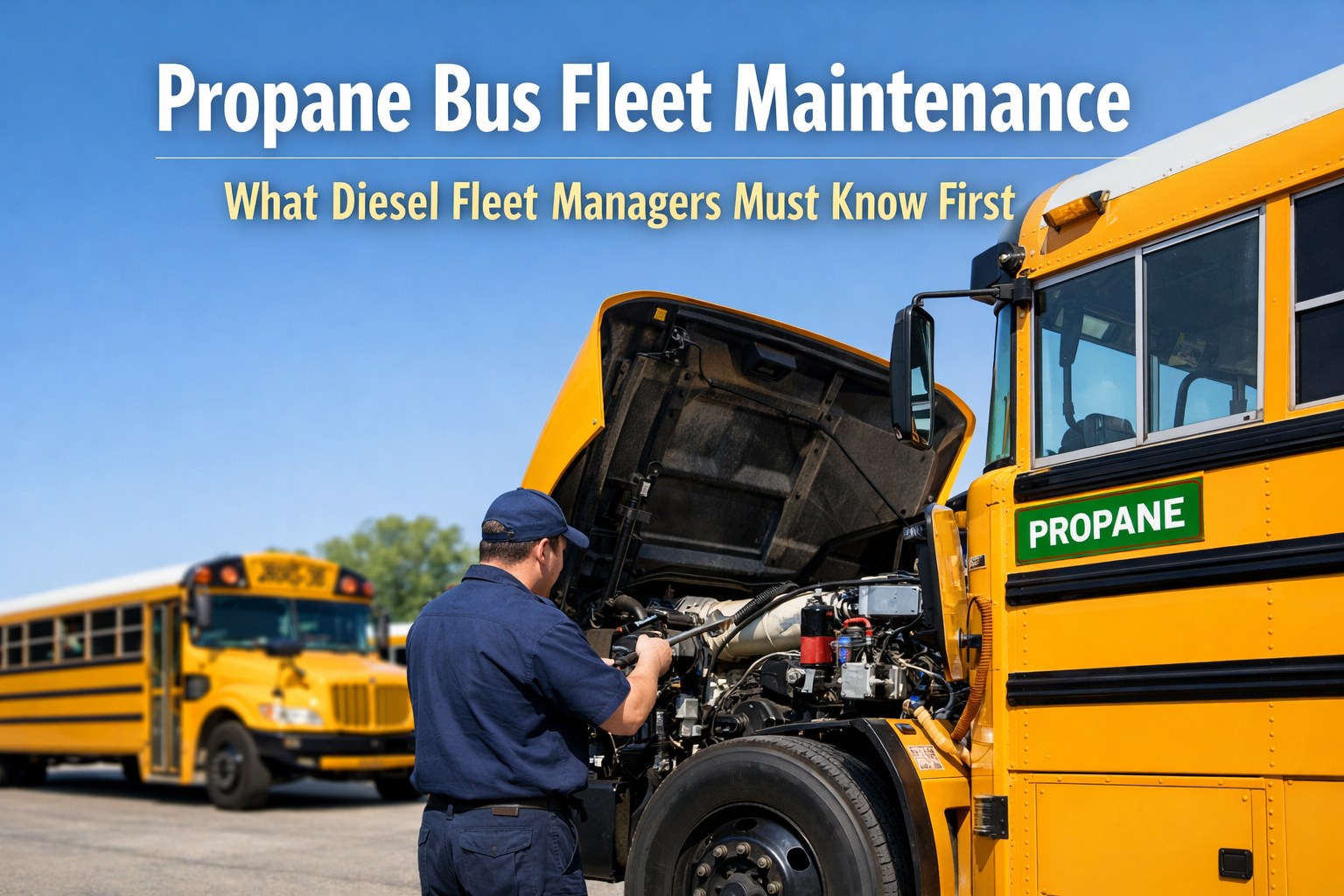
Your first propane bus arrives next month. Your diesel technicians have never touched one. You're wondering if you can just run it on your existing PM schedule—the answer is no. Doing so will void your warranty, accelerate component wear, and miss critical spark plug service that diesel engines don't have. Propane adoption in school bus fleets surged 200% year-over-year according to the 2025 School Bus Fleet survey, making it the fastest-growing alternative fuel in student transportation. But most diesel-dominant fleets are making expensive mistakes because nobody told them propane engines are fundamentally different machines.
Why Diesel Maintenance Assumptions Fail on Propane
Propane engines use spark ignition—like a gasoline car—not compression ignition like diesel. This fundamental difference changes everything about how you maintain them:
- High compression ratio ignites fuel
- Complex aftertreatment (DPF, DEF, SCR)
- Fuel injector precision critical
- Gelling in cold weather
- Idle limits to protect components
Systems
- Spark plugs ignite fuel-air mixture
- Simple 3-way catalyst (like cars)
- Cleaner combustion, less wear
- No cold weather issues
- No idle restrictions
The 7 Critical Maintenance Differences
These aren't minor variations—they're completely different service requirements. Running propane on diesel schedules wastes money or misses critical service:
These savings only materialize when you run the correct PM schedule. Using diesel intervals means either changing propane oil too often (wasting money) or missing spark plug service (causing failures). Book a demo to see how BusCMMS manages fuel-specific PM schedules.
5 Propane Safety Protocols Your Diesel Techs Must Learn
Propane isn't diesel—it's a pressurized gas stored as liquid at -44°F. Your technicians need specific training before touching the fuel system:
Safety incidents with untrained technicians create liability exposure and workers' comp claims. Sign up free and add propane safety checklists to your digital inspection workflows.
Required Technician Training Before First Propane Bus
Your diesel ASE certifications don't cover propane fuel systems. Before technicians work on propane buses, they need these certifications:
CETP certification expires every 3 years. When it lapses, your technicians lose authorization to handle propane fuel systems. Schedule a demo to see how BusCMMS tracks certification expiration dates.
Expert Review: Your First Propane PM Schedule
Stop trying to fit propane into your diesel schedule. Here's exactly what a propane bus PM schedule should look like:
Your CMMS needs to support multiple fuel-type PM schedules running simultaneously. Sign up and configure separate diesel and propane schedules in minutes.
Frequently Asked Questions
How often do propane buses need oil changes compared to diesel?
Propane buses require oil changes every 10,000 miles, compared to 6,000-7,000 miles for diesel—43% longer intervals. Additionally, propane engines use only 7-8 quarts of oil per change versus 32 quarts for diesel (75% less). Oil filters cost approximately $4 for propane versus $18 for diesel. Combined, this delivers significant maintenance savings—but only if you're using the correct propane-specific schedule.
What certifications do technicians need to work on propane buses?
Technicians should complete PERC's free 3-day Propane Autogas Technician Training covering fuel systems, components, and safety. For fuel handling and transfer operations, CETP (Certified Employee Training Program) certification through NPGA is required and must be renewed every 3 years. OEM-specific training from manufacturers like Blue Bird is recommended before your first propane bus delivery for system-specific diagnostics.
Do propane buses need anti-gelling additives in cold weather?
No. Unlike diesel fuel that gels in cold temperatures, propane does not freeze or gel regardless of temperature. Propane buses start reliably in extreme cold without fuel additives, block heaters, or kerosene blending. Large diesel fleets spend up to $25,000 annually on winter fuel additives—propane buses eliminate this expense entirely while providing more reliable cold-weather starts.
How do you detect propane leaks during bus inspections?
Unlike visible diesel drips, propane leaks require specific detection methods. Apply soap-and-water solution to connections, valves, and fittings—bubbles indicate a leak. In cold weather, use commercial leak detection fluid or calibrated combustible gas detectors. Frost formation on a propane fuel line indicates an active leak requiring immediate investigation. Propane contains an added odorant (rotten egg smell) to aid detection.
Can I run propane buses on my existing diesel PM schedule?
No—this will either waste money or miss critical service. Propane buses have completely different requirements: extended oil change intervals (10,000 vs 6,000-7,000 miles), spark plug service every 4 oil changes (diesel has none), fuel filter changes at 50,000 miles (vs 10,000-15,000 for diesel), and zero DPF/DEF maintenance. Your CMMS must support fuel-type-specific PM schedules to maintain both fleets correctly.