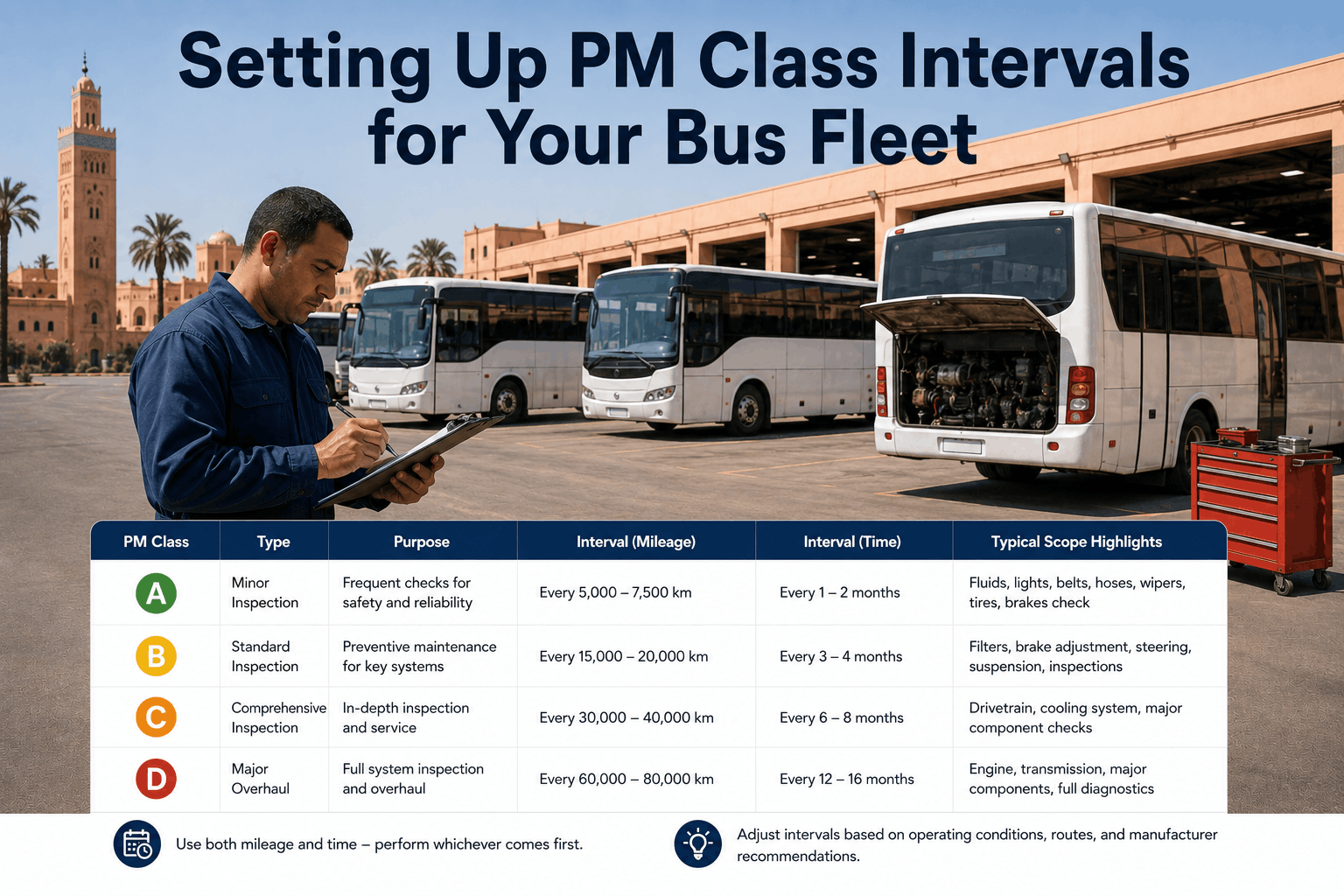
A 50-bus fleet had a maintenance schedule. It was: "change oil when it needs it." That's not a schedule — that's hoping. Real preventive maintenance works like this: every bus gets serviced at specific mileage intervals (A, B, C, D classes). A-class is 10,000 miles (fluids, filters, basic checks). B-class is 25,000 miles (fluid changes, belt inspection, more detailed checks). C-class is 50,000 miles (deep inspection, wear components). D-class is 100,000 miles (major overhaul, transmission service, frame inspection). When you set intervals correctly, every bus gets the right service at the right mileage. When you don't, buses get over-maintained (wasted cost) or under-maintained (catastrophic failure). Most fleets know intervals exist. Almost none actually implement them consistently. This guide shows how to set up PM classes by mileage, track compliance, and use them to cut maintenance cost by 20-30% while improving reliability.
PM classes A/B/C/D aren't just ideas—they're your maintenance schedule. Set them correctly and compliance follows. Most fleets skip this. You won't.
Every bus fleet should run four PM classes. Class A: performed every 10,000 miles or monthly (whichever comes first). Scope: fluid level checks, filter inspection, light and battery check, tire pressure, brake inspection. Time: 1 hour. Cost: $150. Class B: performed every 25,000 miles or quarterly. Scope: all A items plus oil and filter change, coolant check, hose inspection, belt tension. Time: 2 hours. Cost: $400. Class C: performed every 50,000 miles or 6 months. Scope: all B items plus air filter change, transmission fluid check, brake pad wear, suspension inspection. Time: 3 hours. Cost: $650. Class D: performed every 100,000 miles or annually. Scope: all C items plus deep engine inspection, transmission service (flush and fill), fuel system inspection, frame and chassis inspection. Time: 8-12 hours. Cost: $1,800. These are minimums. Your equipment manufacturer may specify different intervals — check your manual. But most diesel bus engines follow this pattern. The key: spacing them out so preventive costs are predictable and spread over time, not clustered at one mileage (which would take the bus out of service for a week). A, B, C, D are staggered specifically so the bus is never down for more than 1-2 days per service.
The goal isn't just to perform maintenance — it's to perform it without taking all your buses out of service at once. A 50-bus fleet with 48 buses in service and 2 in maintenance is sustainable. A fleet with 30 buses in service because half are down for D-class maintenance is broken. Stagger PM classes so they overlap but don't concentrate. Example schedule for one bus: Mile 0: Start of life. Mile 10,000: A-class. Mile 20,000: B-class. Mile 30,000: A-class. Mile 40,000: C-class. Mile 50,000: B-class. Mile 60,000: A-class. Mile 70,000: B-class. Mile 80,000: A-class. Mile 90,000: C-class. Mile 100,000: D-class. This pattern means A-class happens every ~10K miles (as it should), B-class every ~25K (with minor variation), C-class every ~50K, and D-class every 100K. No single service is catastrophically long. Across a 50-bus fleet where buses accumulate miles at different rates, stagger the start points so A-class services are distributed throughout the month. If all 50 buses hit mile 10,000 in the same week, you need 50 A-class appointments. Spread them. Have buses 1-10 do A at miles 10K, buses 11-20 at 10.5K, buses 21-30 at 11K, etc. This distributes workload smoothly and keeps bays utilized consistently.
You can't schedule what you don't track. A CMMS (Computerized Maintenance Management System) is the only way to stay on top of PM classes. Configure it with: (1) Vehicle ID (bus number). (2) Current odometer reading. (3) Scheduled A-class date/mileage. (4) Scheduled B-class date/mileage. (5) Scheduled C-class date/mileage. (6) Scheduled D-class date/mileage. When a bus hits the trigger point (either mileage or date, whichever comes first), the CMMS generates a work order automatically. The work order specifies the class, scope, estimated time, and required parts. No manual reminder emails. No guessing if a bus is overdue. The system knows. Most fleets fail at PM not because they don't understand it, but because they don't automate tracking. Manual scheduling works for 3 buses. For 50, it fails immediately. You forget. Someone changes jobs. Records disappear. CMMS eliminates all of that. The cost: $100-200/month for small fleet (50 buses). ROI: prevention of a single catastrophic failure ($18,500 brake system failure) breaks even on 9 years of software. Realistically, you prevent 2-3 failures per year, so payback is <2 months.
The A/B/C/D framework is standard, but intervals vary by bus type, engine, duty cycle, and manufacturer recommendations. Your bus manual is the source of truth. If Volvo recommends oil change at 15,000 miles, not 12,000, use 15,000. If you operate in high-heat desert conditions, you may need oil changes every 8,000 miles instead of 12,000. Urban transit buses with frequent hard braking may need brake inspections every 15,000 miles instead of 25,000. School buses operated seasonally (180 days/year) may hit C-class by time, not mileage. Customize intervals to your reality, but document the reason. If you deviate from manufacturer specs without documentation, you create liability (if something fails and you're sued, the first question is "did you follow the recommended maintenance schedule?"). Here's how to customize: (1) Read your bus manuals and list all recommended maintenance. (2) Group services by severity (critical = stops bus; warning = performance degrades; routine = normal wear). (3) Assign each to A/B/C/D based on severity and frequency. (4) Validate intervals match manufacturer specs. (5) Document your custom schedule and get it approved by your fleet director. (6) Input into CMMS. Now you have a defensible, fleet-specific maintenance schedule.
Scheduling only works if you actually follow the schedule. Monthly compliance audit: pull your CMMS report of scheduled vs completed PM services. Look for: buses overdue for A-class by >2 weeks, buses overdue for B-class by >4 weeks, buses overdue for C-class by >8 weeks, buses overdue for D-class by >12 weeks. Each overdue service is debt. Debt accumulates. A bus overdue for 3 consecutive A-classes, 2 B-classes, and 1 C-class is not in preventive mode — it's in crisis mode (and you don't realize it until something fails). Flag overdue services immediately and create priority work orders to catch up. If you're consistently missing dates, the problem isn't the buses — it's your capacity. You don't have enough bay time or labor to keep up with demand. You have two choices: (1) Add capacity (hire, expand bays, invest in tools). (2) Reduce fleet size (fewer buses = fewer maintenance slots). Most fleets choose neither and accept the cost of reactive maintenance (which is 50-300% more expensive). That's illogical. Either invest in prevention or accept the cost of failure. No middle ground.
PM classes aren't just a framework — they're a calendar. A-class every 10K miles. B-class every 25K. C-class every 50K. D-class every 100K. These intervals exist because they match the wear characteristics of diesel engines and commercial bus systems. Follow them, and your fleet runs smoothly. Ignore them, and costs skyrocket. Most fleets know the framework but fail at execution because they don't automate. CMMS automation is non-negotiable. It transforms compliance from 40% (manual reminders, forgotten schedules) to 95%+ (automatic triggers). Once you're on schedule, customize intervals to your fleet (bus type, manufacturer specs, duty cycle), stagger them across your fleet to maintain bay utilization, and audit monthly to catch drift. That discipline cuts maintenance cost by 20-30% and extends engine life by 200,000+ miles.
PM classes A/B/C/D are your maintenance schedule. A at 10K miles, B at 25K, C at 50K, D at 100K. Set them up in CMMS so they trigger automatically. Customize to your fleet's specs. Stagger across your 50-bus fleet so you're never down 30 buses at once. Audit monthly for compliance. A fleet on schedule runs 18-22% cheaper and gets 200K+ more engine life than a reactive fleet. The ROI is instant: one prevented failure ($18K+ repair cost) covers a year of CMMS software. Most fleets fail not because they don't understand PM — they fail because they don't automate it. CMMS is table stakes.