A school district superintendent bought 12 new buses. She assumed state inspection requirements were federal standard. Turns out her state required annual inspections, but the neighboring state had semi-annual (twice yearly) requirements. Different state had the standard enforced quarterly. Another state had no formal standard — just annual safety certification. The buses were compliant in her state but would be non-compliant six months later if moved across state lines. School bus inspection requirements don't follow federal standard. Each state writes its own rules. Some states mandate inspection every 12 months. Others require 6 months. Some require detailed defect documentation. Others accept basic pass/fail. This creates chaos for multi-state operators and confusion for single-state districts. A school bus that's fully compliant in Texas might fail inspection in New York. This guide maps state-by-state inspection requirements so you know exactly what your state mandates and what neighboring states require if you operate across borders.
Inspection rules vary by state. Know your state's requirements and neighboring states if you operate across borders.
School bus inspections are mandated by state education departments and state DOT agencies, not federal authority. This creates significant variation in requirements. Some states follow the Federal Motor Carrier Safety Administration (FMCSA) standards for school buses. Others create their own standards that are stricter or less detailed. The key differences: inspection frequency (annual vs semi-annual vs quarterly), inspection depth (basic checklist vs detailed defect documentation), who conducts inspections (state inspector vs certified mechanic vs in-house personnel), and what triggers out-of-service status. A bus that fails inspection in one state might pass in another because the standards differ. For districts operating within one state, this is straightforward. For districts that transport across state lines (student field trips, athletic teams, regional programs), you must meet the most stringent state's requirements. A school district in Pennsylvania operating buses to New York must meet New York's inspection standards for those trips, not just Pennsylvania's. Understanding your state's exact requirements is the first step. Knowing neighboring states' requirements is critical if you operate across borders.
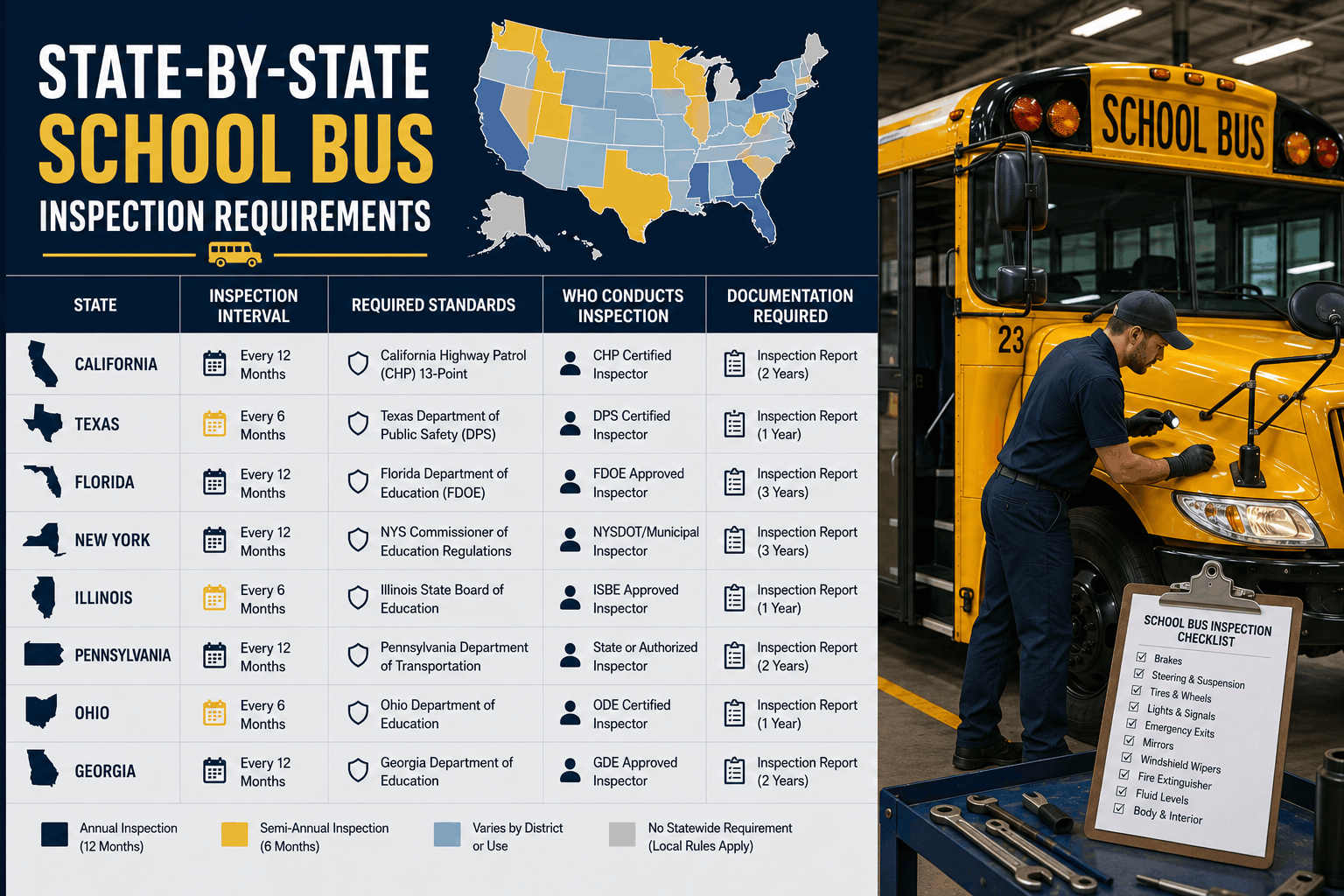
States fall into four frequency tiers. Tier 1 (Annual inspection): 24 states require inspection once per calendar year. These states typically align with federal commercial vehicle inspection standards. Texas, Florida, Colorado, and most Tier 1 states accept a single annual inspection conducted by a state inspector or certified mechanic. A bus passing annual inspection in a Tier 1 state is compliant for that 12-month period. Tier 2 (Semi-annual): 18 states require inspections twice per year (every 6 months). New York, Massachusetts, New Jersey, and other northeastern and mid-Atlantic states typically fall here. A bus in a Tier 2 state must pass inspection in January and again in July (or similar 6-month intervals). Compliance risk is higher because you have twice as many inspection windows where a defect could be found. Tier 3 (Quarterly): 6 states require formal inspections every 3 months. California, Hawaii, and a few others mandate this higher frequency. Quarterly states are typically the most rigorous and have higher defect-citation rates. Tier 4 (Monthly): Alaska and one or two other states conduct spot-check inspections monthly on random buses in fleets. These states want ongoing enforcement rather than interval-based inspection. If you operate buses in a Tier 4 state, you're under constant inspection pressure. The tier your state falls in determines your maintenance schedule intensity and documentation burden.
Beyond frequency, states differ on what happens when a defect is found. Some states require detailed written documentation of any defect with a timeline for correction. Others allow simple defect notation without detailed documentation. When a defect is found, some states immediately pull the bus from service until it's fixed (strict enforcement). Others allow the bus to operate with a defect if the district signs a waiver stating the defect will be corrected within X days. This creates significant variation in operational impact. A brake defect found during inspection in a strict-enforcement state means the bus is out of service until brakes are repaired. A brake defect in a waiver state might allow continued operation for 5–10 days while the repair is scheduled. For districts in waiver states, this is operationally convenient. It's also riskier — you're running buses with known defects. For districts in strict-enforcement states, this is operationally difficult but safer. Most fleets in strict states do more preventive maintenance to avoid surprise defects during inspection. Understanding your state's defect policy determines how you structure maintenance scheduling and impacts your ability to handle unexpected failures during the school year.
If you operate school buses in multiple states, you must meet the most stringent state's requirements. A school district in a Tier 1 (annual inspection) state that transports students to Tier 2 (semi-annual) states must conduct semi-annual inspections for all buses, even those that never leave the home state. The operational cost is higher, but the compliance risk is eliminated. The same logic applies to defect policy: if your home state is a waiver state but you operate buses in strict-enforcement states, you must operate as if you're in a strict-enforcement state. Don't defer defect repairs. Fix them immediately. The lowest common denominator for compliance is the strictest state. Building compliance strategy means: (1) Identify all states where your buses operate. (2) Map each state's inspection frequency tier and defect policy. (3) Adopt the strictest tier and policy across your entire fleet. (4) Schedule inspections based on the strictest requirement. (5) Implement preventive maintenance to avoid surprise defects. (6) Document all inspections and repairs thoroughly. A school district that operates in three states (one Tier 1, one Tier 2, one Tier 3) must conduct quarterly inspections on all buses, even those that never leave the home state. This is more expensive than necessary for single-state operation, but it's the cost of multi-state compliance. Most districts underestimate this cost until they get cited for non-compliance out-of-state.
School bus inspection requirements are fragmented by state. There is no national standard. A bus that's fully compliant in one state might be non-compliant in another. For districts operating only within one state, know your state's specific tier and defect policy. For districts operating across state lines, adopt the strictest state's requirements across your entire fleet. This costs more upfront but eliminates compliance risk. The cost of an out-of-state inspection citation and emergency repairs far exceeds the cost of proactive multi-state compliance. Plan accordingly, budget accordingly, and schedule inspections based on the strictest requirement you'll face.
School bus inspection requirements vary significantly by state. 24 states require annual inspection. 18 states require semi-annual (twice yearly). 6 states require quarterly. 2 states require monthly spot checks. Defect policies also vary: some states immediately pull buses out of service, others allow operation under waiver while repairs are scheduled. If you operate buses in multiple states, you must meet the strictest state's requirements across your entire fleet. A district in an annual-inspection state that transports to a semi-annual state must adopt semi-annual inspections for all buses. Multi-state operation costs more, but it eliminates the risk of out-of-state citations, emergency inspections, and emergency repairs. Know your state's requirements. Know all states where your buses operate. Adopt the strictest standard. Budget for the most frequent inspections and strictest defect policies. Compliance is achievable — just plan accordingly.