Vendor management operations become audit-sensitive when outside repair shops, parts suppliers, subcontractors, towing providers, warranty vendors, and specialty service partners touch fleet assets. A bus fleet can have strong internal maintenance processes and still fail an audit because vendor approvals, insurance documents, invoices, work orders, turnaround times, and quality checks are scattered across email, accounting systems, spreadsheets, and paper folders. A vendor management audit asks a simple question: can the fleet prove that every outside vendor was approved, qualified, documented, measured, and controlled? If the answer takes days to assemble, the process is weak. This guide explains the technology, workflows, and reporting metrics required to prepare vendor management operations for audits across bus maintenance, parts procurement, repair tracking, compliance documentation, and cost control.
Build an audit-ready vendor management workflow for bus fleets with approved vendor records, contract tracking, repair documentation, performance metrics, and compliance reporting.
Auditors do not only review what happens inside the maintenance shop. They also review how the fleet controls outside work. If a vendor performs brake repairs, transmission service, emergency road calls, body repairs, tire replacements, warranty work, or parts supply, the fleet must prove that the vendor is approved, insured, qualified, and monitored. Weak vendor controls create financial risk, safety risk, and compliance risk.
The audit problem usually appears when records live in separate places. Accounting has invoices, maintenance has work orders, procurement has contracts, and supervisors have email approvals. When an auditor asks for a 24-month vendor history, the fleet spends days manually connecting documents. A better workflow stores vendor approval, contract terms, work orders, invoices, inspection results, and performance KPIs in one searchable system.
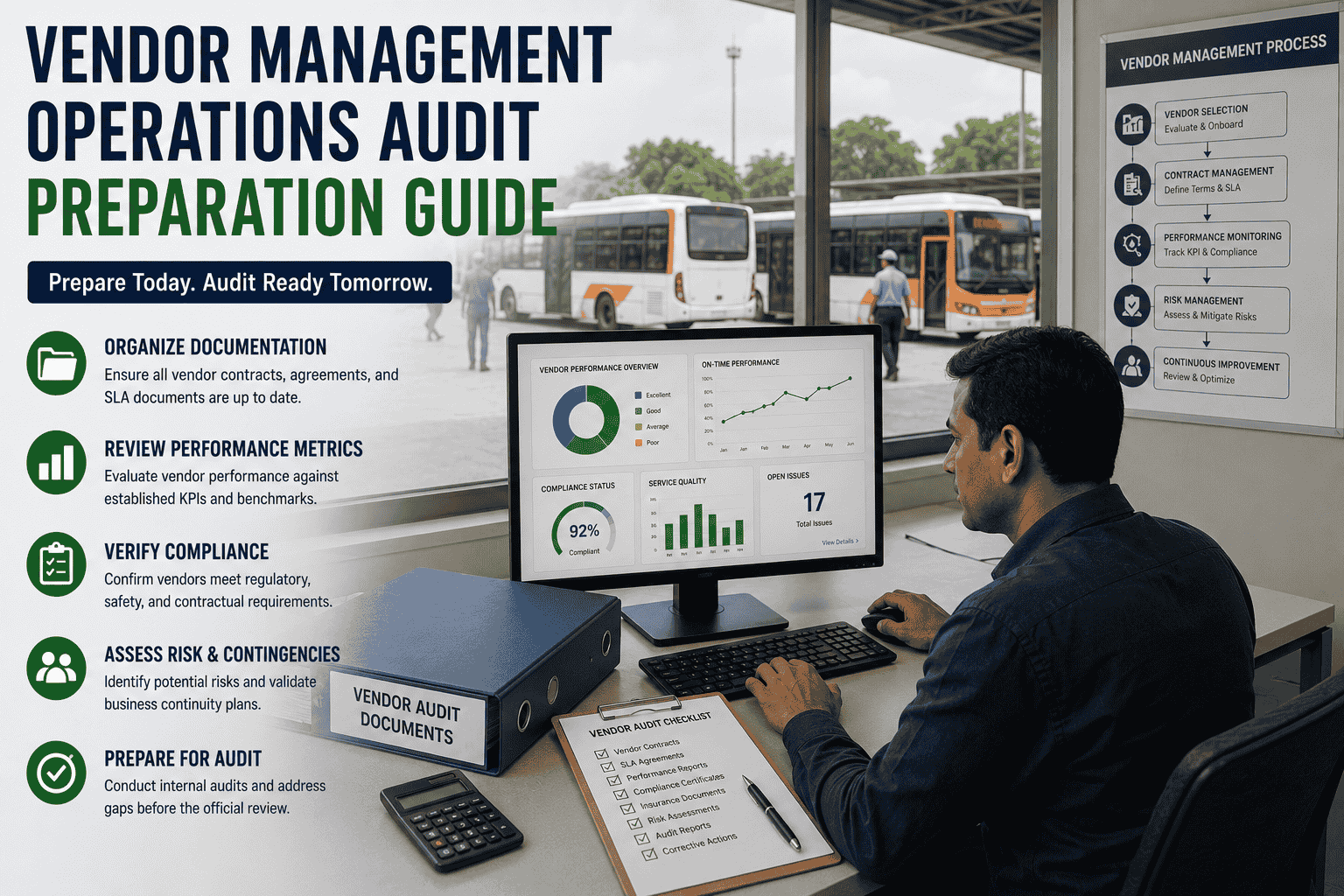
A vendor audit preparation framework should cover five control areas: vendor approval, contract documentation, service documentation, invoice verification, and performance tracking. These controls make it easy to prove that every vendor relationship is managed intentionally instead of informally.
Maintain a master vendor list with status, service category, contacts, tax details, and approval owner.
Store signed agreements, rate sheets, warranties, SLA terms, insurance, and renewal dates.
Every outsourced job should connect vendor, vehicle, defect, labor, parts, cost, and completion notes.
Compare invoice amount against quote, work order, approved labor rate, and received parts.
Track turnaround time, quote variance, rework rate, emergency response, and service quality.
Vendor management operations need measurable KPIs. Without KPIs, a fleet cannot show whether vendors are performing well, whether costs are controlled, or whether quality problems are being corrected. Auditors want evidence that the fleet monitors vendors, not just pays invoices.
Vendor costs become difficult to control when invoices are reviewed separately from maintenance records. A reliable workflow connects invoice review to the original defect, approved quote, purchase order, work order, technician verification, and completed repair documentation. If the invoice does not match the work, the system should flag it before payment.
Driver or technician identifies outsourced repair need.
Approved vendor selected by service category and availability.
Cost, scope, SLA, and expected completion date documented.
Repair notes, parts used, and quality verification attached.
Invoice compared against quote and work order before payment.
A vendor audit packet should be generated quickly. The goal is not to create new documents during an audit. The goal is to maintain records throughout the year so the audit packet is already complete.
Emergency repairs often lead teams to use vendors without approval records, contracts, or insurance checks.
Accounting may pay invoices without seeing repair quality, warranty terms, or work order completion status.
If one vendor fails, fleets need approved alternatives for critical services like brakes, towing, tires, and transmission.
Vendor work should be inspected before the bus returns to service, especially for safety-critical repairs.
Vendor management is not only a procurement function. In bus operations, it is a compliance, maintenance, safety, and cost-control function. The best fleets treat vendors like extensions of the maintenance department: approved, measured, documented, reviewed, and connected to work orders. That is what makes vendor operations audit-ready.
Vendor management operations audits are easier when every vendor record is connected to contracts, insurance, work orders, invoices, quality checks, and performance metrics. Build a vendor master file, link outsourced work to assets, verify invoices before payment, track vendor KPIs monthly, and keep audit packets ready year-round. A CMMS turns vendor management from a scattered paperwork process into a controlled, searchable, audit-ready workflow.