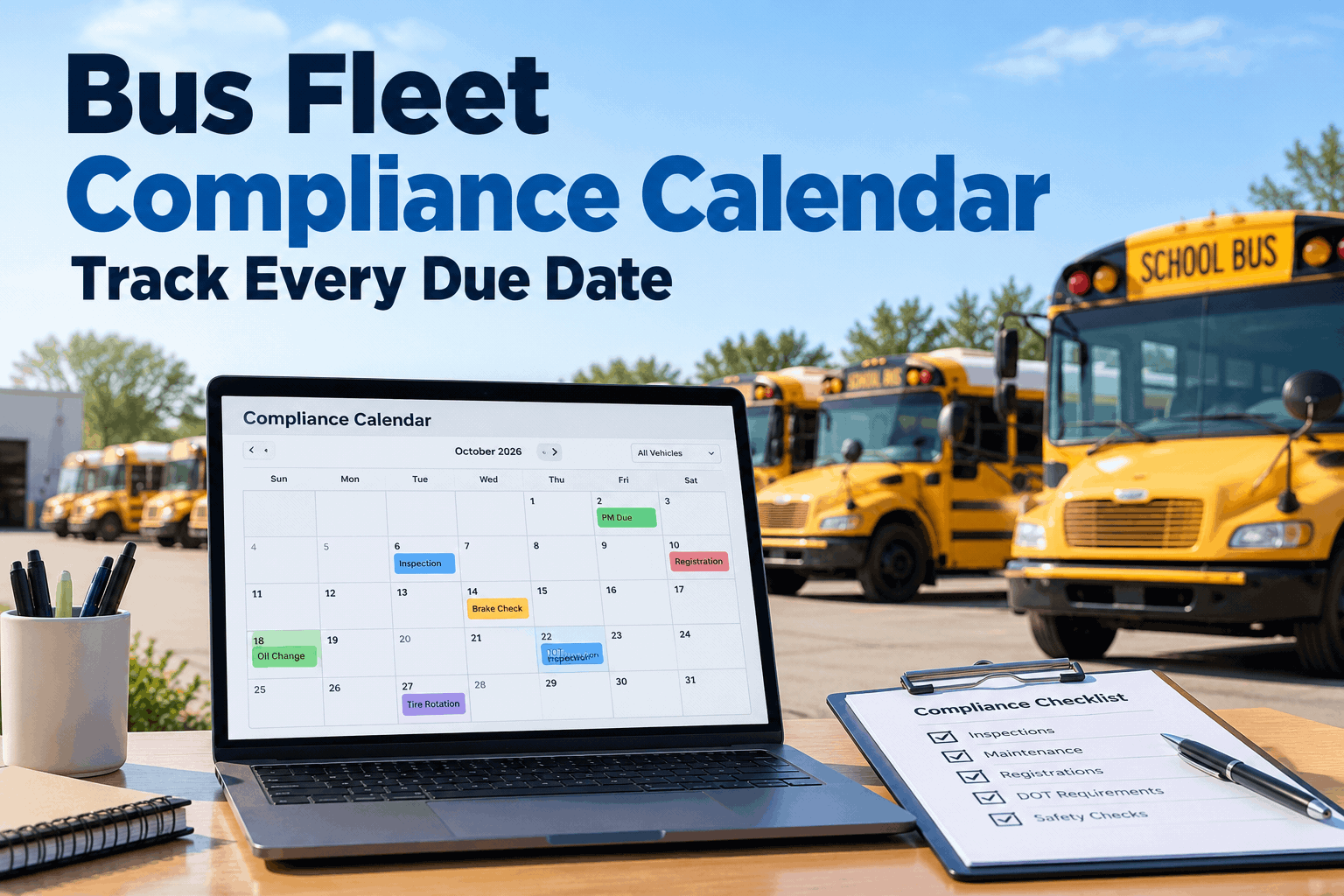
The DOT inspector is already in your lot when the foreman realizes bus 214's annual safety inspection lapsed eleven days ago. Nobody missed it on purpose — it lived on a whiteboard that got erased. A bus fleet compliance calendar exists so that never happens: every due date in one tracked place. You can see a live compliance calendar in a demo.
Bus Fleet Compliance Calendar: Track Every Due Date
DVIR reviews, annual DOT inspections, ADA 90-day lift checks, FTA reviews, NTD submissions, PM intervals, CDL renewals — one calendar that holds every date and warns you before any of them lapse.
Every dot is a date a missed one turns into a grounded bus or an audit finding. The calendar plots them a year out, not week-of.
What a Missed Compliance Date Actually Costs
A single lapsed date rarely stays small. It escalates — from a bus you can't run, to a fine, to a finding that follows you into the next review. Here is how one slipped deadline grows.
The date slips quietly
An annual DOT inspection or ADA 90-day lift check falls off the whiteboard. No alarm sounds — it is simply not done, and nobody notices until something forces the issue.
A bus comes off the road
Run an out-of-date bus and you are out of compliance the moment it rolls. Pull it to fix the paperwork and a route loses its vehicle — a sub bus, a doubled run, or kids left at the curb.
The finding hits the record
A state DOT inspector or FTA reviewer logs the gap. Now it is a documented finding, a corrective-action plan, and a flag on the next fleet compliance management review.
The expensive part is never the inspection itself — it is the grounded bus, the scramble, and the finding that a two-minute reminder would have prevented.
The Deadlines a Bus Fleet Compliance Calendar Must Hold
Compliance is not one date a year. It is dozens of recurring obligations on different clocks — daily, quarterly, annual, and multi-year — and the ones that bite are usually the odd-interval ones nobody has memorized. Here is the real spread.
Driver vehicle inspection reports (DVIR)
FMCSA requires a DVIR when a defect is found or a driver is informed of one. Every route, every day — the single highest-volume compliance item in the fleet, and the easiest to let go paper and unreviewed.
ADA wheelchair-lift & cyclical checks
ADA requires accessibility features like wheelchair lifts be inspected and kept in operative condition on a regular cycle. Miss the interval and a lift failure strands a rider — a safety and legal exposure you cannot write off.
State DOT safety inspections & renewals
Annual (or more frequent) state vehicle safety inspections, plus CDL and medical-card renewals that fall per driver on their own dates. These never line up neatly — which is exactly why they slip.
FTA reviews & NTD reporting
Transit agencies face the FTA triennial review and recurring National Transit Database (NTD) submissions, plus PTASP and TAM documentation. Big, infrequent dates where a year of missing records surfaces all at once.
The daily items you can feel; the odd-interval ones are where fleets get caught. A real bus inspection scheduling system you can start free plots all four tracks on one timeline so none of them rely on memory.
Why Reminders Beat the Scramble: The Alert Ladder
A due date on a calendar you never open is just a date. What makes a compliance calendar work is tiered advance warning — so the work happens on your schedule, not the inspector's. This is the countdown that turns a deadline into a non-event.
With a 30 / 14 / 1-day ladder, the only buses that reach their due date are ones already signed off. The scramble disappears.
Your Compliance-Calendar Setup Checklist
Whether you build it in a spreadsheet or in software, a compliance calendar is only as good as what you load into it. Run this list against your fleet — the items you can't confidently check are the ones most likely to surprise you.
- Every recurring date is entered, not rememberedDVIR review, annual DOT, ADA lift cycle, FTA/NTD dates, PM intervals, CDL and medical-card renewals — all with their real frequency.
- Each date has a tiered advance alertA 30 / 14 / 1-day warning on every item so work is scheduled, not discovered the morning of the inspection.
- Every item has a named ownerA date with no one responsible is a date that slips. Each deadline routes to a person, not a shared inbox.
- Completing a date leaves a recordA timestamped, signed-off entry an auditor can see — so proof of compliance exists without digging through paper.
- You can see what is due this week at a glanceOne dashboard view of upcoming and overdue items, per bus and per driver — not twelve tabs and a sticky note.
- A due date auto-creates the workWhen an inspection or PM comes due, the work order or checklist generates itself and lands with the right tech — no manual hand-off.
If you can tick all six, your fleet is genuinely audit-ready. If a few gave you pause, that is the gap a compliance calendar demo closes in about twenty minutes.
How BusCMMS Turns Scattered Dates Into One Auto-Calendar
A spreadsheet holds dates but can't warn you, assign work, or prove you did it. BusCMMS was built for bus fleets, so the compliance calendar is wired to the inspections and PM it tracks — the date and the work are the same system.
Every date, every interval, pre-loaded
Bus-specific inspection and PM logic ships on day one — diesel, CNG, and electric PM on the right intervals, DVIR and ADA checks already modeled, not built from scratch.
Tiered alerts before every due date
Advance reminders fire 30, 14, and 1 day out, so inspections and renewals are scheduled ahead — the day-of scramble stops being a thing that happens.
Audit-ready records, automatically
Each completed date logs a timestamped record and rolls into FMCSA, FTA, state DOT, and NTD reporting — so a triennial review is a report you pull, not a month of digging.
BusCMMS reports districts and agencies run 95%+ fleet availability once dates stop slipping — because compliant buses are buses on the road.
A Transportation Director's Take
Key Takeaways on Your Bus Fleet Compliance Calendar
A bus fleet compliance calendar is not a nice-to-have — it is the difference between a bus on the road and a finding on your record. Four things to carry out of this.
Memory is the failure point
The dates that lapse are the odd-interval ones no one has memorized. Put all of them in one place.
Alerts, not just dates
A 30 / 14 / 1-day ladder turns a deadline into a non-event — work scheduled, never discovered day-of.
Records are half the point
Completing a date should leave proof an auditor can see, so the next FTA or DOT review is a report, not a dig.
The date and the work are one
When a due date auto-creates the work order, nothing waits on a manual hand-off that someone forgets.
Build your bus fleet compliance calendar once, wire it to alerts and records, and audit season stops being a season. You can start a free calendar and load your first dates today — every due date tracked, so the next inspector finds nothing to find.