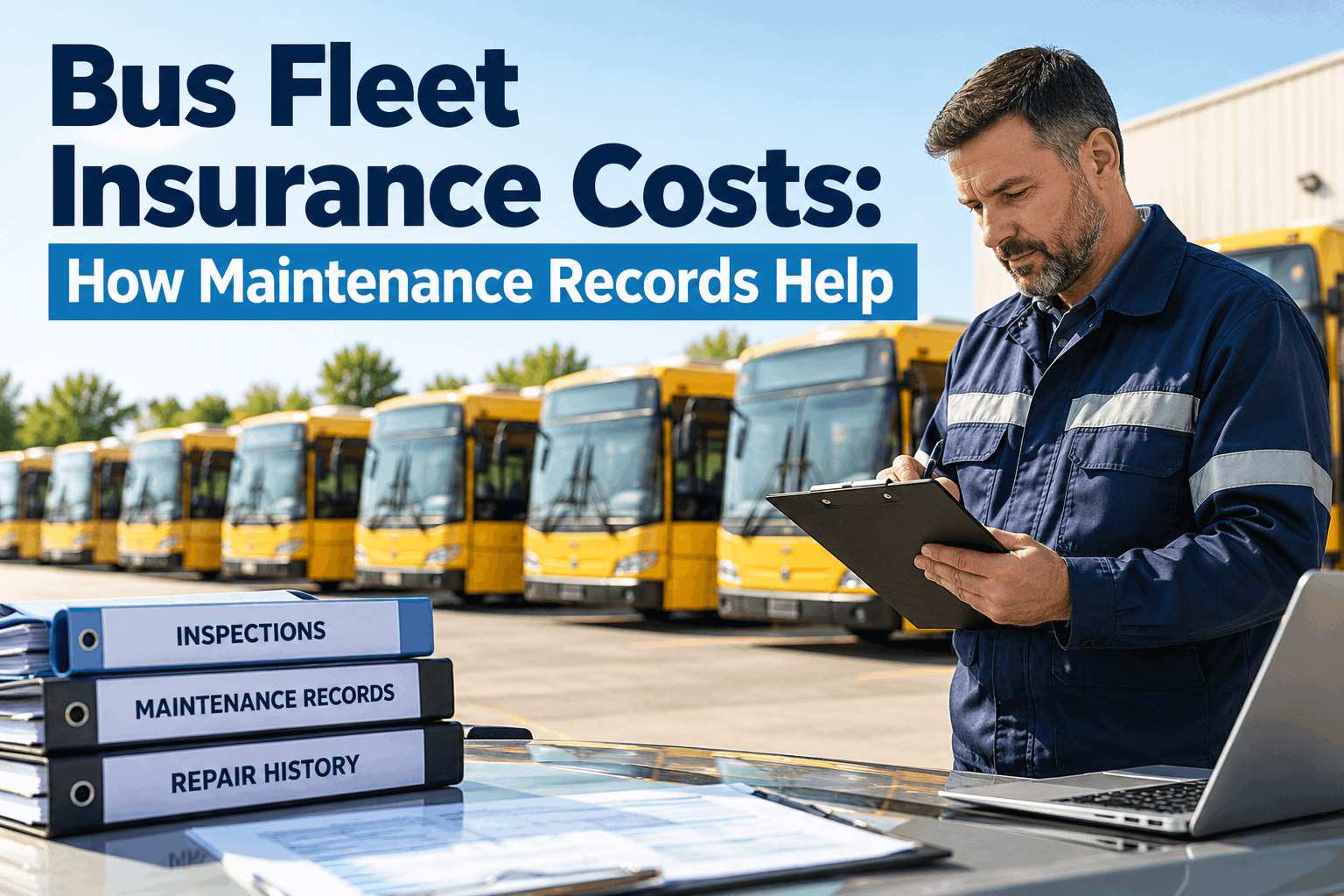
The renewal quote is up again, with a note asking for your maintenance and inspection documentation. You open the drawer: some paper DVIRs, a PM log that stops in March, a repair history in three people's heads. At renewal, undocumented maintenance reads as unmanaged risk — so your bus fleet insurance cost has a lot to do with the story your records tell. You can see what audit-ready records look like in a demo.
Bus Fleet Insurance Costs: How Maintenance Records Help
Insurers price risk, and a documented, well-maintained fleet is a lower-risk fleet to underwrite. Clean inspection and maintenance records don't guarantee a lower premium, but they give you the evidence to make your case — and to defend a claim. Here is how the records factor in.
Same buses, same roads. The difference an underwriter sees is whether you can show the maintenance happened — or just say it did.
Why Maintenance Records Matter to Your Bus Fleet Insurance Cost
Insurers don't price a fleet on hope — they price it on evidence of how it's run. Maintenance and inspection records are among the clearest signals they have, because they show whether safety is a system or a slogan. Here is where your documentation feeds the review.
Underwriting & renewal review
At quote and renewal, an underwriter weighs how well the fleet is managed. A complete PM and inspection history is evidence of a disciplined operation — the kind of risk they'd rather write.
Safety & risk questionnaires
Many carriers ask about inspection programs, defect handling, and maintenance intervals. Being able to answer with documented proof, not estimates, strengthens how your operation is presented.
Claims & liability defense
If an incident happens, a documented trail showing the bus was inspected and the defect addressed is your strongest defense. Missing records leave the story to the other side.
Records don't set your premium on their own — carriers weigh many factors, from loss history to driver records. But a documented fleet gives you the evidence to make your case instead of asking an underwriter to take your word for it.
The Records an Insurer or Adjuster Actually Looks For
"Good records" is vague until you see the specific documents a risk review or a claim asks for. These are the ones that carry weight — and the ones that are hardest to produce from paper and memory.
Swipe sideways to see both columns.
The common thread is proof with a date on it. A fleet compliance and records system keeps all of it in one place, and you can start building that documented history free.
At Claim Time, Records Are the Defense
Underwriting is where records help your cost; a claim is where they protect you. When an incident is disputed, the question becomes simple: can you show the bus was maintained and the defect addressed? With a documented trail you can. Without one, the gap speaks for itself.
The incident is the same. What differs is whether you can produce a dated record — or whether the absence of one fills the silence.
You can't control every incident, but you can control whether your maintenance is provable. A demo shows how the defect-to-repair trail is captured automatically.
Your Insurance-Ready Documentation Checklist
Getting your records insurance-ready is not about volume — it's about being able to produce the right proof on demand. Run this against your fleet before your next renewal or questionnaire. The boxes you can't check are the gaps a reviewer will find first.
- Every inspection is timestamped and retrievableDaily DVIRs stored digitally, searchable by bus and date — not a paper stack you'd have to dig through.
- PM compliance is provable, not assumedA record showing services ran on their intervals, with a compliance rate you can report rather than guess at.
- Every defect has a documented resolutionA flagged item ties to a work order and a completion — so you can show a defect was fixed, not just noticed.
- Each bus has a full service historyA per-vehicle record of repairs, parts, and PM that shows the bus was kept roadworthy over its life.
- Compliance records are audit-readyFMCSA, state DOT, and FTA documentation pulled as a report, so a safety questionnaire is a quick answer, not a scramble.
- You can produce any record in minutesWhen a carrier or adjuster asks, the answer is a search — not a week of reconstructing history from memory.
Walk into a renewal able to check every box and you're presenting a managed fleet, not defending an unmanaged one. A quick demo maps these against what you keep today.
How BusCMMS Builds the Record for You
The hard part of insurance-ready documentation isn't wanting it — it's capturing it without extra work. BusCMMS was built for buses, so the record is a byproduct of the daily workflow: every inspection, PM, and repair logs itself as it happens.
A timestamped record of everything
Every digital DVIR, PM, and repair logs automatically with a date and an owner — the audit trail builds itself from the work you already do.
A closed defect-to-repair loop
A flagged defect becomes a work order and a completion, so every issue has a documented resolution — the trail that defends a claim.
Reports a reviewer can read
Pull PM compliance, inspection history, and FMCSA, DOT, and FTA documentation as reports — so a questionnaire or renewal is a few clicks, not a scramble.
A documented, well-run fleet is also a safer one — BusCMMS reports fleets reaching 95%+ availability as defects get caught and fixed, which is the same discipline insurers want to see.
An Operations Director's Take
Key Takeaways on Bus Fleet Insurance Cost and Records
Your bus fleet insurance cost is shaped by how well you can prove the fleet is managed — and maintenance records are the proof. Four things to carry out of this.
- 01Undocumented reads as unmanaged. At renewal, maintenance you can't show is maintenance an underwriter can't credit.
- 02Records support, they don't guarantee. Carriers weigh many factors; documentation gives you the evidence to make your case.
- 03At claim time, the trail is the defense. A timestamped inspection and a closed defect loop speak when an incident is disputed.
- 04The record should build itself. Captured as a byproduct of daily work, documentation is proof on demand, not a project.
Treat your records as the evidence behind your bus fleet insurance cost — timestamped inspections, provable PM, a closed defect loop — and your next renewal becomes a conversation you walk into prepared. The maintenance already happens; the difference is whether you can prove it.