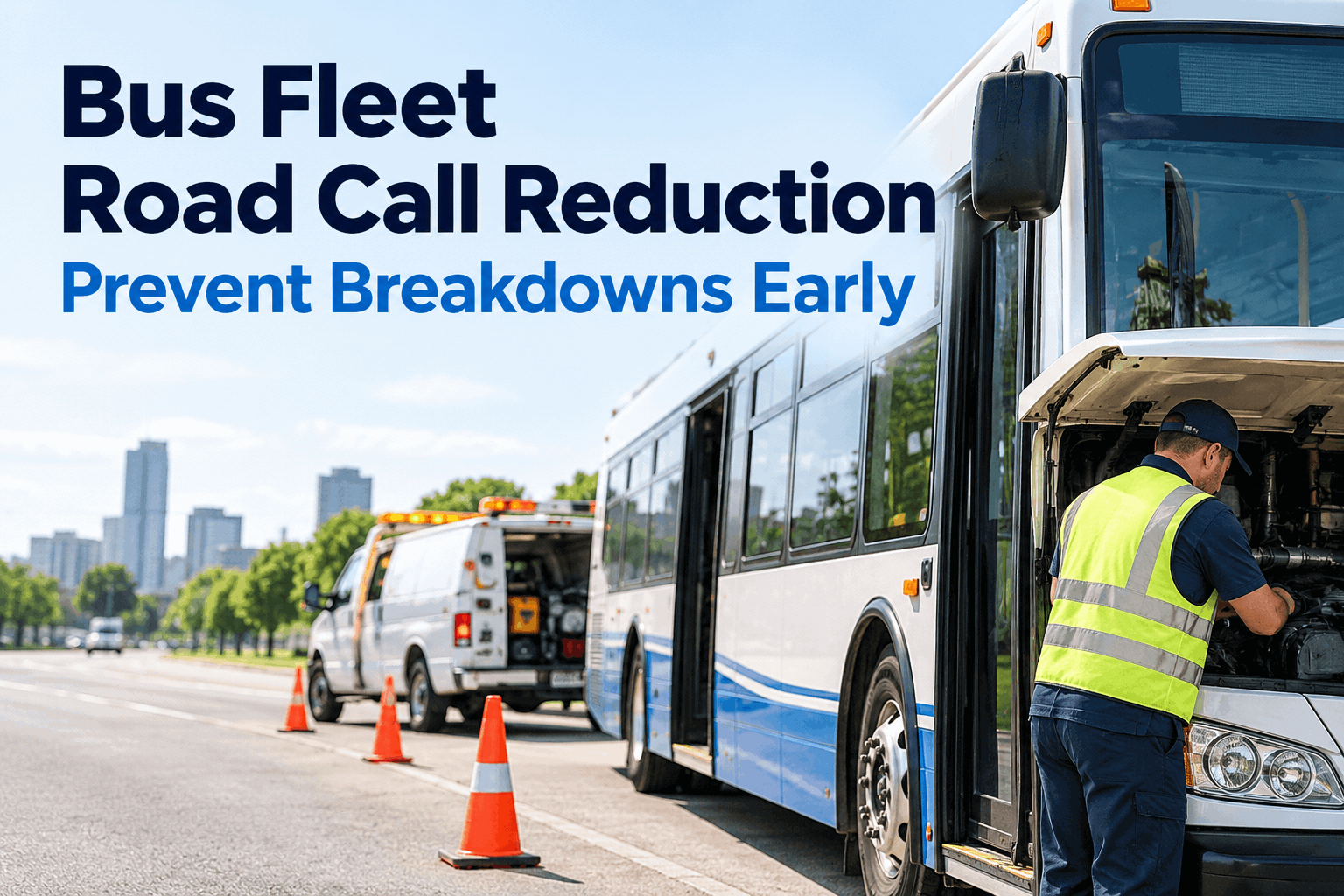
It is 7:10 a.m. and bus 38 is dead on the shoulder with a route full of kids and a water pump that had been weeping for two weeks. Every one of those mornings traces back to a warning that showed early. Bus fleet road call reduction is not about faster tow trucks — it is about catching that pump in the bay. You can see how fleets catch failures before the route in a demo.
Bus Fleet Road Call Reduction: Prevent Breakdowns Early
Most road calls are not surprises — they are missed warnings. A weeping pump, a soft belt, a flagged fault code. Catch the drift in the bay and the breakdown on the route never happens. Here is where road calls start and how to stop them early.
The same part fails either way. The only question is whether you meet it at the 400-mile warning in the bay, or at the failure point on the shoulder.
What a Single Road Call Actually Costs You
The tow bill is the smallest line on the invoice. A road call sets off a chain — and most of the cost lands on people and routes, not the repair itself. Here is what one breakdown really sets in motion.
The bus stops
A dead bus on the route with passengers aboard. Tow or roadside repair, and the vehicle is out of service for the day.
The route runs late
A spare is scrambled or a route doubles up. Kids are late to school, riders miss connections, and dispatch eats the morning.
The overtime stacks up
Techs drop planned work to chase the emergency; the rushed fix often misses the root cause, so the same bus comes back.
The trust takes a hit
Enough stranded routes and the phone calls start — from parents, from riders, from the board asking why availability is slipping.
BusCMMS reports fleets that shift breakdowns into planned work reach 95%+ availability — the difference between a road call and a scheduled PM is one caught warning.
Put a dollar figure on one of your own recent road calls, tow and overtime and lost routes included, and the math for prevention writes itself — something a quick demo can map against your numbers.
Where Bus Road Calls Actually Come From
You cannot reduce what you do not track. When fleets log the cause of every road call, a pattern shows up fast: a handful of systems account for most of them, and most are the kind of slow failures a good PM program catches early. Here is the typical breakdown of the breakdowns.
Cooling, belts, brakes, batteries — slow, visible failures a scheduled PM or a pre-trip catches. The breakdown is rarely the first sign.
That is the whole opportunity: most road calls are not random, they are overdue. A bus preventive maintenance scheduling system turns those slow failures into planned jobs, and you can start tracking your own road-call causes free to see your pattern.
The Three Catch Points Before a Breakdown
A failing part passes three gates before it strands a bus. Miss all three and you get a road call. Catch it at any one and you get a planned repair. Here is where each catch happens — and what has to be working for it to.
Three independent nets — service intervals, the daily pre-trip, and engine fault codes. A road call means the part slipped past all three.
Your Road-Call Reduction Checklist
Cutting road calls is less about one big move and more about closing the gaps a failing part slips through. Run this against your operation — the gaps you find are exactly where your next breakdown is already forming.
- Every bus has a PM interval it can't drift pastMileage- or time-based service that auto-schedules and alerts before it's due — not a PM that slips when the shop gets busy.
- PM is fuel-type awareDiesel, CNG, and electric buses run different service profiles — one generic interval misses what each actually needs.
- Drivers flag defects where they're caughtA mobile pre-trip that captures the weeping pump or soft pedal the morning it appears, not a paper sheet read days later.
- Fault codes become work orders automaticallyTelematics engine warnings route straight into the shop queue instead of blinking on a dash no one reviews.
- You track the cause of every road callA logged reason on each breakdown, so repeat offenders and weak systems surface instead of hiding in anecdote.
- A flagged defect can't be forgottenEvery caught warning becomes a tracked job routed to a tech — nothing dies between the pre-trip and the bay.
Close these gaps and your road-call rate falls because the failures never reach the route. If a few boxes are open, that is the fastest ground to cover in a 20-minute demo walkthrough.
How BusCMMS Drives Bus Fleet Road Call Reduction
Road-call reduction is really three jobs working together: schedule the service, catch the defect, and act on the fault code — all without anything falling through a crack. BusCMMS was built for buses, so these run as one system instead of three disconnected tools.
Fuel-type-aware PM that never slips
Diesel, CNG, and electric intervals auto-schedule by mileage or calendar with due-soon alerts — the slow failures behind most road calls get caught on schedule.
Defects and fault codes to work orders
A failed pre-trip item or a telematics engine code auto-creates a work order and routes it to a tech — the warning never gets lost.
Road-call tracking and analytics
Log the cause of every breakdown and watch availability, cost per mile, and repeat offenders on one dashboard — so you fix the pattern, not just the bus.
BusCMMS reports districts and agencies cutting maintenance costs 25-35% within 12 months and saving around $2,800 per bus a year — most of it from breakdowns that became planned work.
A Transit Fleet Manager's Take
Key Takeaways on Bus Fleet Road Call Reduction
Bus fleet road call reduction comes down to one idea: meet the failure in the bay, not on the route. Four things to carry out of this.
- Most road calls are overdue, not random. Cooling, belts, brakes, and batteries fail slowly and show warnings a PM or pre-trip catches.
- Three catch points stop a breakdown. Scheduled PM, the daily pre-trip, and telematics fault codes — a road call means a part slipped past all three.
- The real cost is downstream. The tow is minor next to the late routes, scrambled spares, overtime, and lost trust.
- What you log, you can reduce. Track the cause of every road call and the weak systems surface so you fix the pattern.
Treat bus fleet road call reduction as prevention, not response — schedule the service, catch the defect, act on the fault code — and bus 38's water pump gets replaced on a Tuesday afternoon instead of on the shoulder at 7:10 a.m. That is the entire difference between a reliable fleet and a reactive one.