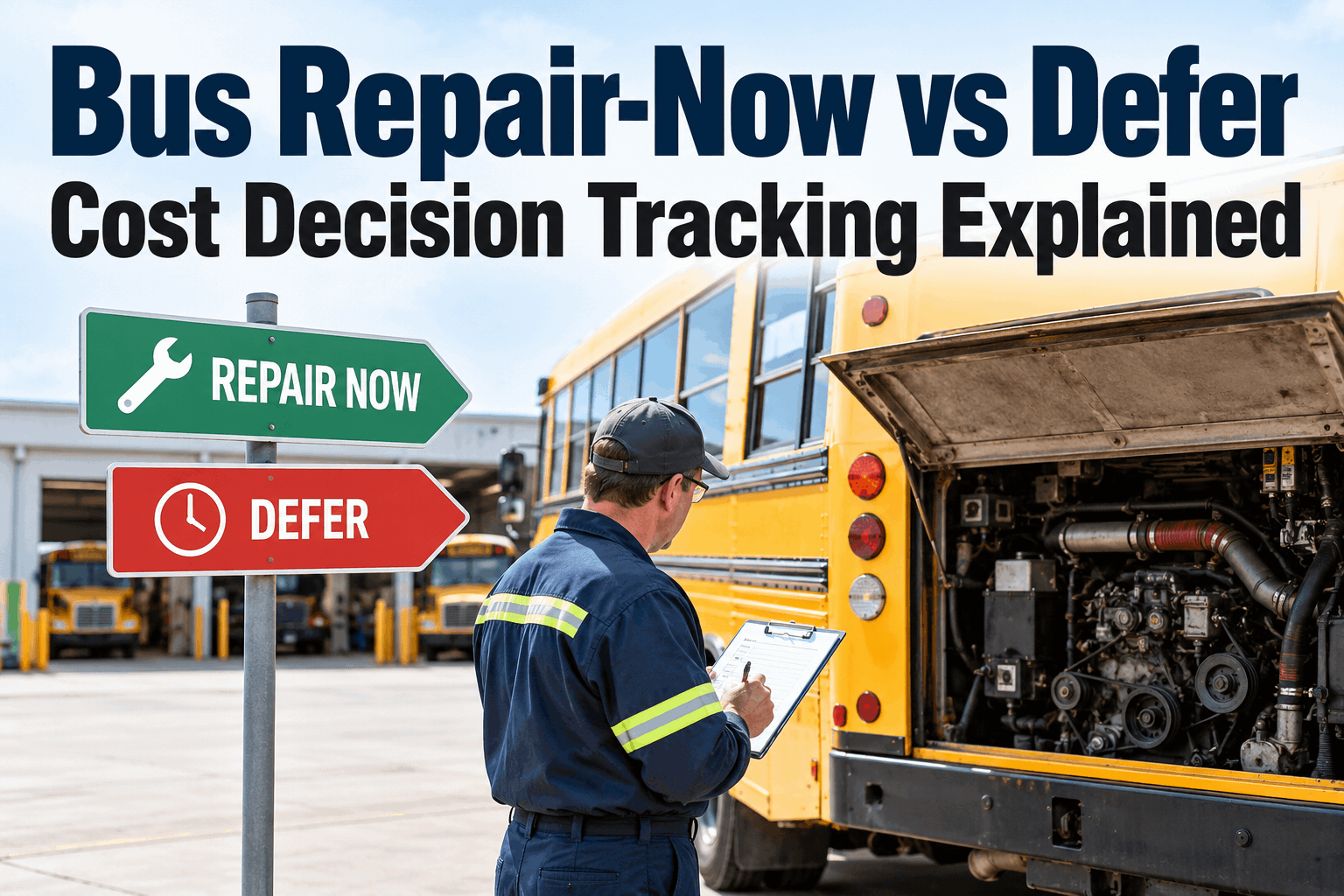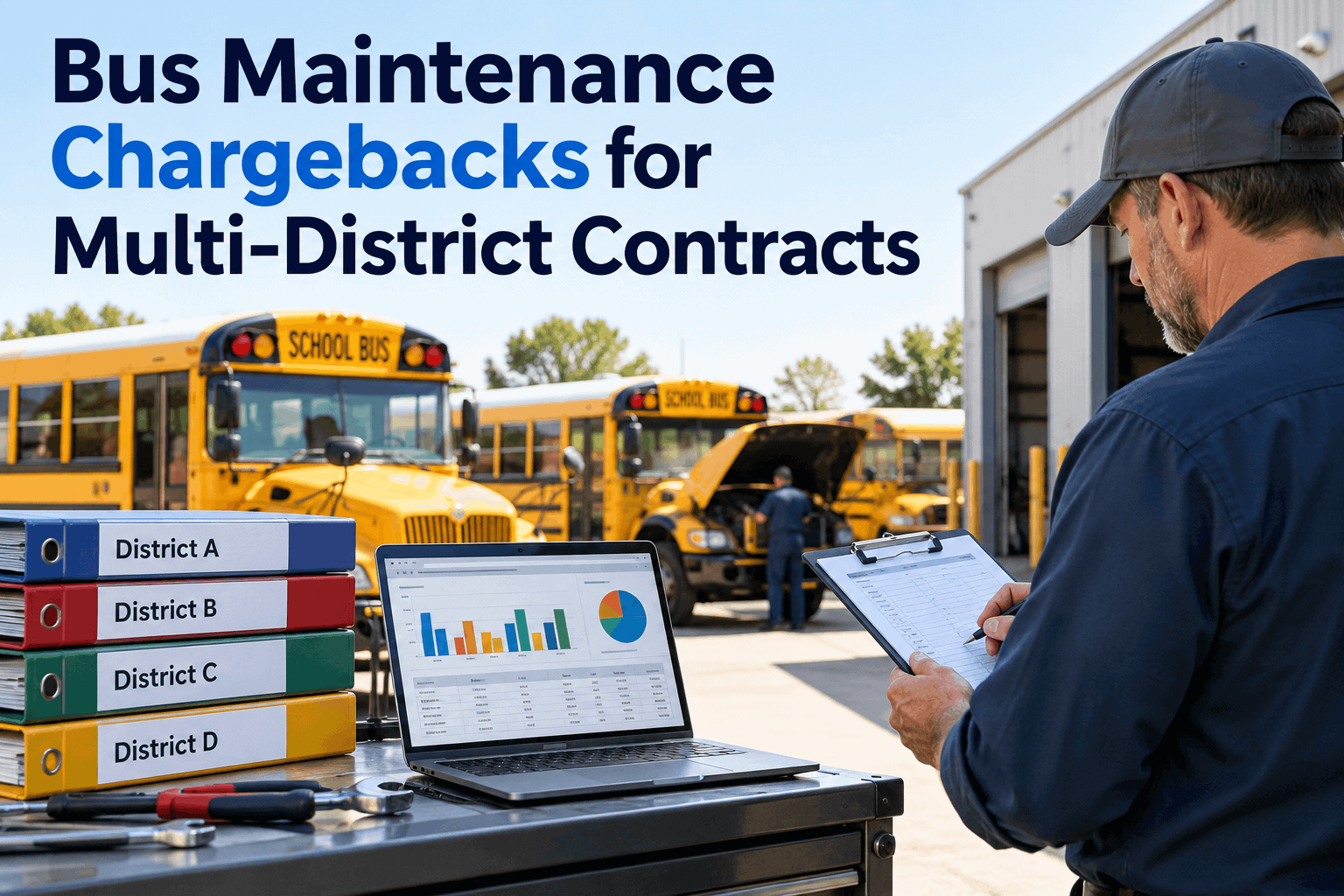
One shop, one crew — but your buses serve four districts, each on its own contract. Month-end, District A asks why their invoice jumped, and you're rebuilding it from work orders that never recorded whose bus it was. Bus maintenance chargebacks turn that scramble into clean per-district invoices. See cost allocation in a demo.
Bus Maintenance Chargebacks for Multi-District Contracts
When one shop maintains buses for several districts, every repair has to land on the right invoice. Here's how to allocate maintenance costs per district, bill them accurately, and back up every charge when a contract holder asks.
Why Multi-District Chargebacks Are Hard to Get Right
When one shop serves several contracts, the money gets tangled fast. A tech pulls a part off the shelf for a bus that runs District B in the morning and District C in the afternoon. Shared overhead — the lift, the diagnostic tools, the shop supervisor's time — serves everyone. Without a system tying each cost to a bus and a district, month-end billing becomes a guess, and a guess is what gets a contract disputed.
Costs aren't tied to a district
A work order records what was fixed, not which contract it belongs to. At billing time, nobody can say for certain whose bus it was.
Shared overhead has no fair split
The lift, the tools, the supervisor serve every district. Allocate that overhead by gut and one contract overpays while another is subsidized.
Invoices can't be backed up
When a district questions a charge, you need the work order, parts, and labor behind it. A lump-sum invoice with no detail invites a dispute you'll lose.
The fix isn't a bigger spreadsheet — it's tagging every cost to a bus and a district as it happens, so the invoice assembles itself from real work orders instead of memory. See that tagging in action in a demo.
Direct vs Shared Costs: The Two Halves of a Chargeback
Every maintenance dollar is either direct — clearly tied to one district's bus — or shared, serving the whole operation. Getting the chargeback right means handling each the right way: direct costs go straight to the district, shared costs get allocated on a fair, consistent basis.
- Parts installed on a specific district's bus
- Labor hours logged to that bus's work order
- Fuel consumed on that district's routes
- PM performed on buses assigned to the contract
- Shop overhead — rent, utilities, equipment
- Supervisor and administrative time
- Shared diagnostic tools and shop supplies
- General parts inventory carrying cost
The shared half is where disputes start, so the allocation basis has to be defensible — and written into the contract. Common bases are buses per district, miles run, or direct-labor hours, all of which a fleet analytics and reporting dashboard can calculate from the data you already capture.
How to Allocate Shared Costs: Three Fair Methods
There's no single right way to split shared overhead — there's the way you and the districts agree to, applied consistently. Three bases cover almost every contract. Pick one, write it in, and use the same one every month so no district can claim they're carrying another's load.
By bus count
Split shared cost by each district's share of the buses you maintain. Simplest to explain and audit — if a district runs a third of the fleet, it carries a third of the overhead.
Best when: fleets are similar in age and use.By miles run
Allocate by each district's share of total miles. Fairer when one district's routes are far longer — more miles means more wear, so more of the shared cost.
Best when: route lengths differ a lot.By direct-labor hours
Split by the labor hours each district's buses actually consumed. Ties overhead to real shop demand — a district with older, higher-maintenance buses carries more.
Best when: maintenance load varies by district.Whichever you choose, the key is consistency and a clear audit trail, so you can set up your allocation basis and start tracking it free rather than re-deciding it under pressure each month.
What a Defensible District Chargeback Looks Like
A chargeback a district will pay without a fight is itemized, not a lump sum. It separates direct costs from allocated shared costs, and every line traces back to a work order. Here's a month for one district, assembled from tracked data.
- Direct repairs (District A buses)$4,820
- PM labor (District A buses)$2,100
- Fuel (District A routes)$3,240
- Allocated shared overhead by bus count$1,150
- Total chargeback$11,310
Each line links to its work orders, parts, and labor — so when District A asks, the answer is one click, not a week of digging.
That's the difference between a charge a district accepts and one they contest. You can see an itemized chargeback built from live data in a demo to understand how the detail rolls up.
Setting Up Chargeback Tracking: Four Steps
Accurate chargebacks aren't an accounting project you do at month-end — they're a tagging habit you build into the shop. Get these four in place and the invoice assembles itself.
Assign every bus to a district or contract
The foundation: each unit is tied to the contract it serves, so any cost on that bus has a home. Buses that float between districts get a split rule.
Capture cost on every work order
Labor hours and parts logged as the job closes, priced automatically — so the direct cost per bus is real, not estimated at billing time.
Set your shared-cost allocation basis
Pick bus count, miles, or labor hours, agree it with the districts, and write it into the contract. Same basis every month, no exceptions.
Generate the per-district report monthly
Roll the tagged costs into an itemized chargeback per district, with every line traceable to its work order for when a question comes.
Built this way, chargebacks stop being the worst week of your month. You can walk through the per-district rollup in a demo and see how the tagging drives the invoice.
Your Multi-District Chargeback Checklist
These are the habits that keep contract billing accurate, fair, and audit-ready across every district you serve. Run them against your own operation.
- Every bus mapped to its contractNo unit without a district home — floaters get a documented split rule, not a guess.FOUNDATION
- Labor and parts cost captured per work orderReal cost at the job, priced as it closes — the direct line of every chargeback.PER JOB
- Shared-cost basis agreed and written inBus count, miles, or labor hours — in the contract, so the split is never re-argued.CRITICAL
- Fuel tracked per bus and routeSo fuel lands on the district whose routes burned it, not spread evenly by default.PER FILL
- Each invoice line traces to its work orderOne click from a charge to the job behind it — the difference between defending and digging.PER INVOICE
- Chargebacks run on the same cycle monthlyPredictable timing and format, so districts know what to expect and budgets stay clean.MONTHLY
A Contract Operator's Take on District Chargebacks
Key Takeaways on Bus Maintenance Chargebacks
Bus maintenance chargebacks turn one shared shop's costs into accurate, defensible per-district invoices — and the whole thing rests on tagging cost to a bus and a contract as it happens. Four things to carry into your own billing.
Tag cost to a bus and district
If a cost isn't tied to a contract when it happens, it can't be billed accurately later.
Direct is easy, shared is the fight
Direct costs bill straight; shared overhead needs a fair, written allocation basis.
Pick one basis and stay consistent
Bus count, miles, or labor hours — agreed, in the contract, same every month.
Itemize and trace every line
A charge that links to its work order is paid; a lump sum is disputed.
Treat bus maintenance chargebacks as a tagging discipline, not a month-end reconstruction — assign every bus to a contract, capture cost at the work order, allocate shared costs on an agreed basis, and itemize every invoice — and billing across districts stops being a source of disputes. The cleanest contract is the one where every district can see exactly what it paid for. Book a demo and bring your district contracts.