The air dryer on Bus 52 is weeping. Not failed — weeping. Part's on back-order, four buses already down, so you defer it. A dozen times a week you make that call: smart move, or slow-motion road call? Bus repair-now vs defer cost decision tracking is how you decide on data, not gut. See deferral tracking in a demo.
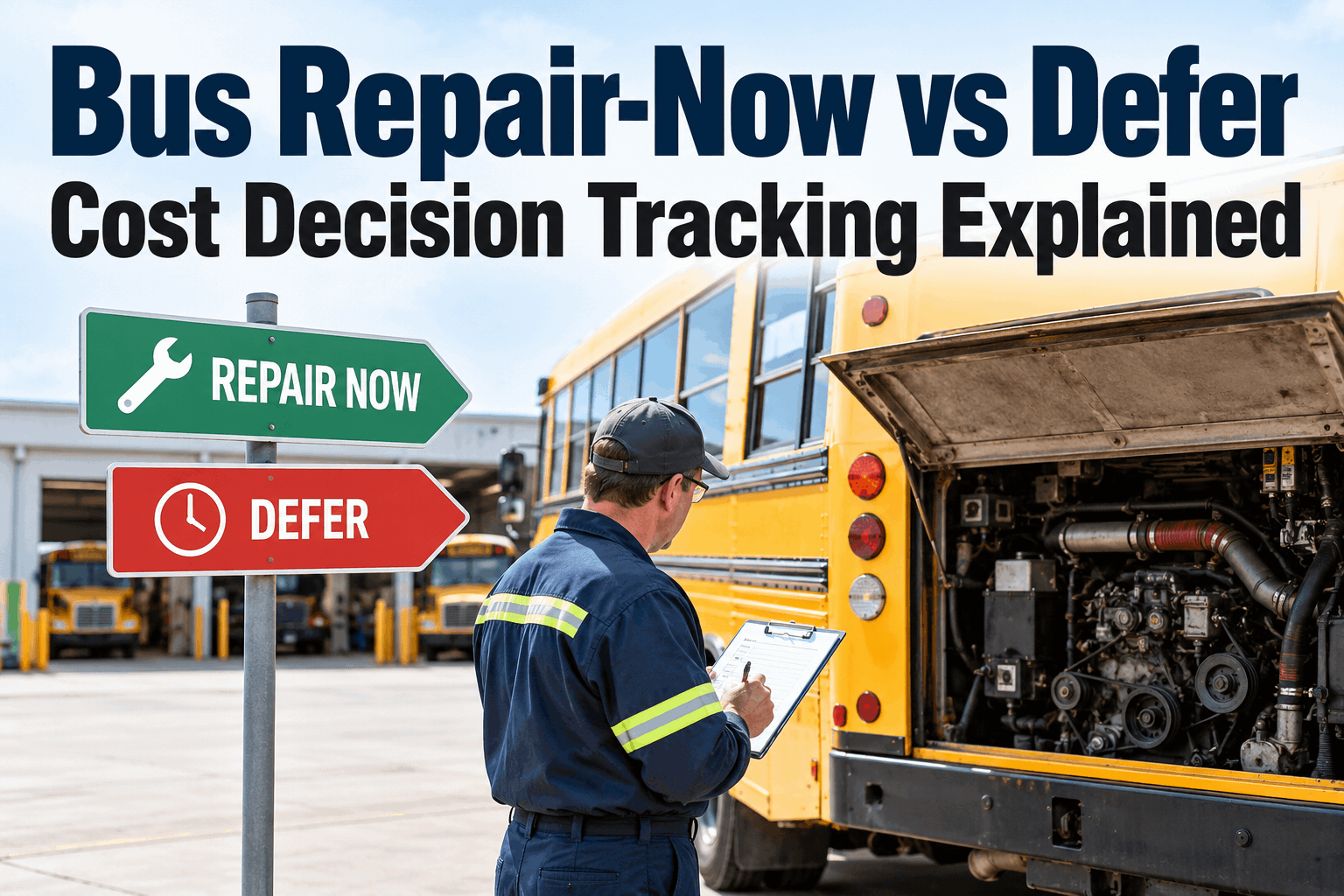
Bus Repair-Now vs Defer Cost Decision Tracking Explained
Some repairs can wait; some can't; and the ones you get wrong turn into breakdowns. Here's a framework to decide repair now vs defer by risk and cost — and how to track every deferral so the backlog never buries you.
When Deferring a Bus Repair Is Smart — and When It Isn't
Deferral gets a bad name, but it's a real tool. You have finite techs, finite parts, and finite budget, and not every issue earns a bay today. The skill is telling the repairs that genuinely wait from the ones that only look like they can. Two columns, one hard line.
- Cosmetic or comfort items with no safety or compliance tie
- Minor wear that isn't progressing and can ride to the next PM
- Non-critical parts on back-order, with a workaround in place
- Low-use spare buses where downtime doesn't strand a route
- Any safety defect — brakes, steering, stop arm, lift, warning lights
- Anything that fails a DVIR or state inspection — the bus is out
- A fault that's actively escalating or risks secondary damage
- A high-use bus where a road failure strands students mid-route
The one rule that never bends: a safety or compliance defect is never a deferral candidate, no matter the cost or the parts situation. Everything else is a judgment call — which is exactly what you track. See how those calls get logged in a demo.
The Hidden Cost: Why Deferred Repairs Don't Stay Cheap
Here's the trap. A deferred repair looks free — you didn't spend anything today. But many faults don't hold still; they escalate. The weeping air dryer becomes a failed one, which strands a bus, which becomes a road call. What was a $150 part quietly climbs toward a four-figure incident while it sits on the backlog.
The point isn't never defer — it's defer with eyes open. A repair that's safe to wait this week may not be in a month, so the deferral needs a review date and a watch, not a shrug. That's the difference between a tracked maintenance backlog and a pile of forgotten problems.
A Repair-vs-Defer Decision Framework You Can Actually Use
Good deferral decisions aren't a vibe — they're a quick score on a few factors, every time. Weight safety heaviest, because it's the one that overrides everything, then rate the rest. The score tells you which quadrant of the matrix the repair lands in.
Safety & compliance
Does it touch brakes, steering, a stop arm, a lift, or a DVIR item? If yes, the decision is already made — repair now.
Bus criticality
Is this a daily high-use route bus or a rarely-used spare? Downtime on a critical unit costs far more than on a backup.
Failure likelihood
Is the fault stable or actively getting worse? A progressing issue escalates; a stable one can genuinely wait.
Downtime impact
If it fails unplanned, how many routes does it strand and how hard is it to cover? High impact pulls toward repair now.
Cost of delay
Will waiting cause secondary damage — one worn part taking out another? If deferring makes the bill grow, it isn't saving money.
Score it once and the repair sorts itself: a high safety-and-criticality score is repair-now, a low all-round score is safe to defer and track. You can set up priority scoring for your own fleet free and stop making the call from memory. You can also walk the scoring through on your own fleet in a demo.
Tracking the Backlog: How Deferred Repairs Age Out
A deferral isn't a decision you make once and forget — it's a clock you start. The same issue that was safe to wait at week one becomes a liability at week twelve. Aging bands keep every deferred item moving toward a resolution instead of rotting on a list nobody reads.
Normal flow
Freshly deferred, within the safe window. No action needed yet — it's on the list with a review date.
Cause review
Why is it still open? Re-check the fault hasn't progressed and confirm it still belongs in defer, not repair.
Manager decision
It goes to the fleet manager: schedule it, formally accept the risk, or escalate. No more quiet drifting.
Repair, accept, or retire
The hard stop. Anything this old is fixed, risk-accepted in writing, or the bus is retired — never just ignored.
An item deferred more than twice is a signal in itself — it either matters more than the score said, or it should've been done the first time. Tracking makes that pattern visible, and you can walk through the deferral backlog view in a demo.
Your Repair-vs-Defer Tracking Checklist
These are the habits that turn deferral from a risky shortcut into a controlled, defensible decision. Run them against your own shop.
- Safety items auto-excluded from deferralA DVIR or safety-flagged defect can't be marked defer — the system blocks it, not just policy.CRITICAL
- Every deferral scored and recordedWho deferred it, why, and the risk score — so the decision is defensible, not a verbal maybe.FOUNDATION
- A review date on every deferred itemNothing is deferred open-ended — each one comes back up for a look before it ages out.PER ITEM
- Deferral cost tracked when it escalatesWhen a deferred item becomes a breakdown, link the two so you learn which calls cost you.MONTHLY
- Backlog trended, not just listedMeasured in weeks of labor, aiming for a shrinking trend — a growing backlog is a warning.WEEKLY
- Twice-deferred items escalatedAn item pushed back more than twice gets a hard look — the repeated defer is telling you something.ONGOING
A Fleet Manager's Take on Deferral Decisions
Key Takeaways on Bus Repair-vs-Defer Decision Tracking
Bus repair-now vs defer cost decision tracking turns a dozen gut calls a week into scored, dated, defensible decisions — so you defer what truly can wait and never the things that can't. Four things to take back to the shop.
Deferral is a tool, not a failure
With finite techs and parts, deferring low-risk work is smart — if it's tracked.
Safety is never a defer candidate
Brakes, steering, lifts, DVIR items — the decision is already made.
Deferred repairs escalate
A $150 fault can become a four-figure road call — defer with a review date, not a shrug.
Score, date, and age the backlog
Every deferral gets a risk score, a review date, and a hard stop at 90 days.
Treat bus repair-now vs defer cost decision tracking as a scored, dated discipline — weight safety first, watch the escalation, and age out every deferral — and you turn an invisible gamble into a managed decision. The goal isn't to never defer; it's to never defer blind. Book a demo and bring a repair you're unsure about.