You sign off on another tire invoice that is higher than last quarter — but ask which buses burn through tires, or who rotated the drive axles on the 2019s, and the answers live in a mechanic's memory. Bus tire management software turns that guesswork into tire cost per mile, tracked per bus. You can see your tire cost per mile broken out in a demo.
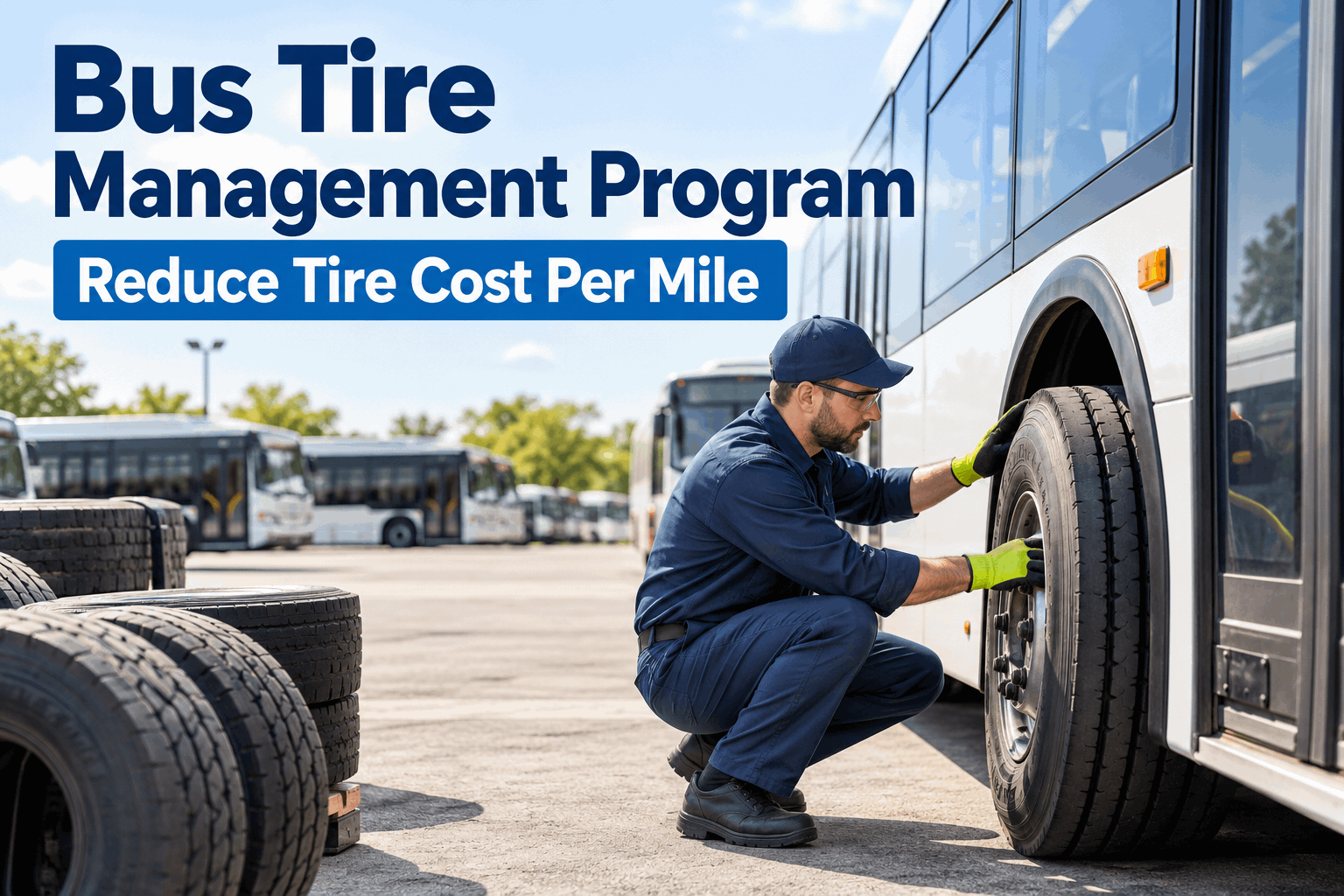
Bus Tire Management Program: Reduce Tire Cost Per Mile
Tire cost per mile is the one number that tells you whether your tire spend is working. Track acquisition, rotation, inspection, and retread against the miles each tire delivers, and the leaks show themselves. Here is how to run the program that lowers it.
Cost per mile is not about buying cheaper tires. It is about getting more miles out of the tires you buy — which is exactly what a program tracks.
Where Your Tire Budget Quietly Leaks
Most tire overspend is not one big waste — it is four small ones repeating across the fleet, none of them visible until you track them. Each one is a few hundred miles of tire life thrown away, bus after bus.
Missed rotations
Drive tires scrub and wear uneven when they are not rotated on schedule. The tire comes off thousands of miles early — pure lost life nobody logged.
Under-inflation running
A tire a few PSI low wears the shoulders and runs hot. Without a pressure check in the pre-trip, it quietly eats tread and risks a blowout on the route.
No retread strategy
A good casing scrapped instead of retreaded throws away the cheapest miles a fleet can buy. Without casing tracking, the retread window is missed every time.
Mismatched buying
Random brands and specs across the fleet mean no volume pricing, no apples-to-apples cost per mile, and no way to know which tire actually lasts on your routes.
None of these show up on an invoice — they show up as a cost per mile that creeps upward while everyone swears they are buying good tires.
The Tire Lifecycle a Management Program Tracks
A tire is not a one-time purchase — it is an asset with a life, and cost per mile is won or lost at each stage. A real tire management program follows every tire through that life instead of noticing it only when it fails. Here is the path.
The jump at retread is the whole point: a casing you tracked gets a second life cheaply; a casing you lost track of gets scrapped early.
Tires live in the same system as the rest of your stockroom, so a bus parts and inventory management system tracks each casing, its rotations, and its retread window — and you can start logging your tire lifecycle free to see where yours are scrapping early.
What Bus Tire Management Software Actually Tracks
"Tire management" sounds vague until you see what it captures. A real program logs the specific data that turns a vague tire budget into a cost per mile you can act on. Here is what lives in the system for every tire on every bus.
Position & identity per tire
Which bus, which axle position, brand, spec, and casing ID — so a tire is an asset you follow, not an anonymous black circle.
Miles delivered & cost per mile
Acquisition and service cost against the miles each tire runs — the number that ranks your tires and routes by what they really cost.
Rotation & inspection history
When each tire was last rotated, its tread depth and pressure readings — scheduled as PM so nothing drifts past its interval.
Retread & casing status
How many lives a casing has left and when its retread window opens — so good casings get a second life instead of the scrap pile.
Stock levels & reorder
On-hand tire inventory with low-stock alerts and auto-reorder — so a blown tire never means a bus down waiting on a part.
Spend by bus, route & brand
Tire spend rolled up by vehicle, route, and brand — so you see which buses eat tires and which brand actually earns its price.
Put together, that is the difference between a tire drawer and a tire program. You can see this tracked on your own buses in a demo.
Your Tire Cost-Per-Mile Checklist
A tire program is the sum of a handful of habits done consistently. Run this against your shop — the boxes you can't check are where your cost per mile is quietly climbing right now.
- Every tire has an ID and a positionTracked by bus, axle, brand, and casing — not an anonymous tire you only notice when it fails.
- Rotations run on a schedule, not a hunchRotation set as a PM interval so drive tires wear even and nothing comes off thousands of miles early.
- Pressure and tread are in the pre-tripTire PSI and depth captured on the daily DVIR, so an under-inflated or worn tire is caught before it scrubs or blows.
- Casings are tracked to their retread windowYou know which casings can take a retread and when — so the cheapest miles in the fleet aren't scrapped by accident.
- Tire stock auto-reorders before it runs outLow-stock alerts and reorder points so a replacement is on the shelf — no bus parked waiting on a tire.
- You can see cost per mile by bus and brandA dashboard that ranks tire spend so you standardize on what lasts and retire what doesn't — the whole point of the program.
Check these consistently and your tire cost per mile falls because nothing is thrown away unnoticed. If a few are open, that is exactly what a short demo can map against your fleet.
How BusCMMS Runs Your Bus Tire Management Program
Tire cost per mile only drops when inventory, maintenance, and analytics work together — the casing, the rotation schedule, and the cost report in one place. BusCMMS was built for buses, so your tire program runs as part of the system, not a spreadsheet beside it.
Tire inventory & casing tracking
Every tire tracked by position and casing ID with stock levels, low-stock alerts, and auto-reorder — so you manage tires as assets, not a drawer of rubber.
Rotation & inspection as scheduled PM
Rotations and tread checks run on intervals with due alerts, and tire items sit on the daily digital pre-trip — so wear is caught, not discovered.
Cost-per-mile analytics
Tire spend rolled into cost per mile by bus, route, and brand on one dashboard — so you standardize on what lasts and prove the savings to the board.
BusCMMS reports districts and agencies cutting maintenance costs 25-35% within 12 months and saving about $2,800 per bus a year — tires, as one of the largest line items, are a big part of that.
A Fleet Shop Foreman's Take
Key Takeaways on Bus Tire Management Software
A bus tire management program is really a cost-per-mile program — getting more miles out of the tires you already buy. Four things to carry out of this.
Cost per mile is the number
Not sticker price — miles delivered per dollar. Track it per tire and the leaks surface.
The leaks are small and repeated
Missed rotations, low pressure, scrapped casings, mismatched buys — invisible on an invoice.
A casing has a second life
Tracked to its retread window, a casing delivers the cheapest miles in the fleet instead of the scrap pile.
One system, not a spreadsheet
Inventory, rotation PM, and cost analytics together is what turns a tire drawer into a program.
Run a real bus tire management program — track every casing, schedule every rotation, watch cost per mile by bus — and your biggest line item after fuel starts working for you instead of leaking quietly. The tires are the same; what changes is how many miles you get from them.