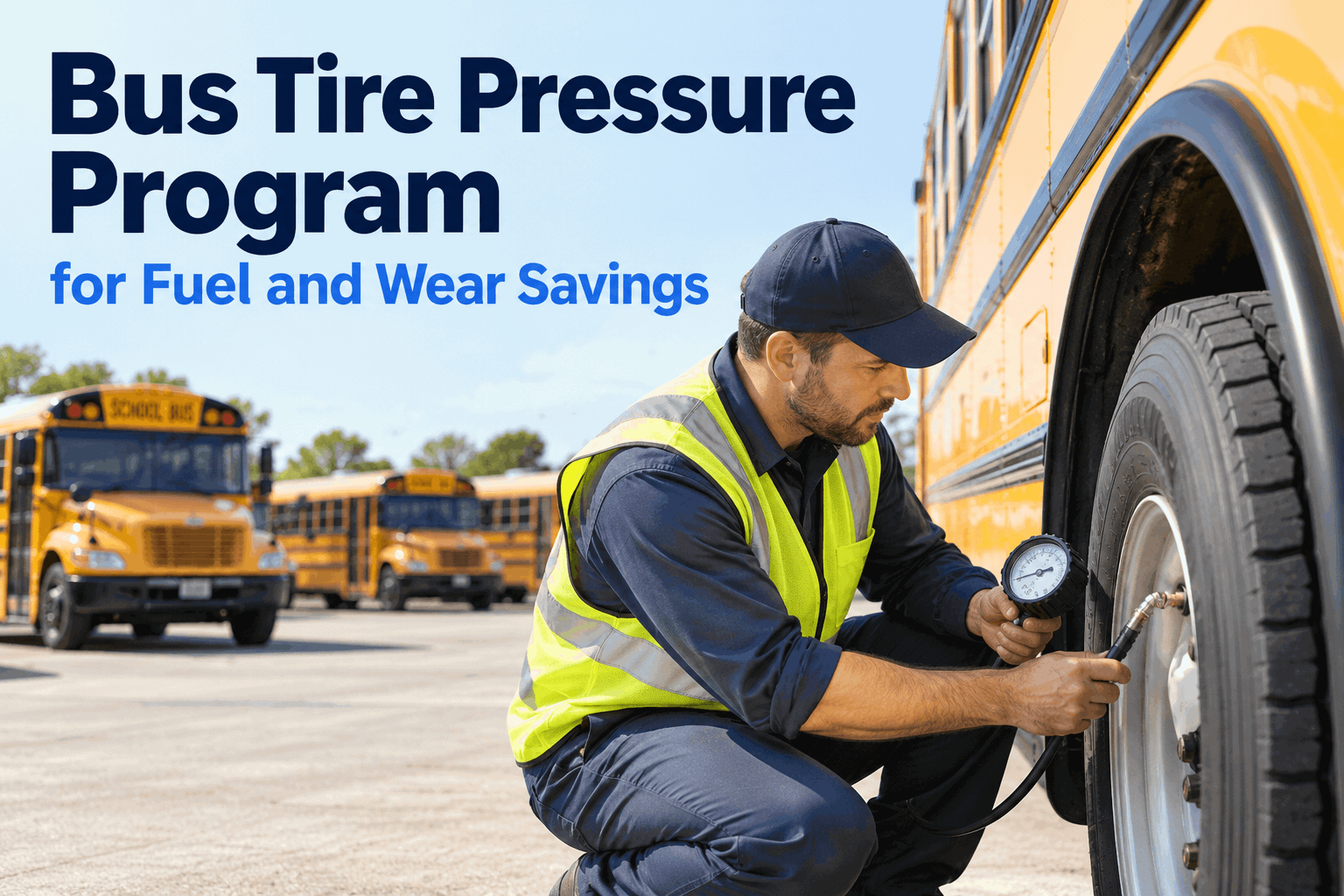
Here's a cost nobody puts on a work order: the air that isn't in your tires. An underinflated bus tire burns extra fuel and wears out early — and because it fails slowly, nobody flags it until the tread's gone. A bus tire pressure program turns that silent drain into a tracked line item. See tire checks in a demo.
Bus Tire Pressure Program for Fuel and Wear Savings
One underinflated tire costs you twice — at the pump and at the tire shop. Here's how a simple, tracked tire pressure program cuts fuel burn, extends tire life, and keeps every bus safe on the road.
Why Tire Pressure Quietly Costs You at the Pump
Roughly a third of a heavy vehicle's fuel goes just to overcome rolling resistance — the energy it takes to keep the tires turning. When a tire runs low, its sidewall flexes more, the contact patch spreads, and rolling resistance climbs, so the engine burns more fuel for the same work. By one common industry estimate, every 10 PSI of underinflation trims fuel economy by about 1%, and the FMCSA's cost-benefit analysis found improper inflation costs typical fleets around 0.6% in fuel economy across the board.
Rolling resistance is the one fuel cost you can cut with air, not capital — correct pressure is free horsepower you're currently leaving on the shoulder.
A fraction of a percent on every gallon, every bus, every day adds up to a real number on the annual fuel line — and it's one of the few fuel costs you can fix with a gauge instead of a new bus. You can see fuel and tire cost per bus tracked together in a demo.
The Second Hit: How Bad Pressure Wears Tires Out Early
Pressure doesn't just cost fuel — it decides how a tire wears. Run it low and the tread scrubs off at the shoulders; run it high and it wears a strip down the center. Either way you're throwing away tread you paid for, and replacing bus tires early is one of the biggest controllable line items in a fleet budget. The FMCSA analysis pegged the tire-cost penalty from improper inflation at 10 to 13% a year.
Uneven wear also means a tire gets pulled at half its tread life for a problem a five-minute check would have caught. Pressure and tire spend move together, which is why your parts and inventory tracking is where the wear savings show up — a link you can see on your own fleet in a demo.
What a Bus Tire Pressure Program Actually Involves
A program isn't a poster that says "check your tires." It's a defined cadence, a logged result, and an action when something's off — built into the maintenance routine you already run. Four pieces make it work.
Set the right target PSI
By axle and load, per the bus and tire spec — not a guess. Steer, drive, and tag tires often run different pressures.
Check on a fixed cadence
Pressure on the pre-trip DVIR and a deeper check on a PM interval, so no tire goes weeks unmeasured. Cold readings, consistently.
Log every reading
Record the number, not just a pass/fail. A tire that keeps needing air has a slow leak — the log is what reveals the pattern.
Act on what's off
A low reading becomes a work order, not a note that fades. Inflate, find the leak, or pull the tire — and close the loop.
The whole thing lives inside the inspection and PM flow you already have — which is why a bus-built maintenance system makes it nearly automatic: the check is on the DVIR, a bad reading spawns a work order, and the history builds itself. See the tire-check flow in a demo.
Tire Pressure Is Also a Safety Line You Can't Skip
The savings are the pitch, but safety is the reason it's non-negotiable on a bus. An underinflated tire runs hot, and heat is what causes blowouts — the kind that can strand a bus full of students or, worse, cause a loss of control. Tire condition is a DVIR item for exactly this reason: it's a federal pre-trip requirement, not an optional efficiency play.
Heat and blowouts
Low pressure means more flex, more heat, and a far higher blowout risk — especially on long, hot summer routes.
A documented DVIR check
Logged tire inspections are both the safety control and the audit trail — proof the check happened, every trip.
That's the quiet advantage of a tracked program: the same logged check that saves fuel and tread is also the one that keeps a hot tire off a route full of kids. You can set up tire-pressure DVIR items free and have the safety and savings covered at once.
Your Bus Tire Pressure Program Checklist
These are the habits that turn tire pressure from an afterthought into tracked fuel and wear savings. Run them against your own operation.
- Target PSI set by axle and busSteer, drive, and tag pressures documented per spec — the standard every check measures against.FOUNDATION
- Pressure on the pre-trip DVIRA quick cold check every trip, so no bus leaves the yard on a soft tire.SAFETY
- Deeper tire check on a PM intervalPressure, tread depth, and wear pattern logged on a schedule — catching slow problems early.PM CYCLE
- Actual readings logged, not pass/failThe number, every time — a tire that keeps dropping is a slow leak the log makes visible.EVERY CHECK
- Low readings become work ordersAn out-of-spec tire auto-creates a job — inflate, find the leak, or pull it, and close the loop.PER FLAG
- Fuel and tire cost tracked per busSo the program's payoff is visible — MPG holding and tires lasting is the proof it's working.MONTHLY
A Fleet Manager's Take on Tire Pressure
Key Takeaways on a Bus Tire Pressure Program
A bus tire pressure program is the rare fix that pays back three ways — fuel, tire life, and safety — for the cost of a gauge and a logged check. Four things to take back to the yard.
One low tire costs you twice
More fuel from rolling resistance, and faster wear from an uneven contact patch.
The numbers are real and federal
FMCSA pegs improper inflation at ~0.6% fuel and 10–13% higher annual tire cost.
A program is cadence + log + action
Target PSI, check on DVIR and PM, log the number, act on what's off.
Savings and safety, same check
The logged tire inspection cuts cost and keeps a hot tire off a student route.
Treat a bus tire pressure program as standard maintenance, not a special project — set the targets, put the check on the pre-trip and PM, log every reading, and act on the ones that drift — and you turn a silent drain into tracked savings. Air is the cheapest thing in your shop, and it's quietly worth the most. Book a demo and bring your fuel and tire numbers.