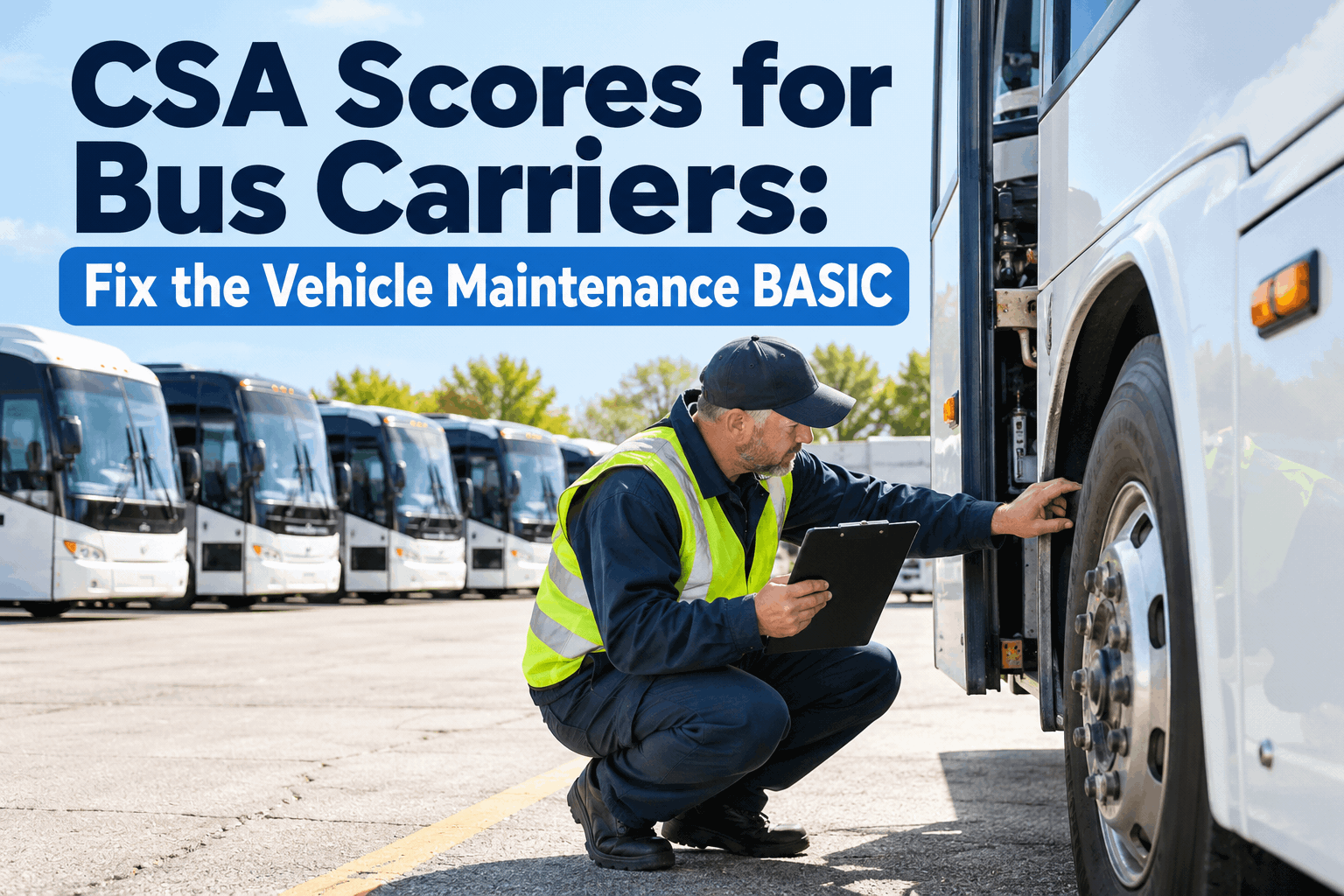
A roadside officer writes up a cracked brake lining and a marker lamp out, and six weeks later your Vehicle Maintenance BASIC percentile ticks up. For bus carriers, CSA scores are mostly a maintenance story — the Vehicle Maintenance BASIC is where your shop protects them or quietly erodes them. You can see how maintenance records defend your BASIC in a demo.
CSA Scores for Bus Carriers: Fix the Vehicle Maintenance BASIC
Of the seven CSA BASICs, the Vehicle Maintenance BASIC is the one your maintenance program directly controls — brakes, tires, lights, defects. This is how a roadside violation becomes a score, why recent ones hurt most, and how a tight inspection-and-repair system keeps the number down. Here is the maintenance side of CSA.
Six of the seven are about drivers, substances, and crashes. The Vehicle Maintenance BASIC is the one the shop owns outright — which is exactly where a CMMS earns its keep.
How a Roadside Violation Becomes a CSA Score
The Vehicle Maintenance BASIC isn't a single number — it is built from every maintenance violation written at a roadside inspection, weighted and compared to your peers. Understanding the math is understanding where to act.
A violation is logged at inspection
An out-of-service brake, a bald tire, a dead lamp — each equipment violation found at a roadside inspection enters FMCSA's Safety Measurement System against your DOT number.
It gets a severity weight
Each violation carries a severity weight from 1 to 10. A minor paperwork item scores low; an out-of-service brake defect scores near the top — so not all violations hurt equally.
Recent violations weigh more
Time weighting multiplies recent violations: roughly 3x in the last 6 months, 2x from 6 to 12 months, 1x from 12 to 24 — then they drop off at 24 months entirely.
You're ranked against peers
The weighted total becomes a percentile versus carriers your size. Higher is worse; cross the intervention threshold (80th percentile for Vehicle Maintenance) and FMCSA attention follows.
That time weighting is the lever: a clean recent stretch pulls your percentile down fast, because the heaviest-weighted window is the one you can still change. A tight digital inspection and defect system is how you keep that recent window clean, and you can start building that record free.
Why Recent Violations Hurt Most — and Clean Months Heal Fast
The 24-month window with heavier recent weighting cuts both ways. A bad month lingers, but a clean streak is the fastest medicine you have — because the violations counting triple today are the ones you prevent tomorrow.
The most recent six months is where the score is won or lost — which is the window a maintenance program can actually control starting today.
This is the good news for bus carriers: the Vehicle Maintenance BASIC rewards getting clean and staying clean, and a demo shows how to keep that recent window spotless.
The Maintenance Violations That Drive Your BASIC
Vehicle Maintenance BASIC violations are not random — a handful of systems account for most of them, and every one is catchable in a pre-trip or a PM. Here are the usual culprits and where you stop them.
Brake violations
The single biggest source of out-of-service maintenance violations. High severity weight, and almost always visible in a thorough inspection before the roadside catches it.
Tire & wheel defects
Tread depth, damage, and underinflation. A pressure-and-tread item on the daily pre-trip prevents the violation a roadside officer would otherwise write.
Lighting & lamps out
One of the most common and most preventable violations. A marker lamp or brake light is a thirty-second pre-trip check and a trivial fix — or a CSA hit.
Inspection & repair records
Missing DVIRs or annual-inspection documentation are violations in themselves — a records gap scores against you even when the bus is mechanically fine.
Nearly every Vehicle Maintenance BASIC violation is catchable before the roadside — in a pre-trip, a PM, or a records check. The score is really a measure of what your shop catches first.
Your Vehicle Maintenance BASIC Checklist
Protecting your CSA scores on the maintenance side comes down to catching violations first and proving you did. Run this against your operation — the boxes you can't check are where roadside violations are getting written that your shop should have caught.
- Pre-trips cover the high-violation itemsBrakes, tires, lights, and defects on every daily DVIR — the exact items that drive the Vehicle Maintenance BASIC, checked before the route.
- Every flagged defect gets fixed and loggedA defect ties to a work order and a completion — so a known issue is resolved before it is found at a roadside inspection.
- PM runs on schedule to prevent failuresPreventive maintenance that catches brake and system wear before it becomes an out-of-service violation at the worst possible moment.
- Inspection and repair records are completeDVIRs, annual inspections, and repair history on file — so a records-based violation never scores against an otherwise sound bus.
- You watch your recent-violation windowAttention on the last six months, where violations weigh triple — a clean recent stretch is what pulls the percentile down fastest.
- You can produce proof on demandTimestamped inspection and repair records retrievable in minutes — for a DataQs challenge, an investigation, or an audit.
Check these and the roadside stops finding what your shop missed. If a few are open, that is the gap a short demo closes against your own fleet.
How BusCMMS Defends Your Vehicle Maintenance BASIC
The Vehicle Maintenance BASIC rewards one thing: catching equipment problems before a roadside officer does, and proving the work. BusCMMS was built for buses, so it attacks the violations and keeps the records in one system.
Bus-specific pre-trips that catch violations
Brakes, tires, lights, and defects on the daily digital DVIR, so the items that drive the Vehicle Maintenance BASIC are caught in your bay, not at the roadside.
Defect-to-repair, closed and logged
A flagged item auto-creates a work order and a completion, so a known defect is fixed before inspection — and the fix is documented for a DataQs challenge or audit.
Audit-ready FMCSA records
Inspection, PM, and repair history timestamped and searchable, aligned to FMCSA requirements — so you can prove compliance and contest a wrong violation.
A clean Vehicle Maintenance BASIC is a byproduct of a well-run shop — BusCMMS reports fleets reaching 95%+ availability as defects get caught and fixed first, the same discipline that keeps roadside violations off your record.
A Safety & Compliance Manager's Take
Key Takeaways on CSA Scores for Bus Carriers
For bus carriers, the maintenance side of CSA scores is the side you control most directly — and the Vehicle Maintenance BASIC is where a good shop shows up in the data. Four things to carry out of this.
- 01The Vehicle Maintenance BASIC is yours to control. Of the seven BASICs, it is the one your inspections and repairs move directly.
- 02Recent violations weigh triple. The last six months count most, so a clean recent stretch pulls your percentile down fastest.
- 03Most violations are catchable first. Brakes, tires, lights, and records gaps are all preventable in a pre-trip or PM before the roadside.
- 04Records win challenges. Timestamped inspection and repair history defends your score and backs a DataQs challenge on a wrong violation.
Treat CSA scores for bus carriers as a maintenance discipline, not a paperwork scramble — catch the violations in the bay, close the repair loop, keep the records — and the Vehicle Maintenance BASIC takes care of itself. The roadside only writes up what your shop lets leave the yard.