A camera procurement spec that only lists resolution and price leaves the six clauses that actually protect a district exposed — field of view, retention, evidence export format, API access, device health reporting, and data ownership rarely show up unless someone writes them in deliberately. Get those six wrong or leave them out, and you own hardware you can't fully use, can't easily replace, or can't get your own footage out of later. See Bus CMMS in action .
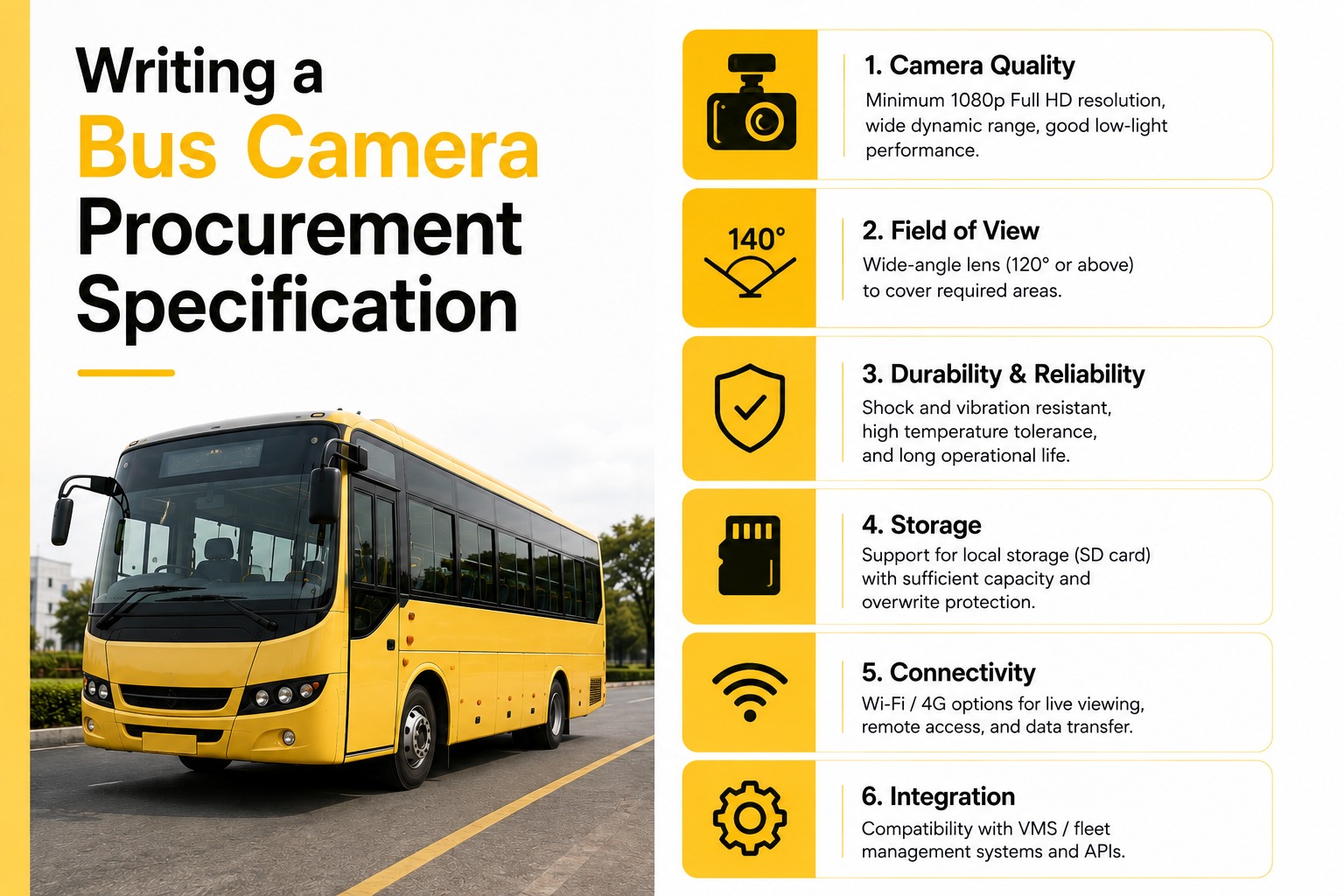
Writing a Bus Camera Procurement Specification
The clauses that actually matter before a vendor signature, the vendor-lock language worth striking, and the field where "we'll figure it out later" costs the most.
Field of View
Named zones the camera must cover — loading door, stop arm, aisle — with a verification method, not just a resolution number.
Retention
Minimum days for continuous and event-clip footage, tied to your state's records schedule, not the vendor's storage default.
Evidence Export Format
A specified, non-proprietary format that plays in standard software, not a viewer only the vendor's app can open.
API Access
Documented, ongoing access to your own fleet's event data — this is the clause most often missing entirely.
Device Health Reporting
Automated status on every unit's recording state — not a manual check the district has to initiate.
Data Ownership
Explicit statement that footage and metadata belong to the district, not the vendor, in perpetuity and after contract end.
Field of View: Write the Zone, Not Just the Camera Count
"Six cameras installed" and "six cameras covering the right zones" are two very different outcomes.
No single federal mandate governs bus camera procurement specifications; the compliance bar here is 49 CFR 396 maintenance record requirements and district policy, which means the specification document itself is the primary tool a district has for defining what "acceptable coverage" actually means. A specification that simply requires "a side camera" without naming the loading door threshold as a required coverage zone gives a vendor room to install something technically compliant that still misses the highest-incident area on the bus. Every required camera position should be named with its specific coverage responsibility spelled out, and the spec should require a documented verification step — actual recorded footage checked against the named zone — before final acceptance, not just an installer's sign-off.
Retention, Export Format, and Why Both Belong in the Contract
A vendor's default retention window and proprietary export format are business decisions, not technical limitations.
A retention clause should specify a minimum number of days for both continuous and event-clip footage in writing, tied explicitly to your state's public-records schedule rather than left to whatever the vendor's storage tier happens to default to. Separately, the evidence export format clause should require footage in a standard, widely playable format rather than a proprietary container that only opens in the vendor's own viewer software — a district that needs to hand footage to law enforcement or an insurer shouldn't discover mid-incident that the file requires a specific app nobody outside the vendor has installed.
API Access and Data Ownership: The Clauses Most Often Left Out
Missing these two clauses is how a district ends up locked into a single vendor indefinitely.
An API access clause guarantees the district documented, ongoing programmatic access to its own fleet's event data — without it, a district's footage and event history live entirely inside one vendor's portal, unreachable by any other system the district might want to adopt later, including its own maintenance platform. A data ownership clause states explicitly, in writing, that footage and metadata belong to the district, not the vendor, both during the contract term and after it ends — without this in writing, a district switching vendors at contract renewal can find itself with no legal claim to years of historical footage and event records generated on its own buses.
Exclusive hardware requirements that prevent connecting to any other platform
Data export fees charged at contract termination or on a per-request basis
Auto-renewal clauses with a narrow cancellation window
Proprietary file formats with no stated conversion or export path
Silence on API access, treated as implicitly denied rather than granted
Device Health Reporting: The Clause That Prevents the Silent Failure
Without this clause, a fleet can go months without knowing which cameras are actually recording.
Here's the objection worth naming directly: cameras installed but never health-monitored are a common, well-documented failure across bus fleets, and it's common to find a meaningful share of a fleet's cameras silently non-functional at any given time without this specifically required in writing. A specification should require automated, ongoing reporting on every unit's recording status — not a manual spot-check the district has to initiate, and not a passive assumption that a recording camera at install time stays a recording camera indefinitely. This clause is what turns tamper and obstruction detection from an optional add-on feature into a contractually guaranteed part of the system.
A Scenario From a Real Bus Operation
A district that discovered its own footage wasn't actually its own.
A district running 50 buses signed a five-year camera contract that specified resolution, camera count, and price in detail, but said nothing about data ownership or API access. Midway through year three, evaluating a switch to a unified maintenance platform, the district discovered its existing camera vendor's contract implied all historical footage and event data remained the vendor's property, accessible only through that vendor's own portal, with no documented path to export three years of records into a new system. The district's next procurement cycle added explicit data ownership and API access clauses, and the resulting five-year contract with a new vendor made clear that all footage, metadata, and event history belonged to the district outright, exportable on request at no additional cost.
We found out the hard way that three years of our own bus footage wasn't really ours to move — the contract never said it was, and the vendor's default position was that it wasn't. Now data ownership and API access are the first two clauses I check in any camera contract, before resolution, before price, before anything else on the sheet.
Not sure your current camera contract actually gives you API access or data ownership? Worth checking before renewal. Talk to the team about a contract review →
Quick Spec Reference
Scannable on a phone during a vendor negotiation.
| Clause | What it must guarantee |
|---|---|
| Field of view | Named coverage zones with a documented verification step |
| Retention | Minimum days in writing, matched to state records law |
| Export format | Standard, non-proprietary, playable outside vendor software |
| API access | Documented, ongoing access to your own fleet's data |
| Health reporting | Automated per-unit status, not a manual spot-check |
| Data ownership | Explicit district ownership, during and after contract term |
Frequently Asked Questions
What clauses should a bus camera procurement specification include beyond resolution and price?
Six clauses matter most: field of view requirements naming specific coverage zones, a retention period tied to state records law, a non-proprietary evidence export format, documented API access to the district's own event data, automated device health reporting, and explicit data ownership language. Resolution and price alone leave a district exposed to gaps in coverage verification, vendor lock-in, and unclear footage ownership.
Why does a field of view clause need to name specific zones rather than just camera count?
A specification requiring only "a side camera" without naming the loading door threshold as a required coverage zone allows a vendor to install something technically compliant that still misses the highest-incident area on the bus. Naming specific zones with a documented verification step — actual footage checked against the required coverage — prevents this gap from going unnoticed until an incident review.
Why is API access often missing from bus camera contracts?
API access isn't a standard hardware feature vendors always volunteer, since it enables a district to move its data to another platform later. Without an explicit clause requiring documented, ongoing programmatic access to the district's own fleet data, a district's footage and event history can remain locked inside one vendor's portal, unreachable by any other system it might want to adopt.
What vendor-lock clauses should be struck before signing a camera contract?
Watch for exclusive hardware requirements preventing connection to other platforms, data export fees charged at contract termination, auto-renewal clauses with narrow cancellation windows, proprietary file formats with no stated conversion path, and contract silence on API access treated as implicit denial. Each of these can trap a district with a single vendor indefinitely.
Why does a data ownership clause matter if a district already has camera footage?
Without an explicit data ownership clause, a contract's default position may treat footage and metadata as vendor property rather than district property, both during and after the contract term. A district switching vendors at contract renewal without this clause can find itself with no clear legal claim to years of historical footage and event records generated on its own buses.