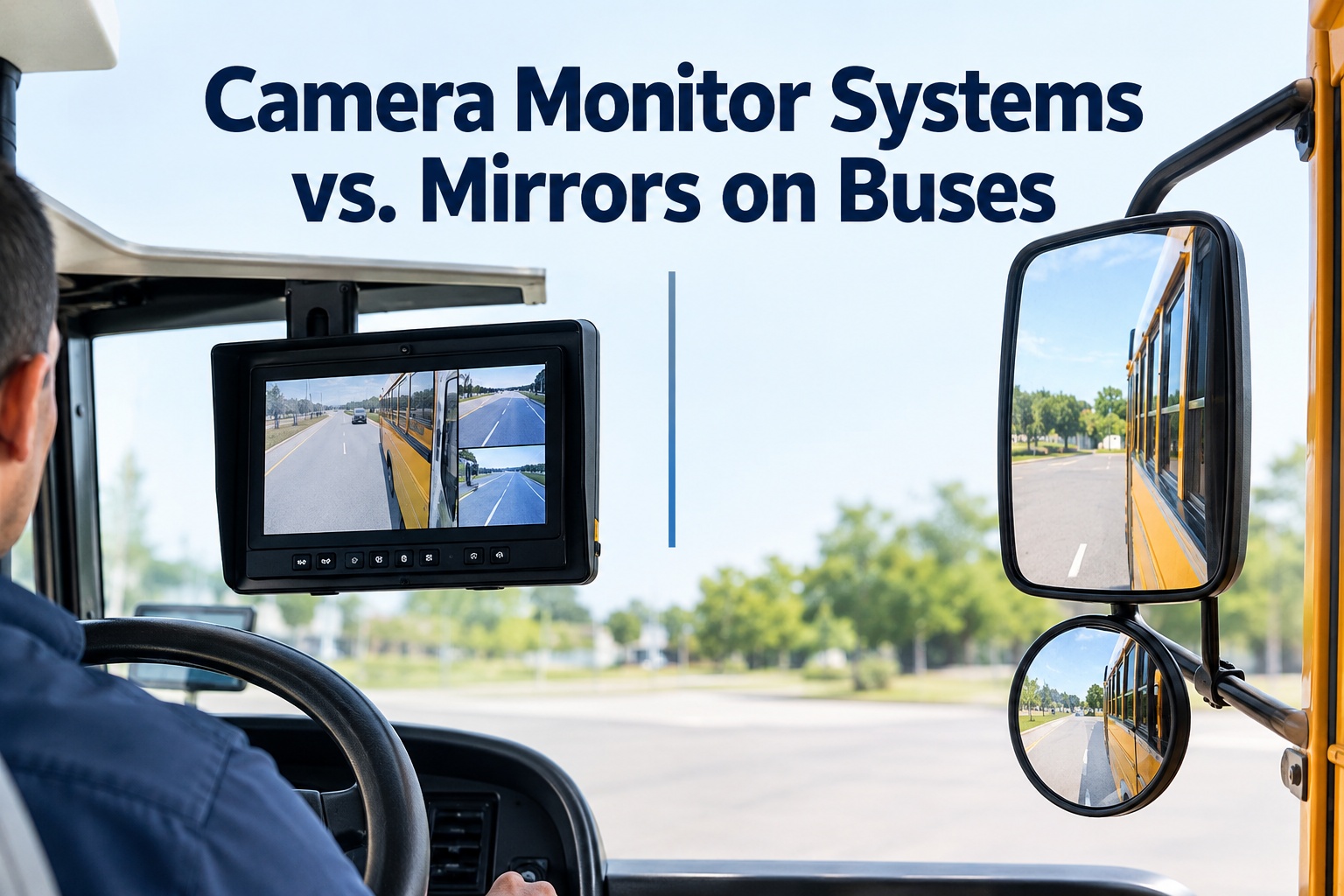
A procurement lead asks whether the new 40-foot order can spec a camera monitor system and drop the side mirrors to cut wind drag and blind zones. It is a fair question with a compliance answer most vendors skip: under current federal rules, a camera monitor system bus setup usually supplements mirrors rather than replacing them outright. This guide walks through what FMVSS No. 111 actually requires, where cameras fit, how transit and school buses differ, and what to put in a procurement spec so the decision survives an audit. Book a walkthrough to see camera equipment, inspections, and work orders on one record.
Updated September 2026 · Reviewed against FMVSS No. 111 (49 CFR 571.111) and 49 CFR Part 673
Camera Monitor Systems vs. Mirrors on Buses: The Compliance Picture
What FMVSS 111 requires, whether cameras can replace mirrors, how transit and school buses differ, and how to document the decision.
Not freely, on new buses. FMVSS No. 111 still requires compliant rearview mirrors on buses, and NHTSA has not finalized a rule letting a camera monitor system replace them across the board. Cameras are widely used to supplement mirrors, and replacement is possible only through specific federal exemptions or future rulemaking.
What FMVSS No. 111 Actually Requires on Buses
FMVSS No. 111, "Rear Visibility" (49 CFR 571.111), is the NHTSA standard governing what a driver must be able to see behind and beside the vehicle. It applies to passenger cars, multipurpose passenger vehicles, trucks, buses, school buses, motorcycles, and low-speed vehicles. Two separate things live inside it, and conflating them is where most capital requests go wrong: a mirror requirement and a rear-visibility (backup camera) requirement.
The backup-camera piece is the part with a hard mandate. A rear visibility system is required on vehicles with a gross vehicle weight rating at or under 10,000 lb (4,536 kg), effective for vehicles manufactured on or after May 1, 2018. That threshold captures some small Type A buses, but most Type C and D school buses and most full-size transit buses sit above 10,000 lb and are not swept in by that specific camera mandate. They remain governed by the mirror requirements instead. Book a demo to see which of your buses fall on each side of that line.
For buses over 4,536 kg other than school buses, the standard calls for outside mirrors of unit magnification with a minimum reflective surface on both sides, positioned to give a rearward view along each side and adjustable horizontally and vertically. School buses have their own mirror rules, requiring System A and System B outside rearview mirror systems. The takeaway: on a typical full-size bus, mirrors are the baseline the standard is built around, and a camera does not automatically erase that baseline.
Can a Camera Monitor System Replace Mirrors?
This is where vendor claims and federal reality diverge. NHTSA has been studying whether a camera monitor system can deliver the same level of safety as required mirrors, but as of this writing it has not issued a final rule that lets a CMS replace outside mirrors on new vehicles across the board. NHTSA has been clear that the standard does not prohibit adding cameras alongside compliant mirrors, so a supplement is straightforward. A wholesale replacement is a different legal question.
There are two realistic paths to running a bus without the conventional mirrors the standard would otherwise require. The first is a manufacturer obtaining a temporary exemption from NHTSA under its exemption procedures for a specific vehicle. The second sits with a different agency entirely: the Federal Motor Carrier Safety Administration, which regulates motor carrier operations, has granted exemptions allowing specific camera monitoring systems to be used in lieu of the two rear-vision mirrors its operating rules otherwise require. Those are product-specific and time-limited, not a general green light. Book a demo to keep exemption paperwork tied to the exact buses it covers. Or start free and organize it yourself.
Camera Monitor System vs. Conventional Mirrors
Set the compliance question aside for a moment and the two approaches solve the same problem in different ways, each with real trade-offs. This is the comparison a safety director weighs before a procurement decision, whether the camera is a supplement or a candidate replacement.
Camera Monitor System
- Closes wheel-height and A-pillar blind zones a flat mirror physically cannot show
- Wider field of view; less head movement for the driver
- Better in some low-light and glare conditions with the right sensor
- Can record for incident review and evidence
- Depends on power, cabling, and a display that can fail
- Lens fouling, calibration drift, and firmware add maintenance
- Replacement status under FMVSS 111 is unsettled
Conventional Mirrors
- The recognized baseline under FMVSS 111 for buses
- No power dependency; works when electronics do not
- Simple, cheap to replace, familiar to every driver
- No latency, no boot time, no display glare
- Fixed blind zones at wheel height and directly beside the bus
- Vibration knocks alignment; heated units fail unnoticed
- No recording; nothing to review after an event
The honest read is that neither is strictly better. A camera sees what a mirror cannot, but adds failure modes a mirror does not have. That is exactly why the most defensible setups on new buses today pair compliant mirrors with a camera that covers the mirror's dead zones, rather than betting compliance on a camera alone. Book a demo to see camera and mirror defects tracked on the same inspection.
Transit Bus vs. School Bus: Not the Same Rules
Applicability is where a lot of fleets get tripped up, because a transit bus and a school bus are treated differently under the mirror portions of the standard and sit in different regulatory worlds overall. A generic "buses need cameras now" claim ignores both the GVWR threshold and the bus type.
Over 4,536 kg and not a school bus: FMVSS 111 calls for compliant outside mirrors on both sides. Large transit agencies also sit under 49 CFR Part 673, where 673.25(d)(3) has them consider visibility-impairment mitigations, which can include cameras. Federal transit oversight is FTA, not FMCSA.
Governed by school-bus-specific mirror rules (System A and System B) plus crossover mirrors that show the danger zone in front of the bus. The rear-camera mandate only reaches school buses at or under 10,000 lb GVWR, which is a minority of the fleet.
Before any spec, answer three questions in order: what is the bus GVWR, is it a school bus or not, and which federal framework governs your operation. Get those wrong and you either over-buy against a mandate that does not apply or under-document a mitigation you were expected to consider. Book a demo to tag each bus by type, GVWR, and applicable framework.
Retrofit vs. New-Bus Spec, and What to Put in Writing
Whether a camera monitor system arrives as a retrofit on buses already in revenue service or as a line item on a new-bus order changes both the compliance posture and the paperwork. A retrofit on an existing bus does not remove the mirrors the vehicle was certified with; you are adding capability. A new-bus spec is where the replace-vs-supplement question gets real, and where an exemption, if any, has to be nailed down before the order is placed.
Procurement Spec Checklist
- 1Compliance basis. State whether the camera supplements compliant mirrors or relies on a specific exemption, and cite it by number.
- 2Performance targets. Field of view, resolution, latency, low-light behavior, and glare handling, stated as measurable numbers.
- 3Failure behavior. What the driver sees if the camera or display fails, and whether mirrors remain as the fallback.
- 4Monitor placement. Within the driver's existing sightline, not a search across the dash or a head turn.
- 5Maintenance access. Lens cleaning, calibration, firmware update path, and how a defect gets logged.
- 6Evidence handling. Recording, retention, and how footage ties back to the specific bus and event.
Write these down and the capital request answers its own hard questions before a board or an auditor asks them. Skip them and the fleet inherits an ambiguous compliance basis and a maintenance burden nobody scoped. Book a demo to turn this checklist into a repeatable spec per bus order.
Camera Failure, Inspection, and Maintenance
A mirror that cracks is obvious on a walk-around. A camera monitor system fails more quietly: a fouled lens, a drifted calibration, a dark display in a dim depot, a firmware version that silently changed behavior. None of that shows up on a generic pre-trip unless the inspection actually tests for it. This is the failure mode that turns a safety upgrade into a liability, and it is exactly what a bus-specific maintenance program is built to catch.
The point is not that cameras are unreliable. It is that a camera is a maintained asset with its own failure modes, and treating it like a permanent, self-checking fixture is how fleets end up with a screen full of nothing on the exact morning it mattered. Book a demo to see a camera defect auto-create a work order tied to the bus.
A Transit Agency Weighs Camera vs. Mirror
Here is an illustrative scenario with hypothetical numbers. A mid-size transit agency runs 45 forty-foot buses over 4,536 kg. Right-turn conflicts with cyclists keep surfacing on downtown routes, and a safety-committee review under 673.25 flags operator visibility as a contributing factor. The agency weighs replacing mirrors with a camera monitor system against keeping mirrors and adding a side camera. Book a demo to see this kind of decision tracked from review to result.
Compliance check
Buses are over 10,000 lb, so mirrors are the FMVSS 111 baseline and no blanket camera mandate applies. A full mirror replacement would hinge on an exemption the agency does not hold.
Decision
Keep compliant mirrors; add a side camera covering the right-turn blind zone on the 12 buses running the affected routes. Rationale recorded for the safety committee.
Install + inspect
Each retrofit closes with a work order and a post-install inspection verifying camera aim, display, and mirror condition together.
Monitor
Right-turn near-misses on those routes are tracked over the next two quarters, and the trend is attached to the mitigation record.
The Bottom Line on a Camera Monitor System Bus Decision
A camera monitor system bus setup earns its place by seeing what a mirror cannot, but on a full-size bus under current FMVSS No. 111 it generally supplements the required mirrors rather than replacing them. Replacement pathways exist only through specific NHTSA exemptions or the separate FMCSA operating exemptions, and those are product-specific and time-limited. The right move for most fleets today is to keep compliant mirrors, add cameras where they close a real blind zone, spec the system with measurable performance and clear failure behavior, and maintain it like the asset it is. Do that and the camera is an upgrade, not an audit risk. Book a walkthrough and see camera, mirror, and maintenance records in one place.
Can a camera monitor system replace mirrors on a bus?
Not freely on new buses. FMVSS No. 111 still requires compliant rearview mirrors on buses, and NHTSA has not finalized a rule permitting a camera monitor system to replace outside mirrors across the board. NHTSA does allow cameras alongside compliant mirrors, so supplementing is straightforward. A full replacement would depend on a specific NHTSA temporary exemption for the vehicle, or, on the operating side, an FMCSA exemption allowing a particular camera system in lieu of the required rear-vision mirrors. Both are product-specific and time-limited rather than a general allowance.
What does FMVSS No. 111 require for buses?
FMVSS No. 111, "Rear Visibility" (49 CFR 571.111), sets rear-visibility requirements. It mandates a rear visibility system (a backup camera) on vehicles at or under 10,000 lb GVWR manufactured on or after May 1, 2018. Above that weight, which covers most full-size transit and Type C and D school buses, the standard's mirror requirements apply: compliant outside mirrors on both sides for buses other than school buses, and System A and System B mirror systems for school buses. Mirrors are the baseline the standard is built around for large buses.
Are transit buses and school buses subject to the same requirements?
No. Under FMVSS 111, school buses have their own mirror rules (System A and System B, plus crossover mirrors for the front danger zone), while transit and other non-school buses over 4,536 kg follow the general outside-mirror requirements. They also sit in different regulatory worlds: large transit agencies fall under FTA's 49 CFR Part 673, where 673.25(d)(3) has them consider visibility-impairment mitigations, whereas school transportation and commercial operations answer to different oversight. Bus type and GVWR both change the answer.
What should we specify when procuring a camera monitor system?
Put the compliance basis in writing first: state whether the camera supplements compliant mirrors or relies on a named exemption. Then specify measurable performance (field of view, resolution, latency, low-light and glare behavior), failure behavior (what the driver sees if the camera or display fails, and whether mirrors remain the fallback), monitor placement within the driver's sightline, a maintenance path for lens cleaning, calibration, and firmware, and how recordings are retained and tied back to the specific bus. A spec that captures these answers its own audit questions.
How should bus camera systems be inspected and maintained?
Treat the camera as a maintained asset, not a permanent fixture. Add a lens-clarity check to preventive maintenance, re-verify aim and field of view after any body or mounting work, test monitor brightness in real depot lighting rather than the shop, and log firmware version per bus so a silent change gets flagged. The goal is to catch quiet failures a generic walk-around misses. When a defect is logged, it should create a work order tied to that bus, so the fix and the evidence live on the same record.