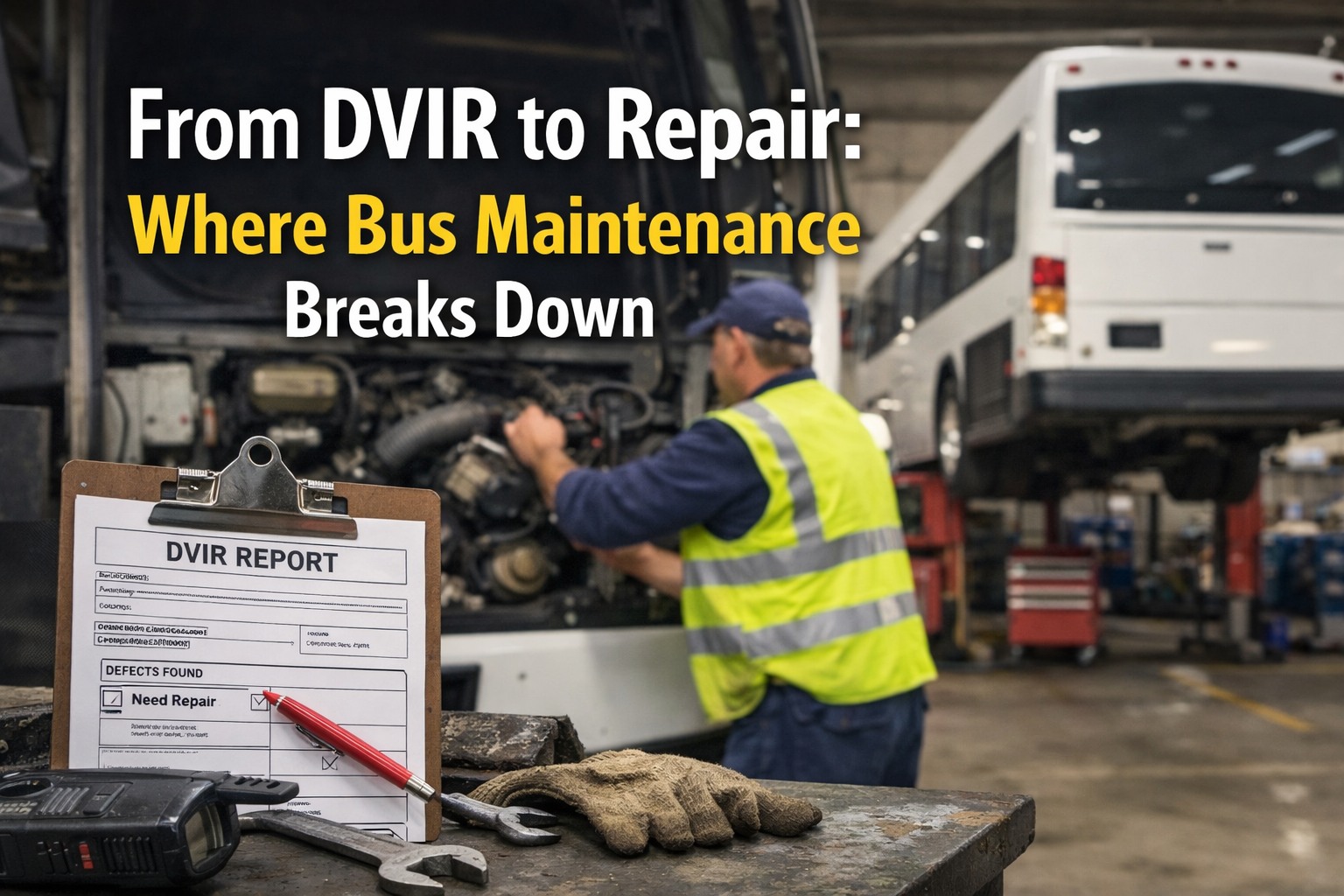
This isn't a failure of people. It's a failure of process. The journey from DVIR defect to completed repair contains multiple handoff points, each one an opportunity for delays, miscommunication, or complete breakdown. When defects reported in inspections don't convert into timely repairs, the entire purpose of the inspection system fails.
Understanding where this workflow breaks down—and how to close the gaps—is essential for any fleet that wants inspections to actually improve safety rather than just generate paperwork. The difference between fleets that struggle with chronic defect backlogs and those that resolve issues efficiently comes down to workflow design, not effort.
The DVIR-to-Repair Journey: Where It's Supposed to Work
Before examining where workflows fail, it helps to understand what should happen when a driver identifies a defect. Federal regulations under 49 CFR 396.11 and 396.13 establish a clear chain of responsibility designed to ensure reported defects get addressed before vehicles return to service.
The Intended DVIR Workflow
During pre-trip or post-trip inspection, driver discovers an issue affecting safety or operability
Driver records defect on DVIR with enough detail for maintenance to understand the issue
DVIR is submitted to maintenance department for review and action
Maintenance creates work order, assigns priority, schedules repair
Technician performs repair and documents work performed
Mechanic signs off that defect has been corrected or no repair was needed
Next driver reviews previous DVIR, confirms repairs completed, signs acknowledgment
This workflow is designed as a closed loop—each step triggers the next, with documentation throughout ensuring accountability. When it works correctly, defects identified at 6:00 AM can be repaired and verified before the afternoon routes. When it breaks down, defects languish for days or weeks while vehicles continue operating.
The Seven Points Where Workflows Break Down
The gap between inspection and repair doesn't happen in one place. It happens at multiple transition points where information, responsibility, or action fails to transfer correctly. Understanding these breakdown points is the first step toward fixing them.
Vague or Incomplete Defect Descriptions
"Brake problem" doesn't tell a mechanic what's wrong. "Steering feels weird" could mean a dozen things. When drivers lack training on how to describe defects precisely, maintenance teams can't prioritize properly or prepare for repairs.
Report Transmission Delays
Paper DVIRs sit in drivers' pouches until end of shift. They get dropped in a box at the yard. Someone collects them tomorrow. By the time maintenance sees the defect, 12-24 hours have passed—and the bus may have run additional routes.
No Prioritization System
When all defects look the same on paper, maintenance can't distinguish between a minor issue and an immediate safety hazard. A burned-out interior light gets the same treatment as brake fade, leading to misallocated resources and unaddressed critical issues.
Manual Work Order Creation
Someone has to manually transcribe defects from DVIRs into work orders. This creates delay, introduces errors, and depends on staff having time to process paperwork. During busy periods, this step gets deprioritized—and defects pile up unreported in the system.
Parts Availability Gaps
A work order gets created, but the part isn't in stock. Nobody communicated what was needed until the technician went to pull the part. Now there's a 3-5 day wait for delivery—and the vehicle sits while a $15 component ships across the country.
Incomplete Repair Documentation
The mechanic fixes the problem but doesn't document what was done. Nobody signs off. The defect shows as "open" in the system even though the repair is complete—or worse, shows as "closed" with no record of what actually happened.
Missing Driver Acknowledgment
Repairs are completed but the next driver never reviews or signs off. The loop never closes. If the repair failed or the issue returns, there's no documentation that the driver was aware the vehicle was supposedly fixed.
Close the gap between inspection and repair. BusCMMS automatically converts defects into work orders, tracks resolution through completion, and ensures every repair gets documented and acknowledged.
Start Free Trial See the WorkflowThe Real Cost of Workflow Gaps
When defects don't convert into timely repairs, the costs compound across multiple categories. Some are obvious—vehicle downtime, repair expenses. Others are hidden but equally damaging—compliance risk, safety exposure, and the operational chaos that comes from unpredictable breakdowns.
Direct Costs
Indirect Costs
A 2024 Siemens report found that unplanned downtime costs industrial operations 11% of their annual revenue. While fleet operations differ from manufacturing, the principle holds: breakdowns that should have been prevented consume disproportionate resources compared to scheduled maintenance.
"The main driver of maintenance expenses in recent years has not been an increase in preventive maintenance services but rather a spike in the costs associated with unexpected or catastrophic repairs."
— Chris Foster, Director of Fleet Management Services, Holman
Why Paper Systems Can't Close the Gap
Traditional paper-based DVIR processes were designed for a simpler era—when fleets were smaller, operations less time-sensitive, and real-time communication wasn't possible. Today, paper systems create bottlenecks at every handoff point in the defect-to-repair workflow.
Time Lag Is Built In
Paper forms must be physically collected, transported, and processed. Even with same-day handling, hours pass between defect identification and maintenance awareness. With overnight collection, critical issues may not surface until the next business day—after the vehicle has potentially run additional routes.
Information Quality Degrades
Illegible handwriting, incomplete entries, and missing context are endemic to paper forms. Someone must interpret what the driver meant, often without the ability to ask follow-up questions. Transcription into work order systems introduces additional errors.
No Visibility Into Status
Paper creates black holes. A defect goes into the pile but nobody knows if it's been addressed until someone physically checks. Drivers don't know if their reported issues are being worked on. Supervisors can't see what's pending. The only way to track status is to ask—and that requires someone to have time to answer.
No Automatic Escalation
Paper can't send alerts when defects age. Critical issues sit alongside minor ones with no mechanism to surface problems that need immediate attention. By the time someone notices a backlog, the damage is done—vehicles have operated with unaddressed safety defects.
Audit Trail Gaps
Paper gets lost. Coffee gets spilled. Forms filed incorrectly are essentially gone. When auditors ask for documentation of a specific repair from six months ago, finding it requires searching through boxes of paper—assuming it wasn't discarded or misfiled.
Closing the Gap: What High-Performing Fleets Do Differently
Fleets with efficient defect-to-repair workflows share common characteristics. They treat the process as a connected system rather than discrete steps, use technology to eliminate manual handoffs, and measure performance to identify bottlenecks. Here's what separates efficient operations from those struggling with chronic backlogs:
Real-Time Defect Transmission
Digital inspection systems submit defects instantly. Maintenance sees issues within seconds of driver submission, not hours or days later. Critical defects trigger immediate alerts to the right people, enabling same-day response for serious issues.
Automatic Work Order Generation
When a defect is reported, a work order is created automatically—no manual transcription required. The defect description, photos, vehicle information, and priority level flow directly into the maintenance system, eliminating the gap between identification and tracking.
Built-In Priority Classification
Defects are categorized by severity at the point of reporting. Critical safety issues (brakes, steering, tires) are flagged differently than minor concerns (interior trim, non-essential lights). Maintenance teams see what needs immediate attention versus what can be scheduled.
Visual Documentation
Photos attached to defect reports eliminate ambiguity. Mechanics can see exactly what the driver observed, assess severity before the vehicle arrives, and order correct parts based on visual evidence. This reduces diagnosis time and prevents wrong-part delays.
Automated Escalation
Defects that age beyond defined thresholds automatically escalate—first to supervisors, then to management. Nothing sits unaddressed because it fell off someone's radar. The system ensures visibility into aging issues before they become problems.
Closed-Loop Verification
The workflow doesn't end when repairs complete. Mechanics must document what was done and sign off. The next driver must acknowledge the repair before operating the vehicle. Every step is tracked, creating complete accountability from identification through resolution.
Building an Effective Defect-to-Repair Workflow
Transforming your DVIR process from paperwork exercise to effective safety system requires addressing each potential breakdown point. Here's a step-by-step approach to building a workflow that actually converts defects into repairs:
Map Your Current Process
Before changing anything, document exactly how defects currently flow from driver to repair. Where are the handoffs? How long does each step take? Where do things get stuck? This baseline reveals your specific bottlenecks—they may differ from typical patterns.
Establish Severity Classifications
Create clear categories for defect priority. Define which issues require immediate vehicle removal from service, which need same-day attention, and which can be scheduled for upcoming maintenance. Train drivers to apply these classifications when reporting.
Digitize the Inspection-to-Work-Order Connection
Implement digital inspection tools that automatically generate work orders when defects are reported. This eliminates the transcription step entirely—defects flow directly into your maintenance management system with all relevant information attached.
Configure Notification Workflows
Set up automatic alerts based on defect type and priority. Critical defects should immediately notify maintenance supervisors. Defects aging beyond target resolution times should escalate automatically. The right people should know about issues without having to check.
Connect to Parts Inventory
Link defect types to likely parts requirements so you can check availability before scheduling repairs. When common defects are reported, the system should indicate whether needed parts are in stock or need to be ordered—before the vehicle arrives at the shop.
Require Complete Documentation
Build documentation requirements into the workflow. Mechanics can't close a work order without describing what was done. The next driver must review and acknowledge repairs before starting their route. Make incomplete closures impossible, not just discouraged.
Measure and Improve
Track key metrics: time from defect to work order, time from work order to repair start, time from completion to acknowledgment, defect aging, and repeat defects. Use this data to identify persistent bottlenecks and measure improvement over time.
Build the defect-to-repair workflow your fleet needs. BusCMMS provides automatic work order creation, real-time alerts, parts integration, and complete documentation—closing every gap in your maintenance process.
Get Started Free View Live FlowKey Metrics for Defect-to-Repair Performance
You can't improve what you don't measure. Tracking the right metrics reveals where your workflow performs well and where gaps persist. Here are the measurements that matter most:
Mean Time to Repair (MTTR)
Average time from defect report to repair completion. Lower is better—industry leaders achieve MTTR under 24 hours for most defects. High MTTR indicates bottlenecks in the workflow that need investigation.
Work Order Conversion Rate
Percentage of reported defects that become tracked work orders. If defects are reported but not entering your maintenance system, the gap between inspection and repair starts at the very first handoff.
Defect Age Distribution
How many open defects are <24 hours old, 1-3 days old, 3-7 days old, 7+ days old? A healthy distribution shows most defects resolved quickly with few aging. A backlog of aging defects signals workflow problems.
First-Time Fix Rate
Percentage of repairs that resolve the defect without requiring additional work. Low first-time fix rates suggest poor defect descriptions, wrong parts, or inadequate diagnosis before repair attempts.
Acknowledgment Compliance
Percentage of completed repairs that receive driver acknowledgment before vehicle returns to service. Incomplete loops create compliance risk and miss the opportunity to verify repair effectiveness.
Scheduled vs. Unscheduled Ratio
Ratio of planned maintenance to emergency repairs. A high percentage of unscheduled work indicates defects aren't being caught and addressed proactively—the inspection system isn't preventing breakdowns.
Common Workflow Scenarios and Solutions
Every fleet faces unique challenges, but certain scenarios repeat across operations. Here's how to handle common situations that disrupt the defect-to-repair workflow:
Scenario: Driver reports "brake noise" with no other details
Problem: Vague description doesn't indicate severity or help mechanic prepare
Solution: Digital inspection forms with structured questions: "Which axle?", "Grinding, squeaking, or other?", "Occurs when braking, releasing, or always?" plus required photo of brake area. Train drivers that detailed reports get faster repairs.
Scenario: Critical defect reported, but bus dispatched anyway
Problem: Communication gap between inspection system and dispatch
Solution: Digital system flags vehicle as "unsafe" immediately upon critical defect submission. Dispatch system sees status and blocks assignment until status changes to "safe." No human judgment required—the system prevents dispatch.
Scenario: Multiple defects reported, none get tracked
Problem: Manual work order creation can't keep pace with inspection volume
Solution: Automatic work order generation for all defects. No manual step required—every defect creates a tracked item. Staff reviews and prioritizes rather than transcribes.
Scenario: Vehicle repaired, but same defect reappears next week
Problem: Root cause not addressed, or repair inadequate
Solution: System tracks recurring defects by vehicle and component. Alerts when same issue appears multiple times. Detailed repair documentation enables review of what was done previously. Escalation to supervisor for repeat issues.
Scenario: Technician shortage creates repair backlog
Problem: More defects than capacity to address them
Solution: Priority-based queuing ensures safety-critical issues get addressed first. Visibility into backlog enables resource decisions—temporary help, outsourcing, overtime. Data supports case for additional staffing.
Closing the Loop on Fleet Safety
The DVIR system was designed as a closed loop—defect identification leading to repair, verification, and acknowledgment. When that loop breaks, inspections become paperwork exercises rather than safety systems. Defects get reported but not fixed. Vehicles operate with known problems. The entire purpose of daily inspections is undermined.
Fixing the gap between inspection and repair isn't about working harder. It's about designing workflows that eliminate manual handoffs, provide visibility at every step, and ensure nothing falls through the cracks. Digital systems make this possible in ways paper never could—instant transmission, automatic escalation, complete documentation, and closed-loop verification.
Every defect that converts efficiently from DVIR to completed repair is a breakdown prevented, a safety incident avoided, and a vehicle returned to productive service. The fleets that master this workflow don't just achieve compliance—they build maintenance operations that actually work.
Fix Defect-to-Repair Delays
BusCMMS closes every gap in your maintenance workflow—from instant defect alerts to automatic work orders to complete repair documentation. See how the system connects inspection to repair in one seamless process.
Start Your Free Trial View Live FlowFrequently Asked Questions
Why do DVIR defects fail to convert into timely repairs?
Defects fail to convert for multiple reasons: vague descriptions that don't communicate the actual problem, transmission delays when paper forms sit waiting for collection, no prioritization system to distinguish critical from minor issues, manual work order creation that creates bottlenecks, and missing accountability for resolution. Each handoff point in the workflow represents an opportunity for delays or complete breakdown of the process.
How long should it take to convert a DVIR defect into a completed repair?
Industry best practice targets vary by severity: critical safety defects should be addressed same-day before the vehicle returns to service, major defects within 48 hours, and minor defects within 7 days. The overall goal is Mean Time to Repair (MTTR) under 24 hours for most defects. High-performing fleets achieve these targets through automated workflows that eliminate manual handoff delays.
What role does technology play in closing the defect-to-repair gap?
Digital inspection and maintenance systems eliminate the manual steps that create delays. Defects transmit instantly to maintenance, work orders generate automatically from inspection failures, priority classification happens at submission, alerts notify the right people without manual check-ins, and documentation requirements are enforced by the system. Technology transforms the workflow from a series of manual handoffs into a connected, trackable process.
How can fleets measure defect-to-repair workflow performance?
Key metrics include: Mean Time to Repair (MTTR) measuring average resolution time, work order conversion rate tracking what percentage of defects become tracked items, defect age distribution showing how many issues are aging in the backlog, first-time fix rate indicating repair quality, acknowledgment compliance measuring closed-loop completion, and scheduled vs. unscheduled ratio indicating whether defects are being caught proactively.
What is "closed-loop" verification in the DVIR process?
Closed-loop verification means every step in the defect-to-repair workflow is documented and confirmed: driver reports defect, maintenance creates work order, technician performs and documents repair, mechanic certifies completion, and next driver reviews and acknowledges the repair before operating the vehicle. This complete chain ensures nothing falls through cracks and creates an audit trail proving defects were properly addressed.