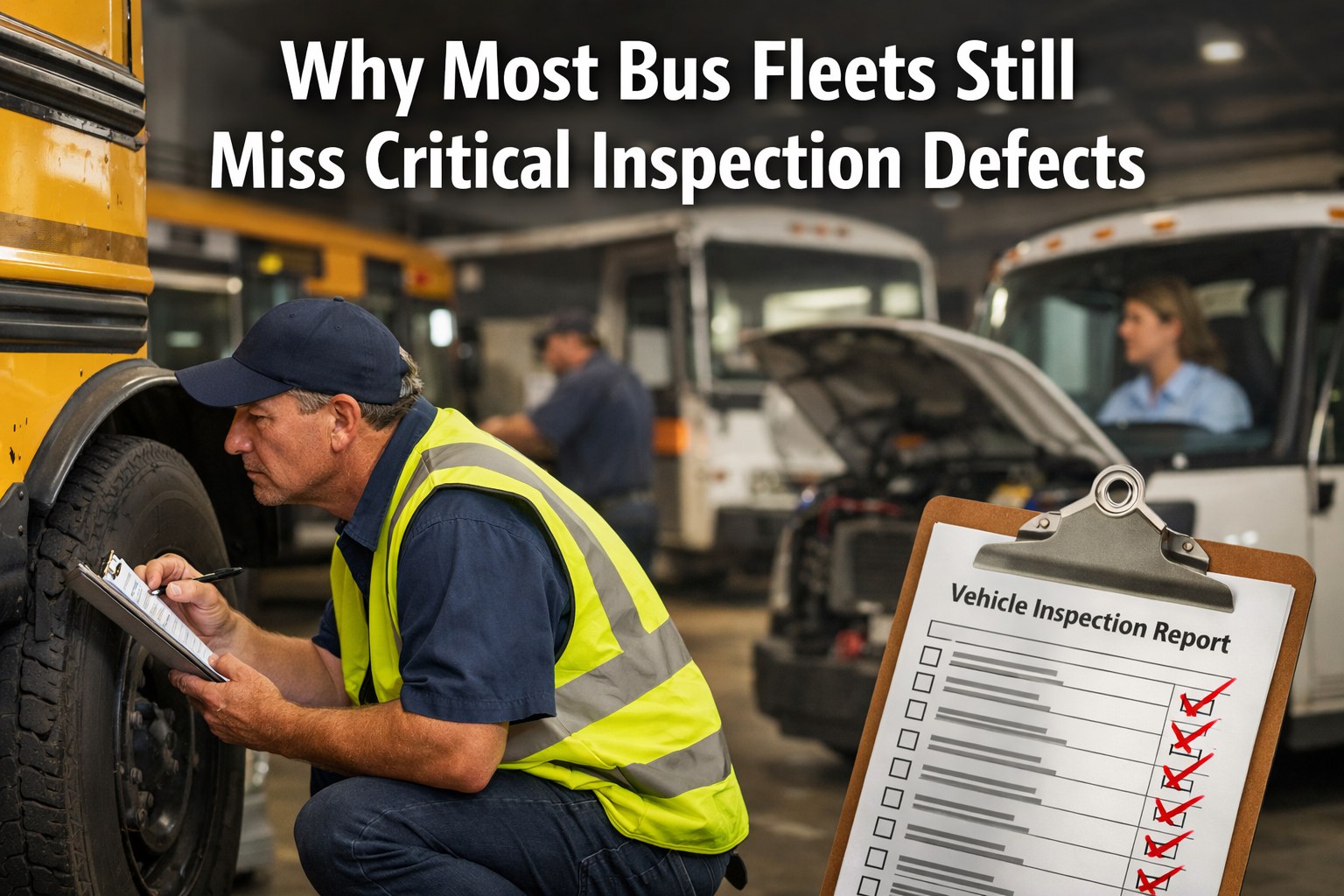
This scenario plays out thousands of times every year across American bus fleets. During the 2024 CVSA International Roadcheck, inspectors conducted 48,761 commercial vehicle inspections. The result? 23% of vehicles were placed out of service for critical safety violations—defects serious enough to immediately remove the vehicle from the road. These weren't hidden problems. Defective brakes. Worn tires. Inoperative lights. Issues that should have been caught during daily inspections but weren't.
The gap between what inspections should catch and what they actually catch represents one of fleet management's most persistent challenges. Understanding why defects slip through—and what the best fleets do differently—can transform your inspection program from a compliance checkbox into an actual safety system.
The Inspection Gap: What the Numbers Reveal
The disconnect between inspection reports and roadside findings tells a troubling story. According to DOT data, 95% of all Driver Vehicle Inspection Reports (DVIRs) are submitted as "no defects found." Yet when certified inspectors examine those same vehicles during enforcement events, they consistently find critical safety violations on roughly one in four vehicles.
The 2024 International Roadcheck broke down exactly where fleets are failing. Defective service brakes accounted for 25% of all vehicle out-of-service violations. Tire issues caused 20.8%. Other brake system problems added another 18.3%. Lighting defects contributed 11.6%. Combined, brakes, tires, and lights—systems that should be checked on every pre-trip inspection—represented 75% of all critical violations.
2024 International Roadcheck: Top Vehicle Violations
Source: CVSA 2024 International Roadcheck Results
These aren't hidden problems requiring specialized equipment to detect. Brake pad wear. Tire tread depth. Burned-out lights. These are basic inspection items that drivers check—or should check—every day. The question isn't whether these defects exist. It's why they consistently escape detection until an inspector or a breakdown forces the issue.
Why Defects Slip Through: The Root Causes
Understanding why inspections miss defects requires examining the entire inspection ecosystem—from the time pressures drivers face to the limitations of paper-based systems. Several factors consistently undermine inspection effectiveness:
Time Pressure and Rushed Inspections
A thorough pre-trip inspection takes 15-30 minutes. But drivers feel pressure to get on the road. Routes to run. Schedules to keep. When inspections are rushed, small issues slip through—the slightly worn brake pad, the tire that's borderline on tread depth, the light that works intermittently. These "minor" issues become critical failures.
"The number one reason pre-trip inspections fail is that they are rushed. Drivers feel pressured to get on the road so they can earn more money." — Whip Around
Inconsistent Inspection Patterns
Without a structured, repeatable process, drivers check different things in different orders—or skip items entirely. They may focus on obvious areas while overlooking components that require closer examination. The lack of a consistent pattern means critical systems get missed based on time, weather, or how the driver is feeling that day.
Inadequate Training
Many drivers don't know what to look for or what constitutes a defect. They check for obvious problems—flat tires, broken mirrors—but miss subtle indicators of developing failures. Without training on specific defect criteria, drivers can't distinguish between normal wear and conditions requiring action.
Paper Form Limitations
Paper inspection forms introduce errors, get lost, feature illegible handwriting, and create inconsistent filing. They can't provide immediate feedback, don't guide drivers through proper inspection sequences, and make it impossible to verify what was actually checked. Forms pile up in offices, making trend analysis nearly impossible.
Assumption of Prior Inspection
Drivers often assume the previous driver flagged any issues. "If something was wrong, they would have reported it." This assumption creates gaps where defects developing between shifts go undetected because each driver assumes someone else caught them.
No Accountability for Thoroughness
Without verification, there's no way to know if an inspection was actually performed or just signed off. Paper forms with checkmarks tell you nothing about inspection quality. A driver can complete the form in two minutes, check every box, and miss critical defects entirely.
Stop missing critical defects. BusCMMS provides structured digital inspections with photo documentation, real-time defect alerts, and complete accountability for every check.
Start Free Trial Book a DemoThe Real Cost of Missed Defects
Missed inspection defects don't just create compliance problems—they generate real costs that compound over time. Understanding these costs helps justify investments in better inspection systems.
Regulatory Penalties
$1,270/day — Failing to complete required DVIR
$12,700 — Falsifying a DVIR to hide a defect
$15,420 — Failing to repair a reported safety defect
$25,000+ — Severe DOT violations depending on severity
Operational Losses
$861 average — Cost per out-of-service order (CVSA)
3-5x higher — Emergency repairs vs. scheduled maintenance
Hours to days — Roadside delays before repairs complete
Immeasurable — Missed routes, stranded passengers, schedule chaos
Long-Term Consequences
CSA score damage — Affects insurance, contracts, reputation
Higher premiums — Poor safety records increase insurance costs
Secondary damage — Unaddressed defects cause cascading failures
Safety incidents — Preventable accidents with real consequences
The Minnesota example illustrates how inspection failures compound. A FOX 9 investigation found that more than 4,500 school buses in Minnesota failed annual safety inspections in a single year—issues ranging from fuel leaks to brake problems to faulty emergency exits. One private transportation company failed 91% of its inspections. A major public school district failed 57% of its fleet, with 69 buses deemed unsafe due to violations including malfunctioning crossing control arms and emergency exit problems.
"When you start seeing that 50% or higher rate, it goes to show that they really aren't putting that effort into maintaining their fleet."
— Lt. Brian Reu, Minnesota State Patrol, Vehicle Inspections
The Components Most Commonly Missed
Certain systems and components are disproportionately represented in missed defects. Understanding where inspections most often fail helps focus training and process improvements on the areas that matter most.
Brake Systems
Brakes consistently top the violation lists for one reason: they're complex systems with multiple failure points that require more than a visual check. Brake adjustment, air system integrity, lining wear, and brake timing issues require active testing, not just looking. Drivers may check that brake lights work without verifying that brakes actually function properly. The 2024 Brake Safety Week found 12.8% of vehicles had brake-related out-of-service violations—defects serious enough to immediately remove the vehicle from service.
Tires and Wheels
Tire inspections often miss underinflation (not visible without a gauge), uneven wear patterns, sidewall damage, and tread depth issues. Drivers checking tires in poor lighting or from a distance miss defects that require hands-on examination. The 2025 International Roadcheck specifically emphasizes tires as a focus area because violations continue despite being a well-known problem area.
Lighting and Electrical
Lights get checked when they're easy to see—headlights, brake lights. But clearance lights, turn signals on all sides, reflectors, and warning systems often get skipped. Electrical issues that cause intermittent lighting problems may work during inspection but fail during operation. Complete lighting checks require walking the entire vehicle and actively testing each system.
Emergency Equipment and Exits
On school buses especially, emergency exits, crossing control arms, stop arms, and safety equipment require regular verification. These systems may not be used daily, making it easy to miss developing problems. Emergency door seals that don't make proper contact, crossing arms that don't deploy fully, and warning lights that function erratically all escape detection until formal inspections or emergencies expose them.
Fluid Leaks and Under-Hood Systems
Checking fluid levels is straightforward. Identifying developing leaks before they become obvious puddles requires more attention. Oil leaks, coolant seepage, and fuel system issues often begin as minor problems that drivers dismiss or don't notice. By the time they're obvious, they've often caused secondary damage or created immediate safety hazards.
What High-Performing Fleets Do Differently
Fleets with strong safety records and low out-of-service rates approach inspections differently. They treat inspections as active safety systems rather than compliance paperwork. Several practices distinguish high-performing operations:
Structured, Consistent Inspection Sequences
Top fleets establish fixed inspection patterns—front to rear, clockwise around the vehicle, then interior. This creates muscle memory so drivers perform the same thorough inspection every time regardless of conditions. Nothing gets skipped because the sequence is automatic.
Photo Documentation Requirements
Requiring photos of critical components—tires, brake chambers, warning lights activated—proves that inspections actually occurred and provides visual evidence of vehicle condition. Photo requirements force drivers to actually examine components rather than checking boxes from memory.
Real-Time Defect Escalation
When a driver reports a defect, maintenance knows immediately—not at the end of the day when paper forms get processed. Real-time alerts enable same-day repairs for many issues, preventing the "reported but never fixed" problem that leaves defects unaddressed for days or weeks.
Training with Real Defect Examples
Instead of generic training, leading fleets show drivers actual photos and examples of defects from their own fleet. Seeing what a worn brake lining looks like, what constitutes excessive tire wear, and what counts as a safety defect builds inspection accuracy far more effectively than reading regulations.
Closed-Loop Defect Resolution
Every reported defect gets tracked from identification through repair to driver verification that the issue is resolved. The next driver to use the vehicle must confirm repairs were completed before starting their route. This closes the loop that paper systems leave open.
Time Allocation for Proper Inspections
High-performing fleets build inspection time into schedules rather than treating it as an afterthought. Drivers have 15-30 minutes before departure specifically for inspections, removing the pressure to rush through checks to make schedule.
Digital Inspections: Closing the Gap
The shift from paper to digital inspections represents one of the most impactful changes fleets can make to reduce missed defects. Research consistently shows that digital inspection systems catch more problems, create better accountability, and enable faster response to identified issues.
Paper-Based Inspections
- Forms get lost, damaged, or illegible
- No verification that checks were performed
- Delayed data entry introduces errors
- Hours or days before maintenance sees defects
- No photo evidence of conditions
- Trend analysis nearly impossible
- Easy to rush or skip items entirely
- Filing and retrieval takes hours
Digital Inspection Systems
- Records stored instantly and permanently
- Guided workflows ensure complete checks
- Real-time data with zero transcription
- Instant alerts when defects are reported
- Required photos document actual conditions
- Pattern analysis identifies recurring issues
- Required fields prevent skipped items
- Search and retrieval takes seconds
Documented Digital Inspection Benefits
The efficiency gains alone make digital inspections worthwhile. Paper forms take 30-45 minutes when filled out properly. Digital systems with smart workflows, photo capture, and pre-populated fields reduce that to 5-15 minutes while actually improving inspection quality. Drivers complete more thorough inspections in less time because the system guides them through every required check.
See how digital inspections transform defect detection. BusCMMS provides customizable inspection forms, required photo documentation, instant defect alerts, and complete audit trails for every vehicle.
Get Started Free Schedule a DemoBuilding an Inspection Program That Actually Works
Transforming inspection effectiveness requires more than just switching to digital forms. It requires building a complete system that addresses the root causes of missed defects. Here's how to approach the change:
Audit Your Current Inspection Reality
Before changing anything, understand what's actually happening. How long do drivers really spend on inspections? What percentage of reports show defects? How often do roadside inspections or breakdowns reveal issues that daily inspections missed? This baseline reveals where your biggest gaps exist.
Design Vehicle-Specific Checklists
Generic inspection forms miss vehicle-specific requirements. Different bus types have different critical systems. Create customized checklists for each vehicle class that include every component requiring inspection—not just regulatory minimums but the items that actually fail in your operation.
Implement Photo Requirements for Critical Items
Require photo documentation for high-failure components: tires, brake chambers, warning lights in operation, fluid levels. Photos prove inspections occurred and create a visual history of component condition over time. They also prevent "pencil whipping"—completing forms without actually checking.
Establish Real-Time Defect Workflows
When a defect is reported, what happens next? Create automated workflows that immediately notify maintenance, generate work orders, and track resolution. The faster defects move from detection to repair, the less time vehicles operate with safety issues.
Train with Real Examples and Clear Criteria
Show drivers actual photos of acceptable vs. unacceptable conditions. Define specific criteria: "Brake lining less than 1/4 inch requires reporting." "Tire tread below 4/32 inch is a defect." Clear standards remove ambiguity and give drivers confidence in their assessments.
Build Time Into Schedules
Rushed inspections miss defects. Build 15-30 minutes of inspection time into driver schedules—time that's protected from route pressure. Drivers who have time to inspect properly will inspect properly. Drivers who are already running late will rush.
Review and Analyze Inspection Data
Digital inspections generate data. Use it. Which vehicles generate the most defects? Which components fail most often? Which drivers report issues vs. which always report "no defects"? Pattern analysis reveals systemic problems and validates that your inspection program is working.
The Regulatory Reality: What's Required
Understanding regulatory requirements helps distinguish between minimum compliance and effective safety practices. Federal regulations establish the floor—what you must do to avoid penalties. Best practices build on that foundation to create actually safe operations.
FMCSA DVIR Requirements (49 CFR 396.11 & 396.13)
Pre-trip inspection required: Drivers must inspect vehicles before operation
Post-trip reporting: Defects discovered during operation must be reported
Written documentation: DVIRs required when defects are found (passenger vehicles must always submit)
Repair verification: Defects must be repaired before vehicle operates, with mechanic certification
Driver acknowledgment: Next driver must review and acknowledge previous report
Record retention: DVIRs must be kept for three months minimum
For passenger-carrying vehicles—including school buses and transit operations—DVIR requirements are stricter than for freight. Every inspection must be documented, not just those finding defects. This higher standard reflects the heightened safety responsibility when transporting passengers.
But regulatory compliance is the minimum. Fleets that treat inspections as compliance exercises rather than safety systems end up with the worst of both worlds: paperwork burden without safety improvement. The goal isn't to pass audits. It's to prevent breakdowns, avoid accidents, and keep passengers safe.
From Checkbox to Safety System
The gap between what inspections should catch and what they actually catch isn't inevitable. It's the result of systems that prioritize form completion over defect detection—rushed processes, paper limitations, inadequate training, and missing accountability.
Closing that gap requires treating inspections as what they actually are: the first line of defense against breakdowns, accidents, and preventable safety incidents. Digital tools make that transformation practical by guiding thorough inspections, requiring documentation, enabling real-time response, and creating the data needed to continuously improve.
Every defect caught during a pre-trip inspection is a breakdown prevented. Every issue addressed before it becomes critical is an accident avoided. The fleets that understand this—and build their inspection programs accordingly—operate safer, more reliable, and ultimately more cost-effective operations.
Identify Hidden Inspection Gaps
BusCMMS helps you build inspection workflows that actually catch defects—with digital checklists, required photo documentation, instant alerts, and complete defect tracking from identification through resolution.
Start Your Free Trial See the WorkflowFrequently Asked Questions
Why do so many inspection defects go unreported despite daily pre-trip checks?
Multiple factors contribute to missed defects. Time pressure causes drivers to rush through inspections in minutes rather than the 15-30 minutes needed for thoroughness. Lack of training leaves drivers uncertain about what constitutes a reportable defect. Paper forms provide no verification that checks were actually performed. Inconsistent inspection patterns mean different components get checked on different days. Without photo documentation or guided workflows, it's easy to check boxes without actually examining components—and there's no way to verify inspection quality after the fact.
What are the most commonly missed inspection items on buses?
Brake systems top the list, accounting for 25% of all out-of-service violations at CVSA inspections—despite being a required daily check. Tire issues (tread depth, underinflation, sidewall damage) cause 20.8% of violations. Lighting defects contribute 11.6%. Emergency equipment and exits on school buses—crossing arms, stop arms, emergency door seals—frequently escape detection because they're not used daily. Fluid leaks in early stages and developing mechanical problems also commonly slip through rushed inspections.
How do digital inspections improve defect detection compared to paper forms?
Digital inspection systems catch 15-25% more defects than paper forms according to industry research. They accomplish this through guided workflows that ensure every component is checked in sequence, required photo documentation that proves inspections occurred, real-time alerts that notify maintenance immediately when defects are reported, and required fields that prevent skipping items. Digital systems also reduce inspection time by 60-80% through smart workflows, making it easier for drivers to be thorough without schedule pressure.
What penalties can fleets face for DVIR violations?
DVIR violations carry significant penalties. Failing to complete a required DVIR can cost $1,270 per day. Falsifying a DVIR to hide a safety defect can result in fines up to $12,700. Failing to repair a reported safety defect before operating the vehicle can cost up to $15,420. Beyond fines, vehicles found with critical defects during roadside inspections are placed out of service immediately—averaging $861 in direct costs per incident, plus schedule disruption, reputation damage, and potential CSA score impacts that affect insurance and contracts.
How can we ensure drivers actually perform thorough inspections rather than just checking boxes?
Building accountability requires multiple approaches. Require photo documentation of critical components—tires, brake chambers, warning lights activated—which proves the driver actually examined each item. Use digital inspection systems with required fields that can't be skipped. Establish consistent inspection sequences so checking becomes automatic habit. Build adequate time into schedules so drivers aren't pressured to rush. Train with real defect photos so drivers know exactly what they're looking for. Review inspection data to identify drivers who consistently report "no defects" versus those who catch issues. Create a culture where reporting defects is valued rather than seen as creating problems.