If a headline told you the 2026 eDVIR rule forces your buses onto electronic inspections, relax. It does not. The eDVIR rule for bus fleets is smaller than the coverage suggested, and understanding exactly what it did, and the three things it deliberately did not do, is the difference between a smooth migration and a panicked one. On March 23, 2026, FMCSA made electronic DVIRs unambiguously legal under 49 CFR 396.11 and 396.13. It did not make them mandatory, and it did not extend the DVIR duty to any fleet that did not already have it. This guide covers what changed, what stayed the same, and the practical steps a bus fleet should actually take. See how BusCMMS turns eDVIRs into completed maintenance records.
Updated September 2026 · Reviewed against 49 CFR 396.11, 396.13, 390.32, and FMCSA final rule Docket FMCSA-2025-0115 (published Feb 19, 2026, effective March 23, 2026)
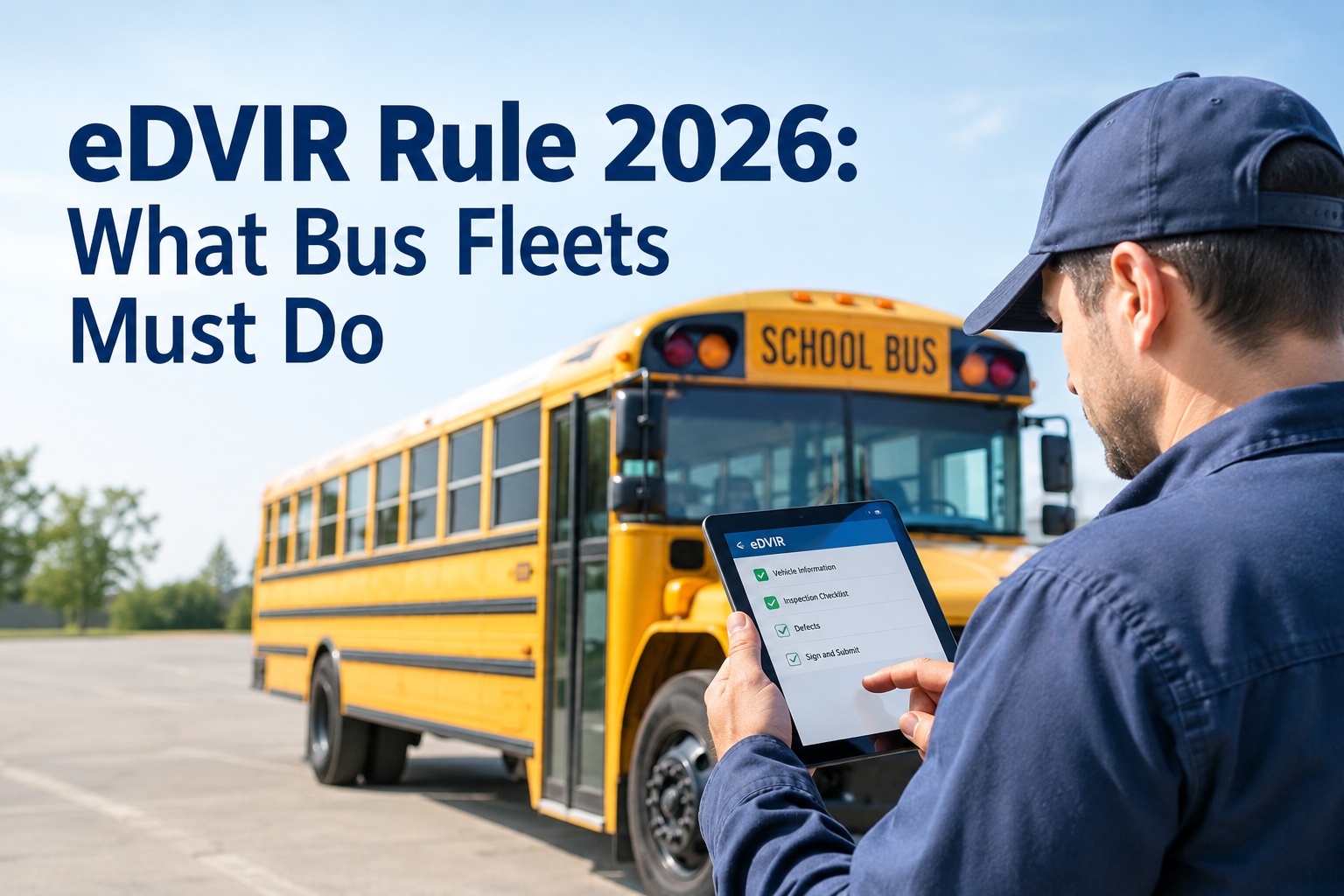
eDVIR Rule 2026: What Bus Fleets Must Do
The 2026 electronic-DVIR rule in plain terms: what it changed, what it left untouched, and the migration steps that matter.
Added explicit language to 396.11 and 396.13 that DVIRs may be created and maintained electronically, per 390.32.
Did not mandate eDVIRs, did not ban paper, and did not extend the DVIR duty to any new fleet.
Electronic signatures, mobile submission, and cloud storage are unambiguously compliant.
What the 2026 Rule Really Did
The rule is smaller than the headlines, and that is the important part. On February 19, 2026, FMCSA published a final rule under Docket FMCSA-2025-0115, effective March 23, 2026. It revised two places in 49 CFR 396.11, and 396.13 the same way, to state explicitly that the required reports may be created and maintained in electronic format, in accordance with 49 CFR 390.32. That is the change. A clarifying sentence, not a new mandate.
Why does a clarifying sentence matter enough to publish? Because electronic DVIRs were already permissible under 390.32 back to 2018, but the older, paper-centric language of 396.11 and 396.13 left a grey area, and different auditors and attorneys read it differently. Some fleets stayed on paper purely to avoid the interpretive risk. The 2026 rule removes that risk by putting the electronic authorization directly into the DVIR sections themselves. It was prompted by a public comment and supported across the industry. Book a demo to see compliant electronic DVIRs without the paper-era ambiguity.
What the Rule Did Not Change
This is where a fleet can get itself into trouble by over-reading a small rule. The 2026 change touched the format of the record, not the substance of the obligation. Everything below is exactly as it was before March 23, 2026.
And critically for buses: the rule did not reinstate the no-defect DVIR requirement, and it did not change the underlying applicability question of whether the FMCSRs reach your particular operation in the first place. If your buses were already subject to DVIR duties, the 2026 rule simply makes going electronic clearly authorized. If they were not, this rule does not newly subject them. Book a demo to apply the right DVIR rules to each operation you run. Or start free and set it up yourself.
Paper Is Legal, but Electronic Wins the Audit
If paper is still allowed, why move? Because the rule removed the only real reason to stay on paper, the interpretive risk, and everything else about paper is a liability. The choice is no longer legal versus illegal; it is which format survives an audit and a short deadline.
Paper DVIRs
- Forms get lost between the bus and the office
- A missing signature is invisible until an audit finds it
- Producing months of records is a slow manual search
- A reported defect can sit on a clipboard unseen
Electronic DVIRs
- Captured at the bus and linked instantly to the record
- The three-signature chain is enforced, not hoped for
- Records produce on demand, per bus, in minutes
- A defect routes straight to a work order
Enforcement has sharpened the point. Offsite audits have risen and record demands can come with tight turnarounds, sometimes as little as a day or two to produce complete DVIR records. On paper, that is a scramble. Electronically, it is a search box. The 2026 rule did not force the move, but it removed the last excuse not to make it. Book a demo to produce a bus's full DVIR history in minutes.
Moving 100 Buses From Paper to Electronic
Here is an illustrative scenario. A fleet of 100 buses runs paper DVIRs and wants to be fully electronic without a chaotic cutover. The move is not a software problem; it is a workflow problem, and done in order it is a few weeks of steady work, not a crisis.
Confirm what applies
Sort buses by operation and settle which are actually subject to DVIR duties and any state rules, so you digitize the right requirement per bus.
Build the digital inspection
Load the safety-critical and bus-specific items, stop arms, warning lights, exits, into a mobile checklist that mirrors the paper form drivers already know.
Wire defects to work orders
Set a reported defect to create a corrective work order automatically, tied to the bus, so nothing depends on a form reaching a desk.
Pilot, then roll out
Run a handful of buses and drivers electronically for a week, fix the friction, then extend to all 100 with the workflow already proven.
Retire the paper
Once electronic records are flowing and retained, stop the paper forms. Keep the old ones on file until their retention window closes.
The result on the other side: a driver inspects bus 47 on a phone, a soft-brake defect fires a work order to the shop, the repair is certified, the next driver acknowledges it, and the entire chain sits on bus 47's record, retrievable in seconds if an auditor asks. That is the same compliance the paper form provided, minus the failure mode where the form never made it back. Book a demo to see the full migration on a fleet your size.
What an Electronic DVIR Must Contain and Retain
Going digital does not lower the bar on what the record has to hold; it just makes holding it easier. An electronic DVIR carries the same required elements as paper, and the retention rule is unchanged. What the 2026 rule confirmed is that capturing and keeping all of it electronically is fully compliant.
One more layer many fleets forget: state pupil-transportation rules can require their own daily inspections and documentation regardless of the federal picture, and they may set their own retention. The 2026 rule addresses the federal format question; it does not override a stricter state requirement. When you build the electronic workflow, build it to satisfy whichever requirement is tighter for your buses. Book a demo to hold federal and state DVIR records on one bus timeline.
The Bottom Line on the 2026 eDVIR Rule for Bus Fleets
The eDVIR rule for bus fleets is a small rule with a big practical signal. Effective March 23, 2026, FMCSA put explicit electronic-DVIR authorization directly into 49 CFR 396.11 and 396.13, confirming that electronic creation, signatures, and storage are compliant. It did not mandate electronic, did not ban paper, did not reinstate no-defect DVIRs, and did not change who is subject to DVIR duties in the first place. So the action for a bus fleet is not to panic about a deadline; it is to recognize that the last reason to stay on paper is gone, and to migrate deliberately, sorting applicability first, digitizing the inspection, wiring defects to work orders, and retaining the full chain per bus. Do that and an audit becomes a search box instead of a scramble. See how BusCMMS turns eDVIRs into completed maintenance records.
What is the 2026 eDVIR rule?
It is an FMCSA final rule under Docket FMCSA-2025-0115, published February 19, 2026 and effective March 23, 2026, that added explicit language to 49 CFR 396.11 and 396.13 stating that DVIRs may be created and maintained electronically in accordance with 49 CFR 390.32. Electronic DVIRs were already permissible under 390.32 since 2018, so the rule did not create a new right. It removed the interpretive grey area in the older paper-centric language, confirming that electronic creation, signatures, and storage are unambiguously compliant.
Are electronic DVIRs mandatory for bus fleets?
No. The rule authorizes electronic DVIRs; it does not require them. Paper DVIRs remain legal. FMCSA's stated purpose was to encourage carriers to adopt electronic, cost-saving methods, not to force the switch. Just as importantly, the rule did not change which fleets are subject to DVIR duties in the first place, so it does not newly require a DVIR from any bus fleet that was not already subject to one. If your operation was already covered, going electronic is now clearly authorized; if it was not, this rule does not change that.
Can bus fleets still use paper DVIRs?
Yes. Paper DVIRs remain fully legal after the 2026 rule. What changed is that electronic is now explicitly authorized alongside paper, removing the interpretive risk that led some cautious fleets to stay on paper. The practical case for going electronic is strong, forms that never reach the office, missing signatures, and slow record production are all paper failure modes, but nothing in the rule compels a fleet to abandon paper. It is a choice about audit resilience and workflow, not about legality.
What must an electronic DVIR contain?
The same elements as a paper DVIR. It must identify the vehicle, record the components inspected and the results including any defects, and carry the driver's certification. Where a defect is reported, the record includes the repair certification and the next driver's acknowledgment, forming the three-signature chain, and all three signatures can be captured electronically with timestamps. The 2026 rule changed the permitted format, not the required content. An electronic DVIR that omits a required element is as deficient as a paper one that does.
How should fleets transition from paper to electronic DVIRs?
Treat it as a workflow migration, not just a software install. First confirm which buses are actually subject to DVIR duties and any stricter state rules. Build a mobile inspection that mirrors the paper form and includes bus-specific items like stop arms and warning lights. Wire a reported defect to create a corrective work order automatically. Pilot with a few buses and drivers, fix the friction, then roll out to the full fleet. Retire paper once electronic records are flowing and retained, keeping old paper on file until its retention window closes. Done in order, it is a few weeks of steady work.