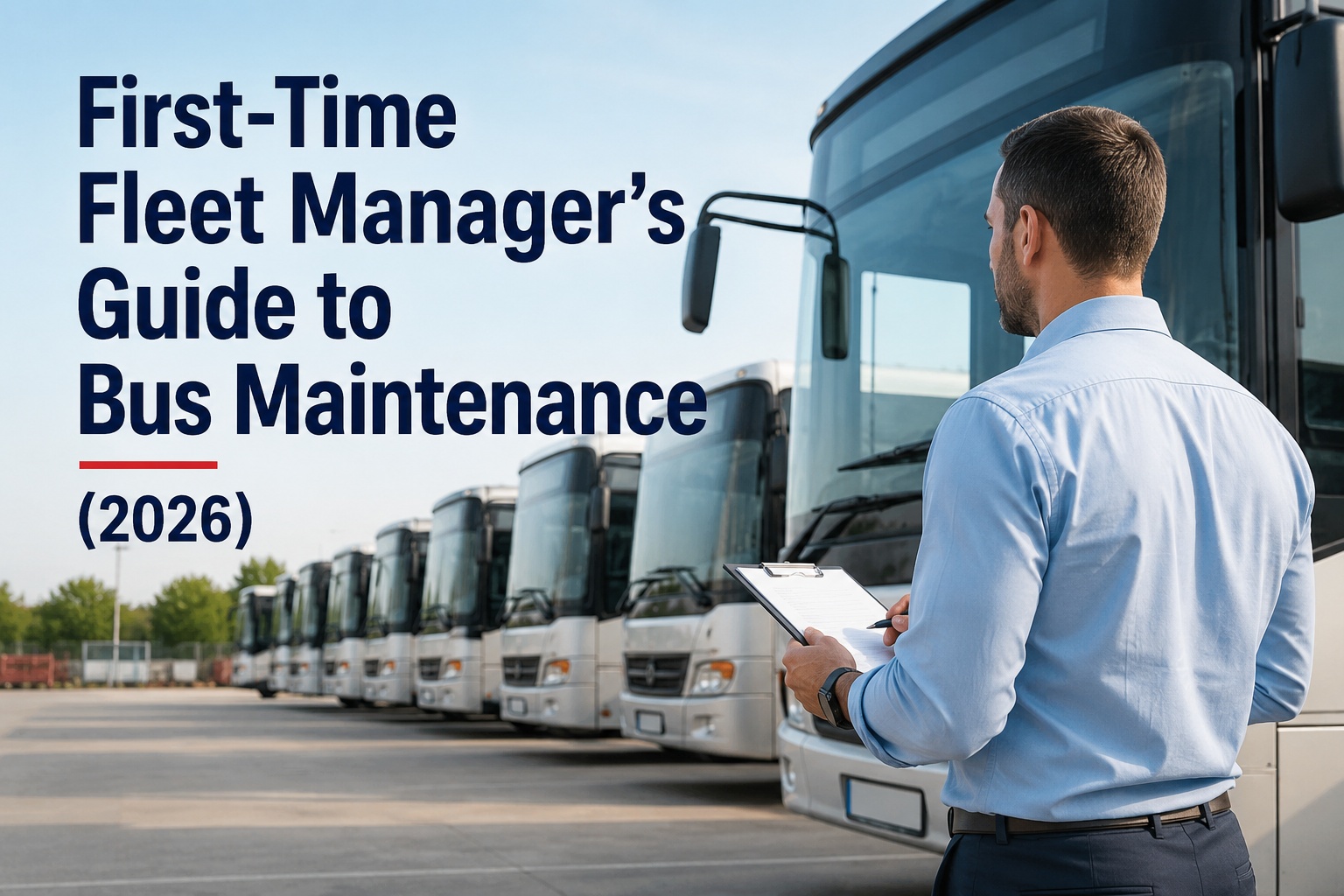
Nobody hands you a manual when you become a bus fleet manager. One day you're a mechanic, a driver, or an operations coordinator, and the next you're the person responsible for whether 40 buses roll out safely every morning, whether the DOT audit goes clean, and whether the budget holds through June. Most first-time fleet managers spend their first six months learning by mistake -- a missed PM that turns into a breakdown, a DVIR gap an auditor finds, a parts order that duplicates what's already on the shelf. This guide is the version of that learning curve condensed into what actually matters in your first 90 days, so you're not finding out the hard way.
First-Time Fleet Manager's Guide to Bus Maintenance
What to focus on in your first 90 days as a bus fleet manager -- inspections, PM scheduling, compliance, budgeting, and the mistakes that cost new managers the most.
What a Bus Fleet Manager Actually Owns
The job title suggests one role, but it's really five overlapping responsibilities, and new managers usually find out which ones they're weak on the hard way. Knowing the shape of the job before you're three weeks in and drowning helps you triage what needs attention first.
Preventive Maintenance
Scheduling PM by mileage or calendar, by fuel type, and making sure it actually happens on time, not just on paper.
Compliance & Inspections
Daily DVIRs, annual inspections, 90-day emergency exit checks, and the paper trail that survives an audit.
Technician & Shop Management
Work order prioritization, parts availability, and making sure your techs aren't waiting on you to unblock their day.
Budget & Reporting
Cost per mile, maintenance spend vs. plan, and the numbers you'll need to defend at the next board or council meeting.
Most new managers over-focus on one of these -- usually whichever they came from -- and under-invest in the others until something breaks. Book a demo to see how BusCMMS keeps all five areas visible on one dashboard, so nothing quietly falls behind while you're focused elsewhere.
Your First 90 Days: A Practical Roadmap
Trying to fix everything in week one is how new managers burn out or miss something important. Here's a sequence that works.
-
1
Week 1: Audit What You Actually Have
Pull every bus's maintenance history, DVIR completion rate, and open work orders. You can't fix a gap you haven't found yet.
-
2
Weeks 2-4: Close the Compliance Gaps First
Missing DVIRs and overdue inspections carry real fines. Fix these before anything else, since they're the fastest way to get burned in an audit.
-
3
Month 2: Standardize PM Scheduling
Move every bus onto a consistent mileage-or-calendar PM trigger by fuel type, so scheduling stops depending on someone's memory.
-
4
Month 3: Start Tracking KPIs
PM compliance rate and fleet availability are the two numbers that tell you if things are actually improving, not just busy.
If you're inheriting a fleet that's been managed on paper or spreadsheets, expect week 1 to take longer than a week. Sign up free and pull your fleet's current maintenance history into one view as your actual starting point.
Preventive Maintenance: The Foundation Everything Else Depends On
Every other part of the job gets easier or harder depending on how solid your PM scheduling is. A fleet with strong PM compliance rarely has audit surprises or budget blowouts, because most problems get caught while they're still cheap to fix.
The core idea is simple even if the details vary by fuel type: every bus should have a PM trigger based on mileage or calendar date, whichever comes first, with intervals adjusted for your actual duty cycle rather than the manufacturer's average-conditions assumption. Diesel, CNG, and electric buses each need genuinely different PM items, not the same checklist with a few lines crossed out. Book a demo to see fuel-type-specific PM schedules built automatically instead of managing separate spreadsheets per powertrain.
Compliance Basics You Can't Learn Later
A few rules matter enough that they belong in week one, not month six.
- Daily DVIRs required for every bus, defects or not, under 49 CFR 396.11
- Drivers must review and sign the prior DVIR before departing, under 396.13
- Emergency exits inspected every 90 days, separate from the daily walkaround
- Annual inspections retained for 14 months; daily DVIRs for at least 3 months
- Electronic DVIRs are fully compliant since FMCSA's March 2026 eDVIR rule
Fewer than 7% of carriers pass a compliance review without a single violation, and most findings trace back to a documentation gap rather than an actually unsafe bus. Book a demo to see how BusCMMS surfaces compliance gaps before an auditor finds them for you.
The KPIs Worth Watching From Day One
You don't need to track forty metrics in your first quarter -- that creates dashboard fatigue and you'll stop looking at any of them. Start with these two, since they tell you more than the rest combined.
PM Compliance Rate
Completed PMs divided by scheduled PMs. Industry average sits around 84%, with top performers at 95%+. Below 85% statistically predicts more breakdowns within 60-90 days.
Fleet Availability
Available hours divided by total scheduled hours. A strong target is 95%+; below 88% usually means PM or parts problems are compounding.
Once these two are stable, cost per mile and mean time between failures are the natural next additions -- we cover the full KPI framework, formulas, and benchmarks in more depth elsewhere on our site if you want to go further once the basics are solid.
From a Fleet Manager on Their First Year
"I came from the shop floor, so my instinct was to fix things with my hands -- jump in on repairs, help with inspections, stay hands-on. What I didn't understand for the first few months was that my actual job had shifted to making sure the system around the shop worked, not doing the work myself. Once I stopped trying to be the best mechanic in the building and started tracking PM compliance and DVIR completion instead, our breakdown rate dropped noticeably within a quarter. The buses didn't change. My focus did."
Mistakes That Cost New Fleet Managers the Most
Managing Everything on Memory or Spreadsheets
Works fine for a 10-bus fleet. Falls apart fast past 25-30 buses, right when you have the least slack to catch the fallout.
Treating Compliance as a Once-a-Year Event
Waiting for the audit notice to check your records means finding gaps under the worst possible time pressure.
Not Separating PM Schedules by Fuel Type
A mixed diesel and electric fleet run on one generic schedule means one side is over-serviced and the other under-serviced.
Reacting Instead of Reporting
Not having a simple monthly report ready means scrambling to justify budget decisions after the fact instead of ahead of it.
Nearly all of these come down to the same root cause: information that lives in someone's head or a scattered set of documents instead of one system everyone can see. Book a demo to see how a bus-specific CMMS prevents each of these from becoming a first-year crisis.
Your First 90 Days: The Bottom Line
Being a first-time fleet manager means learning five overlapping jobs at once -- PM scheduling, compliance, shop management, budgeting, and reporting -- while buses are still rolling out every morning regardless of how ready you feel. Start with a clear-eyed audit of what you've actually inherited, fix compliance gaps before anything else, standardize PM scheduling by fuel type, and pick two KPIs to watch before adding more. Do that in order, and the job stops feeling like five people's worth of work and starts feeling like one manageable role.
If you're starting this role without a clear system already in place, that gap is the single biggest predictor of a rough first year. Sign up free and get your fleet's maintenance, compliance, and KPIs organized before you need them for a board meeting or an audit.
What should a first-time fleet manager focus on first?
Start with an honest audit of what you've inherited -- maintenance history, DVIR completion rates, and open work orders. Close compliance gaps first since they carry the fastest and most direct financial risk, then standardize PM scheduling, and only after both are stable should you add detailed KPI tracking.
What are the core responsibilities of a bus fleet manager?
The role covers five overlapping areas: preventive maintenance scheduling, compliance and inspections (DVIRs, annual inspections, emergency exit checks), technician and shop management, budgeting, and reporting. New managers often over-focus on whichever area they came from and under-invest in the others.
What compliance rules should a new fleet manager know immediately?
Daily DVIRs are required for every bus regardless of defects under 49 CFR 396.11, the prior day's DVIR must be reviewed and signed before departure under 396.13, emergency exits need separate 90-day inspections, and annual inspection records must be retained for 14 months. Electronic DVIRs have been fully compliant since FMCSA's March 2026 eDVIR rule.
Which KPIs should a new fleet manager track first?
PM compliance rate and fleet availability are the two most useful starting metrics. PM compliance rate measures completed PMs against scheduled PMs, with 95%+ considered top performance. Fleet availability measures available hours against total scheduled hours, with 95%+ as a strong target. Both give an early, clear signal of whether the fleet is being managed proactively.
How does a CMMS help a first-time fleet manager get up to speed faster?
A bus-specific CMMS consolidates maintenance history, DVIR compliance, open work orders, and KPI tracking into one dashboard instead of scattered spreadsheets or paper records. This gives a new manager an accurate starting picture in days rather than weeks, and prevents the common first-year mistakes of managing by memory or discovering compliance gaps only when an audit forces the issue.