Preparing for a DOT bus audit doesn't have to be overwhelming. Fleets that implement a structured 90-day preparation plan pass their DOT inspections with flying colors—and more importantly, maintain the safety and compliance that protects their drivers, passengers, and reputation. The Department of Transportation audit is one of the most critical assessments a commercial bus fleet can undergo. It examines your maintenance records, driver qualification files, vehicle inspection reports, drug testing documentation, and compliance with Federal Motor Carrier Safety Administration (FMCSA) regulations. A single non-compliance finding can result in out-of-service orders, fines up to $15,000 per violation, or even operational shutdown. However, fleets that prepare systematically have a 94% pass rate on their first attempt. This comprehensive guide walks you through a proven 90-day DOT audit preparation framework that covers DVIR records management, preventive maintenance documentation, driver qualification file organization, drug and alcohol testing compliance, safety management systems, and operational readiness. Whether you're preparing for your first DOT audit or your twentieth, this step-by-step plan ensures nothing falls through the cracks and your fleet demonstrates the highest standards of federal compliance and safety management.
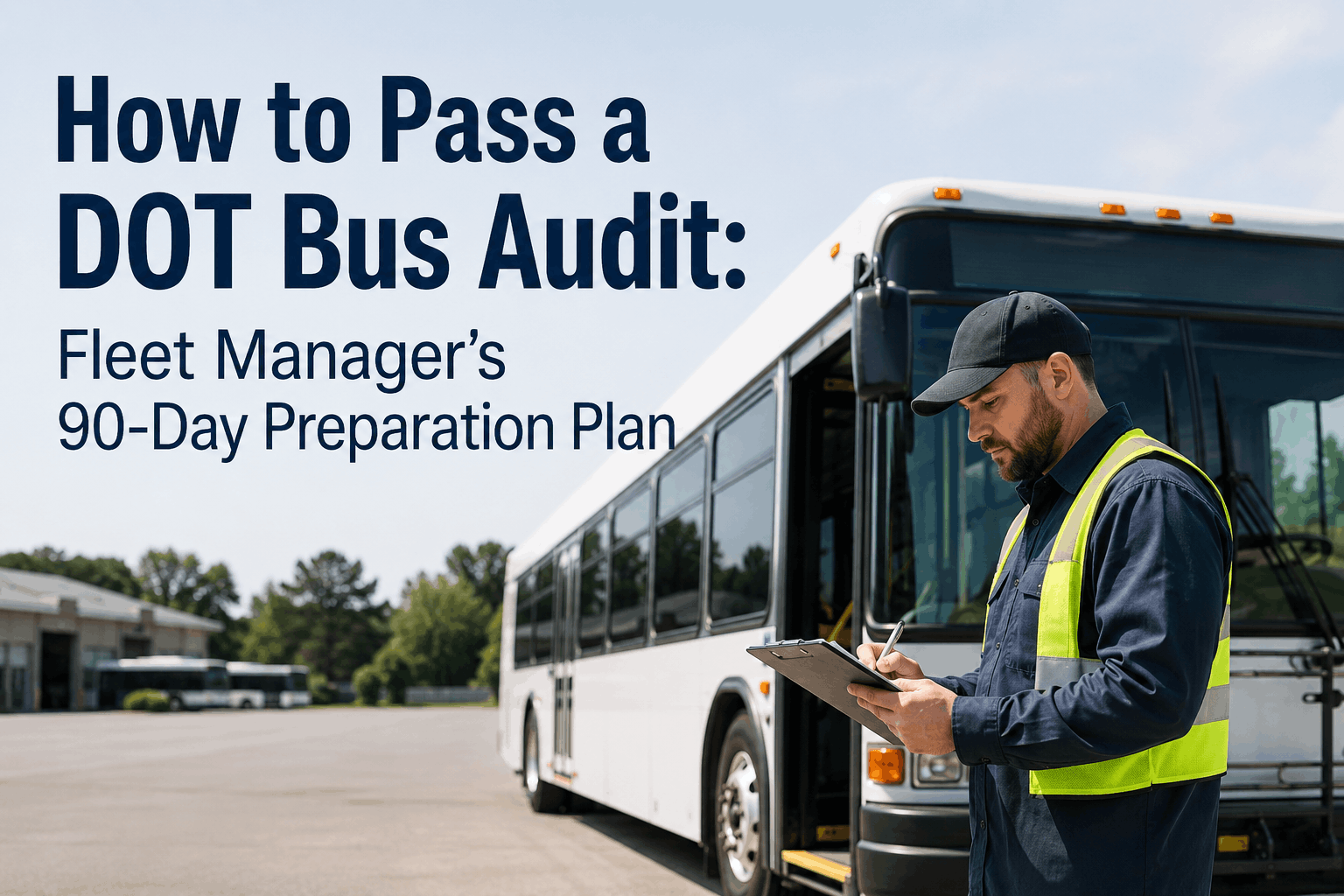
How to Pass a DOT Bus Audit: Fleet Manager's 90-Day Preparation Plan
Complete 90-days preparation framework covering DVIR records, PM documentation, driver qualification files, drug testing compliance, and vehicle inspection protocols. Achieve 94% first-pass rate with systematic DOT audit readiness planning.
1
Understanding DOT Audit Scope: What FMCSA Inspectors Examine
The Federal Motor Carrier Safety Administration (FMCSA) conducts DOT audits to ensure commercial bus fleets comply with federal safety regulations. The audit is comprehensive—inspectors don't just look at a few random records. They examine your complete compliance program across seven critical areas: vehicle maintenance records (including all DVIR forms from the past 12 months), driver qualification files (medical certificates, driving history, hours-of-service logs), drug and alcohol testing records (including test results, negative and positive, and follow-up actions), safety management systems (policies, training documentation, accident investigation reports), vehicle inspection reports (brake inspections, tire safety, lighting systems, emergency equipment), vehicle accident history (investigation reports, insurance claims, corrective actions), and operational readiness (proof of insurance, vehicle registration, safety training records).
Why DOT audits matter for your fleet: A successful DOT audit demonstrates that your fleet operates at the highest safety standards. This affects your FMCSA safety rating, which determines your ability to win contracts, secure insurance at reasonable rates, and operate without restrictions. A failed audit can result in out-of-service orders (preventing you from operating vehicles until violations are corrected), civil penalties ($1,000 to $15,000 per violation), potential criminal liability for serious safety violations, increased insurance premiums, loss of contracts that require clean DOT records, and damage to your fleet's reputation in the industry.
Timeline and frequency of DOT audits: Most commercial bus fleets undergo DOT audits every 24-36 months, though high-risk fleets or those with compliance histories may be audited more frequently. Some transit agencies face annual audits. The notice period is typically 2-4 weeks, though unannounced audits do occur for cause investigations. A structured 90-day preparation plan ensures your fleet is audit-ready at all times, so whether the audit comes with notice or as a surprise, you're prepared.
2
Days 1-30: Establish Your Audit Baseline and Create Your Audit War Room
The first 30 days focus on establishing a complete baseline of your fleet's compliance status and creating a centralized audit preparation command center. Start by conducting an internal audit—a complete self-assessment that identifies gaps before the FMCSA does. This internal audit should cover all seven areas examined by FMCSA inspectors: review every vehicle maintenance record from the past 24 months, examine all driver qualification files for completeness and accuracy, verify all drug and alcohol testing records, review your safety policies and training documentation, collect all vehicle inspection reports, analyze accident investigation reports and corrective actions, and verify insurance and registration documents. Assign one team member as your Audit Coordinator—this person will be responsible for all audit preparation activities, ensuring consistency and accountability.
DVIR record collection and organization: Daily Vehicle Inspection Reports (DVIRs) are the cornerstone of DOT compliance. FMCSA expects fleets to maintain DVIR records for all vehicles, completed before each shift, documenting the vehicle's condition and any defects. Collect all DVIR forms from the past 24 months. If you're using paper forms, scan them into a searchable digital system. If you're using a CMMS like BusCMMS, export all DVIR records into a master spreadsheet organized by vehicle, date, and defect status. FMCSA inspectors will want to see evidence that defects identified in DVIRs were actually repaired and documented. Create a defect tracking log showing: date of defect report, vehicle identification number, description of defect, date defect was repaired, work order number, technician responsible, and sign-off confirming repair completion. Any defect not followed by a repair record is a compliance gap.
Creating your audit war room: Establish a physical or digital space where all audit-related documents are organized and easily accessible. Organize documents into seven binders or digital folders: Vehicle Maintenance Records (sorted by VIN, then chronologically), Driver Qualification Files (alphabetical by driver name), Drug and Alcohol Testing Records (chronological), Safety Policies and Training Documentation, Vehicle Inspection Reports, Accident and Incident Records, and Insurance/Registration/License Documents. Within each folder, use a consistent numbering system so inspectors can easily reference specific documents. If using digital storage, ensure documents are in searchable format (PDFs with text layer) and organized with consistent naming conventions: "Vehicle_VIN_MaintenanceRecords_Jan2025.pdf" is much more useful than "doc123.pdf".
3
Days 31-60: Complete Driver Qualification File Audits and Drug Testing Compliance Verification
Driver Qualification Files are among the most frequently cited compliance gaps during DOT audits. FMCSA requires a complete file for each driver, containing: a completed Application for Employment (Form MCSA-5876), Medical Examination Certificate (proving the driver passed a DOT physical by a certified medical examiner within the past 24 months), proof of Vehicle Group classification (the type of vehicles the driver is authorized to operate), driver's license photocopy (valid and matching the state where employed), driving history records (motor vehicle records from all states where the driver has held a license in the past 3 years), and employment history (verification of employment for the past 3 years). If any of these documents is missing, incomplete, or expired, the entire file is non-compliant.
Systematic driver file audit process: Create a Driver Qualification File Checklist for each driver. For every driver in your fleet, verify: Medical Certificate is current and from a FMCSA-certified examiner (not from a family doctor or clinic without DOT certification)—medical certificates expire 24 months after the examination date, so any certificate older than 24 months is immediately non-compliant. Driving record is complete—if a driver has lived in multiple states, you must have motor vehicle records from ALL states where they've held a license. A missing driving record from a state the driver lived in is a significant violation. Employment history covers the past 3 years—if your fleet has been operating less than 3 years, you need employment history from prior employers. Driver's license matches their employment records—date of birth, name spelling, and license number must match exactly. Commercial driver's license (CDL) endorsements are appropriate for the vehicles they operate—a driver with a Passenger endorsement (P) can drive buses; without it, they're non-compliant.
Drug and alcohol testing program audit: FMCSA requires documented evidence of a random controlled substance and alcohol testing program. You must maintain records of: all drug tests administered (dates, driver names, results), testing consortium membership or third-party administrator name and certification, written testing policy distributed to all drivers, training documentation showing drivers understand the testing program and prohibitions, positive test results and corresponding removal from duty actions, and return-to-duty documentation if a driver tested positive. Create a spreadsheet listing every driver and their testing history for the past 24 months. FMCSA requires random testing at a rate of 50% of drivers for drug testing and 20% for alcohol testing annually. If your records show less than these percentages, you have a documented gap. For any positive test result, verify that the driver was immediately removed from safety-sensitive duties and that return-to-duty procedures were followed (including treatment evaluation, substance abuse professional counseling, and a negative return-to-duty test before resuming duty).
4
Days 61-90: Maintenance Documentation Completion and Final Compliance Verification
The final 30 days focus on ensuring all maintenance records are complete, accurate, and properly documented. FMCSA requires fleets to maintain records proving that preventive maintenance was performed in accordance with manufacturer recommendations and industry standards. For each vehicle, you must have: records of all routine maintenance (oil changes, filter replacements, fluid checks—with dates, mileage, and technician sign-off), records of all repairs (work order, parts replaced, labor hours, completion date, and quality inspection), brake and safety system inspections (completed at intervals specified in your maintenance policy, with signed inspection reports), and a maintenance schedule published and available to all mechanics. Any vehicle that has not received documented maintenance in the past 60 days requires an explanation or documentation that it was out of service for a valid reason.
Brake system and safety inspection documentation: Brake systems are a critical focus area for DOT audits—improper braking is a leading cause of commercial vehicle accidents, and FMCSA treats brake defects very seriously. Document complete brake inspections at minimum annually (many fleets inspect semi-annually for compliance margin). Brake inspection reports must include: date of inspection, vehicle VIN, inspection technician name and certification, detailed findings for all brake system components (brake pads, rotors, drums, hydraulic lines, air systems, parking brakes), any defects identified, repair work performed, parts replaced, and sign-off date. If your fleet operates in winter climates, document anti-lock brake system (ABS) testing and salt corrosion inspections. Tire safety is equally important—maintain records of tire inspections, tread depth measurements, damage assessments, and replacement dates. Any vehicle with tires below 4/32 inch tread depth (or 2/32 for drive wheels) is a safety violation.
Creating your final compliance summary: One week before your expected audit date, create a comprehensive compliance summary document that demonstrates your fleet's overall safety and maintenance culture. This document should highlight: your written maintenance policy and schedule, your drug and alcohol testing policy and compliance numbers, your safety training program and driver certifications, your accident prevention program and investigation procedures, your DVIR defect tracking and corrective action system, your driver qualification file completion percentage and any corrective actions in progress, and your maintenance record completion percentage. If you have 100% compliance in every area, you can confidently present this to inspectors. If there are gaps, be prepared to explain the root cause (fleet transition to digital systems, recent hiring surge requiring training time, temporary staffing shortage) and document the corrective actions being taken to address them. FMCSA values continuous improvement—showing that you've identified gaps and implemented corrective actions is far better than trying to hide non-compliance.
5
Technology Solutions: Implementing Digital DVIR and Maintenance Management Systems
Fleets using paper-based DVIR forms and maintenance records are at a significant disadvantage during DOT audits. Inspectors expect to quickly access specific records—if it takes 30 minutes to find a maintenance record for a particular vehicle, that's wasted audit time and creates frustration. Digital CMMS (Computerized Maintenance Management System) platforms like BusCMMS transform audit preparation from a painful manual process into a streamlined, automated workflow. With BusCMMS, every DVIR is logged digitally with timestamp, driver identification, vehicle VIN, and defect descriptions. The system automatically flags defects requiring repair and links them to work orders. Maintenance records are automatically stored, searchable by VIN, date, or defect type, and instantly retrievable for inspection. This digital organization reduces audit preparation time from days to hours and ensures no records are lost or misfiled.
Benefits of digital maintenance management for DOT compliance: Real-time defect tracking ensures every DVIR defect generates an immediate work order and repair documentation. Automated maintenance scheduling ensures preventive maintenance is performed on schedule and documented automatically. Complete historical records are instantly accessible—an inspector can request records for a specific vehicle and see the complete maintenance history in seconds. Compliance reporting generates comprehensive reports showing defect rates, repair completion rates, downtime trends, and maintenance program effectiveness. Data backup ensures your records are secure and recoverable even if physical documents are lost. Electronic signatures and timestamps create an audit trail proving who completed each maintenance task and when. For fleets preparing for DOT audits, transitioning to a digital maintenance system in the days before an audit is not recommended—there's too much risk of data entry errors. Instead, plan the transition at least 90 days before your expected audit so the system is stable and all historical data is properly migrated and verified.
6
Common DOT Audit Violations and How to Avoid Them
Certain violations appear repeatedly across DOT audits, and they're often easily preventable with proper procedures. The most common violation is incomplete or expired driver medical certificates—this accounts for nearly 25% of driver qualification file defects. Solution: implement a system (calendar, CMMS alert, spreadsheet notification) that alerts you 60 days before a medical certificate expires, giving the driver time to schedule their DOT physical. Another frequent violation is missing motor vehicle records from previous states where drivers held licenses—many fleets overlook this requirement. Solution: when hiring a new driver, request driving history from every state they've lived in during the past 3 years, not just their current state. A third common violation is DVIR defects with no corresponding repair documentation—inspectors see the defect reported but can't find the work order or repair record. Solution: implement a mandatory defect closeout process where every DVIR defect requires a linked work order and cannot be closed until the repair is documented and verified.
Additional frequent violations: Brake inspection records missing or incomplete—inspectors expect detailed brake inspections at least annually. Solution: schedule annual brake inspections on a calendar, require inspectors to document all brake components, and maintain organized inspection reports. Preventive maintenance documentation lacking technician names or completion dates—without identification of who performed maintenance and when, you can't prove the work was actually done. Solution: implement a standard work order format requiring mechanic name, date, time, parts replaced, labor hours, and supervisor sign-off. Accident investigation reports missing or incomplete—if your fleet had an accident, you must have a thorough investigation report, root cause analysis, and documented corrective actions. Solution: develop a standardized accident investigation form and ensure every accident gets documented within 24 hours. Safety training documentation incomplete—drivers and mechanics should have annual safety training documentation. Solution: maintain a training record for each employee showing date of training, topics covered, trainer name, and employee signature. Testing program documentation showing insufficient random testing percentages—if your records show you're not meeting the 50%/20% random testing requirement. Solution: implement a third-party testing administrator to ensure random selection and documented testing.
7
Day-of-Audit Preparation and Inspector Engagement Strategy
When the FMCSA audit team arrives, your preparation should be invisible—everything should feel organized, accessible, and professional. Designate your Audit Coordinator as the primary contact for inspectors. Before the audit begins, meet with the inspection team to understand their focus areas, the specific vehicles they'll examine, and the records they'll want to review. Prepare a quiet, organized workspace where inspectors can review documents without interruption. Have all seven document categories organized and labeled so inspectors can quickly find requested records. Assign one knowledgeable staff member to accompany inspectors during vehicle inspections—they can explain recent repairs, maintenance procedures, and answer questions about the fleet's safety program. Keep a running list of any questions or requests inspectors make during the audit, and follow up promptly with additional documentation if requested. If an inspector identifies a violation or non-compliance, don't become defensive—acknowledge the finding, take notes, and ask what corrective action would address the violation. After the audit, request a detailed exit meeting where inspectors summarize their findings, explain any violations, and provide guidance on corrective actions.
8
Post-Audit Actions and Continuous Compliance Maintenance
A successful DOT audit doesn't end when inspectors leave. It's the beginning of continuous compliance maintenance. If your fleet passed without violations, congratulations—but don't become complacent. Maintain the same record-keeping standards that passed inspection. If there were violations, develop a corrective action plan for each one, with responsible parties and completion dates. Report corrective action completion to FMCSA within 30 days of the audit. Even minor violations should be taken seriously—three or more violations in any area can result in a "conditional" safety rating that limits your ability to operate and affects contract eligibility. The 90-day preparation cycle doesn't end with the audit—it should become your ongoing compliance program. Every 90 days, conduct an internal audit to ensure standards are being maintained. Monitor driver medical certificate expiration dates continuously. Verify that random drug testing is being conducted at required percentages. Ensure preventive maintenance is being performed on schedule. Review accident reports and implement corrective actions. Update and distribute safety policies as regulations change. A well-organized compliance program is not a burden—it's the foundation of safe fleet operations that protects your drivers, passengers, and business.
"We implemented BusCMMS's DOT audit preparation workflow and passed our FMCSA audit with zero violations. The digital organization of our DVIR records and maintenance documentation saved us countless hours during the audit process, and the inspectors commented on how well-organized our records were. The system has become essential to our ongoing compliance program."
— Sarah Martinez, Fleet Director, Metro Transit Authority (Chicago, IL)
DOT Audit Preparation Questions
How often do DOT audits occur and what's the typical notification period?
Most commercial bus fleets undergo DOT audits every 24-36 months. High-risk or non-compliant fleets may be audited annually. FMCSA typically provides 2-4 weeks notice, though cause investigations may occur without notice. A continuous 90-day preparation cycle keeps your fleet audit-ready at all times, regardless of timing.
What happens if we fail a DOT audit? What are the penalties and corrective actions?
Failed audits result in violations, civil penalties ($1,000-$15,000 per violation), possible out-of-service orders, conditional safety rating, and contract loss. Corrective actions must be reported to FMCSA within 30 days. Multiple violations can result in operational shutdown until compliance is demonstrated.
How do we organize digital DVIR records for DOT compliance?
Use a CMMS like BusCMMS to log all DVIRs digitally with timestamps, vehicle VIN, driver ID, and defect descriptions. Automatically link defects to work orders and repair records. Organize by vehicle and date for instant searchability. Inspectors can retrieve any DVIR in seconds, demonstrating superior organization.
What driver qualification file documents are absolutely required by FMCSA?
Each driver file must contain: Application for Employment (MCSA-5876), current Medical Certificate (from certified examiner, <24 months old), proof of CDL and Vehicle Group classification, valid driver's license photocopy, complete three-year driving history from all states, and employment history for three years or since hire.
How frequently must we conduct brake inspections and what must documentation include?
Minimum annual brake inspections are required; many fleets inspect semi-annually for compliance margin. Documentation must include: inspection date, vehicle VIN, technician name and certification, detailed findings for all brake components, defects identified, repairs performed, parts replaced, and technician sign-off date.
What are the random drug testing percentages required by FMCSA and how do we prove compliance?
FMCSA requires random controlled substance testing at 50% of drivers annually and alcohol testing at 20% of drivers annually. Maintain records showing each test date, driver name, results, and testing consortium/administrator. Use a third-party tester to ensure independent random selection and documented compliance.
How can we bridge to digital maintenance systems without losing historical paper records?
Scan all paper records into searchable PDFs (text-layer OCR). Systematically enter historical maintenance data into your CMMS 90+ days before your expected audit. Verify data accuracy by cross-checking digital entries against scanned documents. Maintain paper originals as backup until data migration is complete and verified.
What should we do if an inspector identifies a violation during the audit?
Acknowledge the finding professionally, take detailed notes, and ask what corrective actions would address it. Don't become defensive. After the audit, develop a corrective action plan with timelines and responsible parties. Report completion to FMCSA within 30 days. Multiple violations can affect your safety rating and contract eligibility significantly.
Pass Your DOT Audit with Confidence
A structured 90-day preparation plan ensures your fleet is audit-ready. BusCMMS provides the digital organization and documentation system that transforms DOT compliance from stressful manual work into automated, auditable processes. Schedule a consultation to learn how your fleet can achieve a zero-violation DOT audit result.