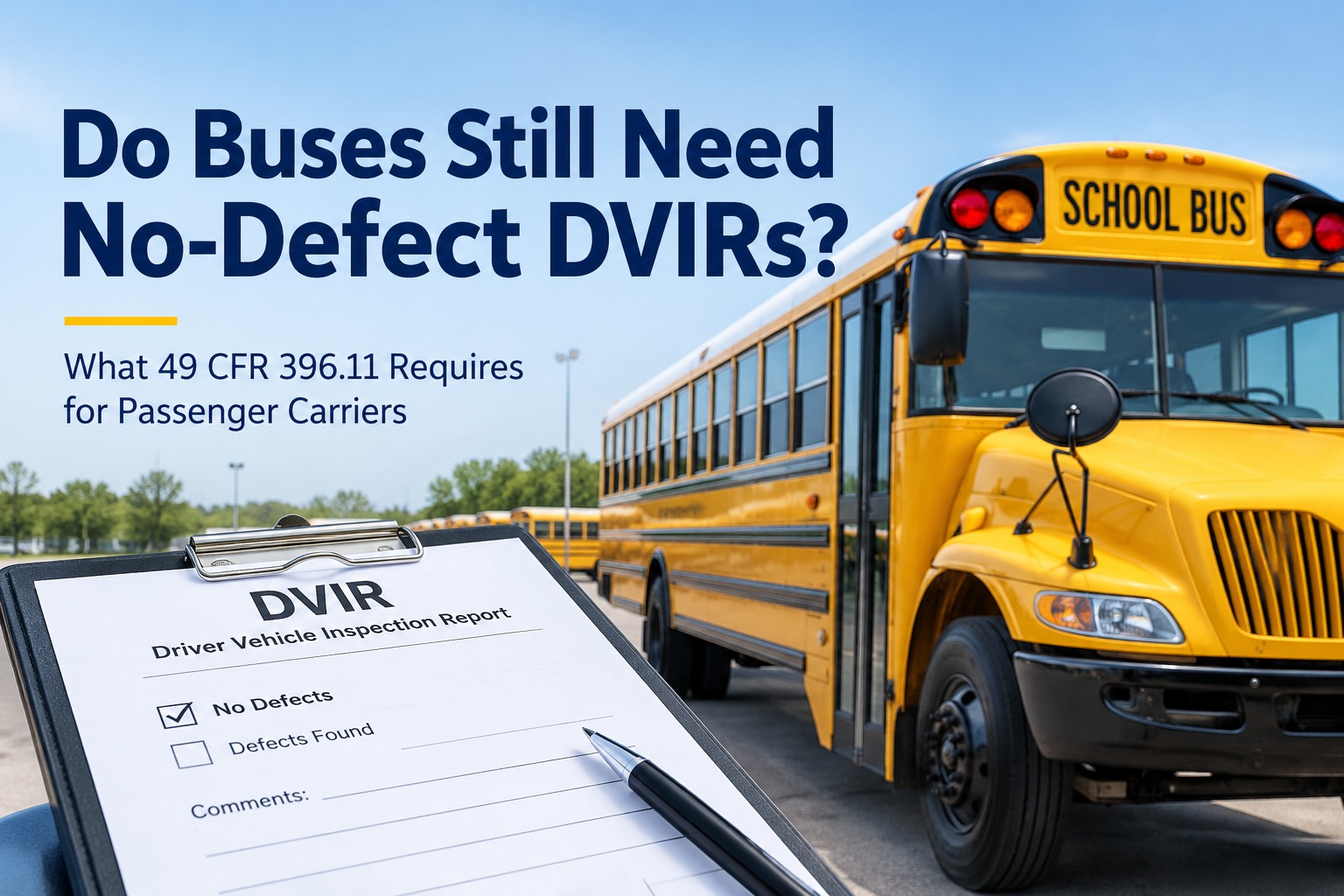
If your drivers still fill out a full DVIR every day when nothing is wrong with the bus, you may be doing paperwork the federal government stopped requiring in 2020. The short answer to the no defect DVIR passenger carrier question is this: since September 17, 2020, drivers of passenger-carrying commercial motor vehicles in interstate commerce no longer have to submit, and carriers no longer have to retain, a DVIR when no defect was found. But that one change is narrower than it sounds, and it did not touch the inspection itself or what happens the moment a defect appears. This guide covers exactly what changed, what did not, and why plenty of bus fleets still run daily DVIRs on purpose. See how BusCMMS connects inspections, defects and repairs in one bus record.
Updated September 2026 · Reviewed against 49 CFR 396.11 and FMCSA's 2020 final rule (85 FR 50787, effective September 17, 2020)
Do Buses Still Need No-Defect DVIRs?
What FMCSA's 2020 rule changed for passenger carriers, what it deliberately left in place, and what your fleet should still document.
The 2020 Rule, in Plain English
For years, passenger carriers were the odd ones out. A 2014 rule had already freed property carriers, truck fleets, from filing a DVIR on days when a driver found nothing wrong. Passenger carriers were specifically excluded from that relief and kept filing daily no-defect reports. FMCSA estimated bus drivers spent roughly 2.4 million hours a year on those forms, at an industry cost near 74 million dollars, for reports that documented, by definition, that nothing was wrong.
The 2020 final rule closed that gap. Published at 85 FR 50787 and effective September 17, 2020, it rescinded the requirement that drivers of passenger-carrying commercial motor vehicles in interstate commerce submit, and that carriers retain, a DVIR when the driver has neither found nor been made aware of any defect. FMCSA's own framing was explicit: this removes an information-collection burden without adversely affecting safety, in part because only a small fraction of DVIRs ever reported a defect in the first place. Book a demo to see inspections captured without the no-defect paperwork.
What Did Not Change, and Why It Matters
This is the part fleets get wrong, and getting it wrong is how a paperwork convenience becomes a safety and compliance failure. The rule eliminated one specific report. It did not eliminate the inspection behind it, the duty to report a defect, or the records you keep when a defect is found.
So the honest way to describe the change is not "buses do not need DVIRs anymore." It is "buses no longer file a DVIR to say nothing was wrong, but everything about finding, reporting, fixing, and documenting an actual defect is exactly the same." A fleet that heard the headline and quietly stopped inspecting would be far worse off than before the rule existed. Book a demo to keep the inspection habit without the no-defect form. Or start free and set it up yourself.
Interstate, Intrastate, State Rules, and Company Policy
The relief is narrower than a blanket "you can stop." Three qualifiers decide whether it actually reaches your operation, and any one of them can put the daily no-defect DVIR right back on your desk.
Interstate vs. intrastate
The federal rule addresses interstate commerce. If you operate intrastate, whether the relief applies depends on your state adopting or mirroring it, so verify with your state before changing anything.
State pupil-transportation rules
Many states require daily driver inspections and their own documentation for school buses independent of the FMCSRs. A state rule can require a daily record the federal change never touched.
Your own company policy
Nothing stops a fleet from requiring daily no-defect DVIRs as internal policy. Many keep the practice deliberately for the safety habit, the audit trail, and the liability protection it provides.
Put simply: the federal government stopped requiring the no-defect report for interstate passenger CMVs, but your state or your own policy may still require it, and both are common for school buses. Before you change a workflow drivers have run for years, confirm which of these three actually governs your buses. Book a demo to match the DVIR workflow to your state and policy, not just the federal floor.
A Fleet That Inspects Daily but Rarely Reports
Here is an illustrative scenario. A district runs 40 buses, inspects every one daily by policy, and on a typical day gets zero defect reports. Then one Tuesday, a driver finds a cracked mirror. Here is what the federal rule requires versus what a good fleet actually keeps.
Federal Minimum
- No no-defect DVIR required on clean days (interstate)
- The cracked mirror triggers a required DVIR
- Carrier repairs and certifies before re-dispatch
- Retain that defect DVIR, repair cert, and review cert 3 months
What a Strong Fleet Keeps
- A lightweight record that the daily inspection happened
- The defect, with a photo, tied to the specific bus
- A work order linked from the defect to the completed repair
- The full chain retained well past 3 months for defense
The federal minimum and the strong-fleet version agree completely on the defect day. They differ on the clean days, where the smart move is not a full no-defect DVIR but a light, low-friction record that the inspection occurred, so that if anyone ever asks whether bus 14 was checked on a given morning, the answer is not a shrug. That is the balance the 2020 rule actually enables: less busywork, same safety, better evidence. Book a demo to see clean-day proof and defect-day chains on one record.
Where Electronic DVIRs Fit After the Change
The 2020 change and the more recent electronic-DVIR authorization point in the same direction: less friction, better records. A 2026 FMCSA final rule explicitly authorized electronic DVIRs under 396.11 and 396.13, effective March 23, 2026, removing any lingering doubt that digital reports and signatures satisfy the requirement. Together, the two changes reshape what a smart bus DVIR workflow looks like.
On a clean day, there is no federal no-defect report to file, and a light digital tap confirming the inspection happened is enough for your own policy and audit comfort. On a defect day, the driver captures the problem on a phone with a photo, the defect becomes a work order automatically, the repair is certified, and the next driver acknowledges it, all electronically, all linked. The paperwork that survives is only the paperwork that means something, and it is retrievable per bus instead of scattered across clipboards and file drawers. Book a demo to run clean-day and defect-day DVIRs digitally.
The Bottom Line on No-Defect DVIRs for Buses
Do buses still need no-defect DVIRs? Federally, for interstate passenger carriers, no, not since September 17, 2020, when FMCSA rescinded that specific report. But the change is narrow. The daily inspection duty remains, a defect still triggers a required DVIR, the repair-and-acknowledgment chain still has to close, and defect records are still retained for at least three months. State rules and company policy can still require daily documentation, and for school buses both are common. The fleets that handle this well did not stop inspecting; they stopped generating paperwork that proved nothing and doubled down on the records that actually protect students and the district. Keep the habit, drop the busywork, and make sure the defect-day trail is airtight. See how BusCMMS connects inspections, defects and repairs in one bus record.
Do passenger carriers still need no-defect DVIRs?
Federally, no. Since September 17, 2020, drivers of passenger-carrying commercial motor vehicles operating in interstate commerce are no longer required to submit, and carriers are no longer required to retain, a DVIR when the driver has neither found nor been made aware of any defect. FMCSA rescinded that requirement in a final rule published at 85 FR 50787. Important caveats: the relief addresses interstate operations, so intrastate operators should verify with their state, and state rules or company policy may still require daily documentation.
What changed on September 17, 2020?
That is the effective date of FMCSA's final rule rescinding the no-defect DVIR requirement for passenger carriers. Before it, passenger carriers had to file and retain a DVIR every day even when nothing was wrong, an obligation property carriers had already been relieved of in 2014. The 2020 rule extended that relief to passenger carriers, eliminating an estimated 2.4 million hours of annual paperwork and about 74 million dollars in yearly industry cost, while, by FMCSA's assessment, not adversely affecting safety.
Are daily DVIRs still required for buses?
A daily DVIR is no longer federally required for interstate passenger CMVs on days when the driver finds no defect. However, the daily inspection itself is still expected, a defect on any day still requires a DVIR, and state pupil-transportation rules or a fleet's own company policy commonly still require daily documentation. So in practice many bus fleets continue a daily inspection record, either because their state requires it or because they choose to keep the safety habit and audit trail. What is gone is only the federal no-defect report for interstate operations.
What must a driver report when a defect is found?
When a driver finds or is made aware of a defect that would affect safe operation or could cause a breakdown, the driver must still prepare a DVIR documenting it. The carrier must then repair the defect, or certify that repair is not necessary, before the vehicle is dispatched again, and the next driver reviews and acknowledges that certification. The 2020 rule did not change any of this. It only removed the report you file when there is nothing to report; the defect-reporting and repair chain is fully intact.
Can state or company policy still require daily no-defect DVIRs?
Yes. The federal rescission does not prevent a state from requiring daily driver inspections and documentation, and many states do for school buses. It also does not prevent a fleet from keeping daily no-defect DVIRs as internal company policy, which many do for the safety discipline, the audit trail, and liability protection. Intrastate operators in particular should confirm their state's position, since the federal relief is framed around interstate commerce. Before dropping a long-standing daily practice, confirm whether a state rule or your own policy still requires it.