A PTASP bus safety plan rarely fails because an agency stopped caring about safety. It fails because the safety decision and the evidence proving it happened live in different systems. This guide explains what a PTASP is under 49 CFR Part 673, where camera and video evidence fit and how to keep an audit-ready trail without a last-minute rebuild. Book a walkthrough to see safety events, defects, and maintenance in one record.
Updated September 2026 · Reviewed against 49 CFR Part 673
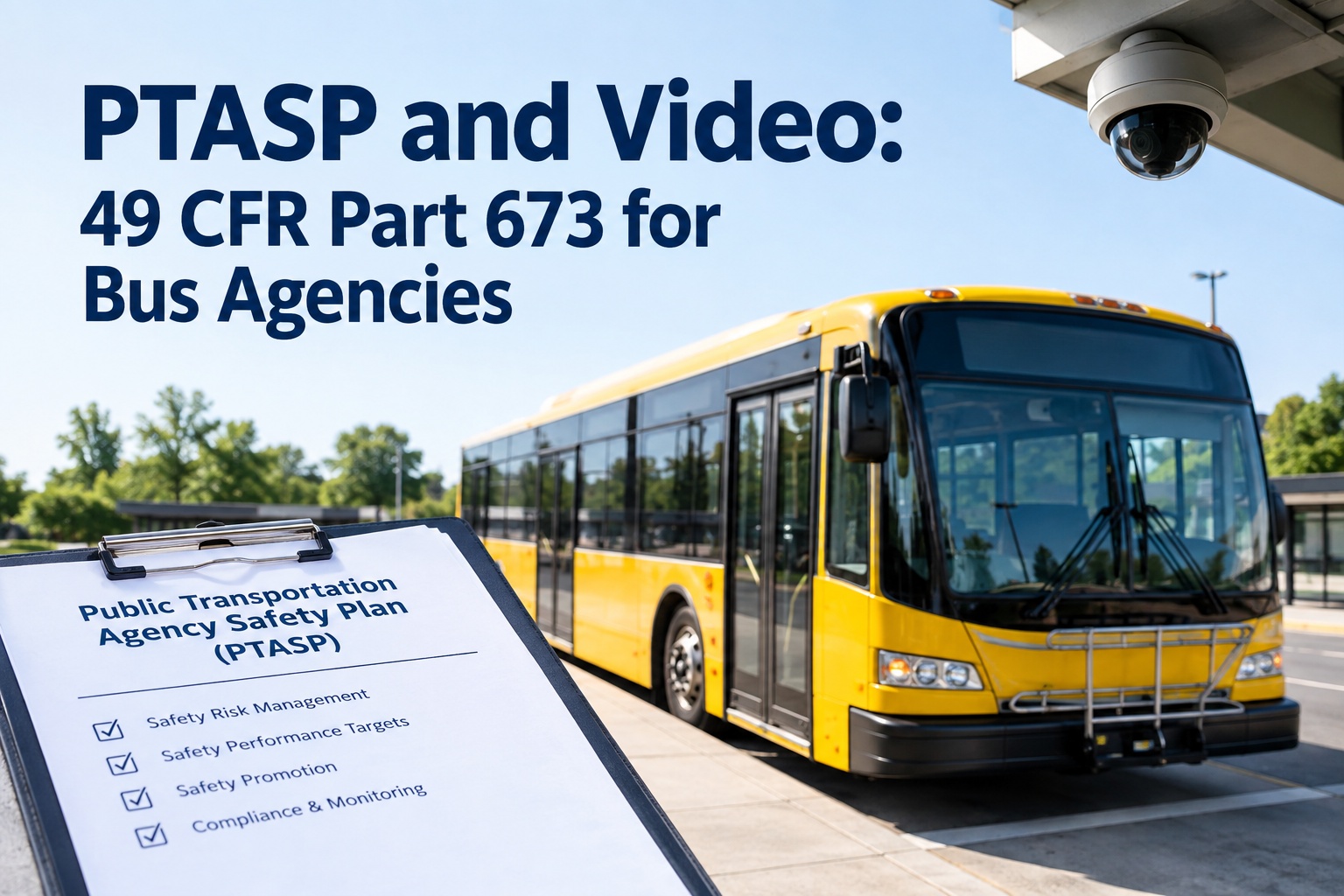
PTASP and Video: Where Bus Camera Evidence Fits in Your Safety Plan
The plain-English guide to Part 673 safety risk management, the visibility-impairment consideration in § 673.25(d)(3), and how to document a mitigation from hazard to monitoring.
Video is not the safety plan. A PTASP is the documented Safety Management System an applicable FTA-funded transit agency uses to identify hazards, assess risk, choose mitigations, and monitor them. Camera and video information can support those processes as evidence, but Part 673 does not order every agency to install cameras.
What a PTASP Is and What 49 CFR Part 673 Actually Requires
A Public Transportation Agency Safety Plan sets out how a transit agency runs a Safety Management System (SMS). It is required under 49 CFR Part 673, which applies to certain recipients and subrecipients of Federal Transit Administration grant funds that operate public transportation. It does not apply identically to everyone: rail transit and Section 5307 recipients are squarely in scope, while small providers have reduced obligations and some operators fall outside it.
The SMS at the center of your plan is built on four pillars. Every requirement hangs off one of them, and placing a task under the right pillar usually tells you what evidence it produces.
Safety Management Policy
Sets responsibilities, names the Accountable Executive, and commits leadership to safety.
Safety Risk Management
Identifies hazards, assesses risk, and selects mitigations. This is where § 673.25 lives.
Safety Assurance
Monitors whether mitigations actually work and whether new hazards appear over time.
Safety Promotion
Trains staff and communicates hazards and safety actions across the organization.
Under § 673.31, you must keep the documents describing your plan and your SMS process results for at least three years after they are created, and produce them for FTA, a State, or a State Safety Oversight Agency on request. The plan document alone is not the whole record. The evidence that a hazard was found, assessed, mitigated, and monitored is also part of the record. See how three years of safety and maintenance history stay searchable by bus.
How Safety Risk Management Works, and Where Video Comes In
Safety Risk Management under § 673.25 is a loop: you identify a hazard, assess the risk, decide on a mitigation, and Safety Assurance watches whether it holds. Camera and video information can touch several points in this loop.
- 1
Hazard Identified
Operator report, near-miss, complaint, or a pattern in event data.
Video role: surfaces or confirms the hazard - 2
Risk Assessed
Likelihood and severity weighed against the affected buses and routes.
Video role: shows real conditions, not assumptions - 3
Mitigation Selected
Engineering or operational fix chosen, assigned, and scheduled.
Video role: informs which fix addresses the real cause - 4
Action Completed
Retrofit installed, inspection done, work order closed with sign-off.
Evidence: inspection result + maintenance record - 5
Effectiveness Monitored
Assurance checks whether the events stop and no new hazard appears.
Video role: verifies the mitigation is working
The distinction to hold onto: the safety plan and its SMS records are the regulated artifact; a recording is operational evidence supporting the process. Treating your DVR as your safety program is a common mistake. Your records need the decision trail, with video referenced where it helped. Book a demo to see how a camera-flagged event links straight to the bus and its history.
Visibility Impairment and § 673.25(d)(3): Read the Applicability Line
This is the provision most tied to cameras, and the one most often misquoted. Section 673.25(d)(3) does not tell every transit agency to bolt cameras onto every bus. It is a "must consider" obligation scoped to a specific group of providers.
When identifying mitigations for the safety risk reduction program related to vehicular and pedestrian safety events involving transit vehicles, each large urbanized area provider and its Safety Committee must consider mitigations to reduce visibility impairments for transit vehicle operators that contribute to accidents, including retrofits to vehicles in revenue service and specifications for future procurements.
Paraphrased. Confirm exact wording against the eCFR before relying on it.Three things follow. First, the obligation lands on large urbanized area providers and their Safety Committees, not every operator. Second, it is a duty to consider visibility mitigations, not a mandate to buy any particular technology. Third, the named mitigations are broad: retrofits to buses in revenue service and specs written into future procurements. Cameras, monitors, mirrors, and other aids are all candidates.
For a school bus operator not funded as an applicable FTA transit provider, this framework is not your compliance path. Do not confuse Part 673 with FMCSA motor carrier rules: different agencies, different obligations, different records. If you are unsure which framework governs your operation, settle that before any technology decision, because it determines which records you keep and for whom. Book a demo to see records organized around the framework that applies to your fleet.
Mapping Each Safety Stage to the Evidence It Should Produce
A mitigation installed but never inspected or monitored is a documentation gap waiting to be found. Know, at each stage, what evidence should exist and who owns it. This table maps a visibility-related process end to end.
| Safety Stage | Bus / Camera Information | Evidence Produced | Responsible Action |
|---|---|---|---|
| Hazard ID | Operator report; recurring near-miss clips on Bus 214 | Dated hazard report tied to the asset | Safety intake logs and classifies |
| Risk Assessment | Route, load, sightline conditions from footage | Risk score with likelihood and severity | Safety Committee reviews where applicable |
| Mitigation Decision | Options: mirror retrofit, camera-monitor, procurement spec | Documented decision and rationale | Accountable Executive authorizes |
| Implementation | Retrofit installed on affected buses | Work order + parts + labor record | Shop completes and signs off |
| Verification | Post-install inspection; camera health check | Passed inspection result | Maintenance verifies function |
| Monitoring | Event rate on that route after the fix | Trend showing events dropped | Safety Assurance tracks over time |
When these six rows live in one connected record, reconstructing the case is a lookup, not a scavenger hunt. Book a demo to see a full safety-to-maintenance chain on one screen.
A Visibility Mitigation, Documented End to End
Here is an illustrative scenario with hypothetical numbers. A mid-size agency runs 60 forty-foot buses. Over one quarter, operators file repeated reports of a right-side sightline problem at right turns, with three near-misses clustered on the same eight buses of one model year.
Hazard logged
8 of 60 buses (13%) flagged. Operator reports and clips attached to each asset record.
Evidence: hazard reportRisk assessed
Rated high-likelihood, high-severity given crosswalk exposure. Reviewed per the agency's process.
Evidence: risk assessmentMitigation chosen
Camera-monitor visibility aid selected over mirror-only; decision and rationale recorded.
Evidence: mitigation decisionRetrofit + inspection
All 8 buses retrofitted. Each work order closed with a passed post-install inspection.
Evidence: work order + inspectionEffectiveness monitored
Near-misses on that turn drop to zero over the next quarter. Trend attached to the mitigation.
Evidence: monitoring trendThe point is not the specific fix, but that at every step an artifact was created and tied to the same eight buses. Twelve weeks later, the agency can show a reviewer the whole arc, from first complaint to monitored result, without reopening five systems. Procurement specs for the next order now carry the visibility requirement, closing the loop for large urbanized area providers. Book a demo to see a mitigation tracked from first report to monitored result.
Recordkeeping Failures That Surface During a Review
Most PTASP evidence problems are the same handful of gaps, and knowing them by name is half the fix. On video specifically: access, retention, redaction, and disclosure can depend on federal, state, and local law, public-records rules, and litigation holds, so there is no single answer on how long to keep footage or whether to release it. Treat each request on its facts.
- !
The static plan
Treating the PTASP as a document you wrote once, disconnected from ongoing risk management and real operational evidence.
- !
Footage as the program
Believing a camera system is the safety program, rather than a source of evidence that supports documented safety processes.
- !
The broken chain
Failing to connect a safety event to the specific bus, the defect, the work order, and the corrective action that resolved it.
- !
Install without follow-through
Documenting that a mitigation was installed but never recording the inspection, maintenance, or effectiveness monitoring.
- !
Scattered systems
Keeping records across spreadsheets and drives that are painful to reconstruct when a reviewer, subpoena, or hold arrives.
- !
One-size disclosure
Assuming every video request carries the same retention or disclosure rule, when the answer varies by law and circumstance.
Every one of these is a connection problem, not a caring problem. BusCMMS ties a safety event, the bus asset, its inspections, defects, work orders, and maintenance history to one operational record, turning scattered files into audit-ready evidence. Book a demo to close these gaps before your next review. Or sign up free and start connecting safety events to the buses they belong to.
The Bottom Line on Your PTASP Bus Safety Plan
A strong PTASP bus safety plan is not proven by the binder on your shelf. It is proven by your ability to walk a reviewer from a hazard, through the risk decision, to the retrofit, inspection, and monitoring that shows it worked, on the specific buses involved. Video and camera evidence support that story but are not the story, and are not federally mandated for every operator. Part 673 asks applicable agencies to run a living safety-management system and keep the results for at least three years. Keep your safety decisions and fleet records in one place, and audit readiness stops being a scramble. Book a walkthrough and see your safety evidence as one connected record.
Does a PTASP or 49 CFR Part 673 require every transit agency to install cameras?
No. Part 673 requires applicable FTA-funded agencies to run a Safety Management System that identifies hazards, assesses risk, selects mitigations, and monitors them. It does not order cameras across the board. The visibility provision in § 673.25(d)(3) directs large urbanized area providers and their Safety Committees to consider mitigations that reduce operator visibility impairment, which can include cameras, monitors, mirrors, retrofits, or procurement specs. Consider is not mandate, and the obligation is scoped to specific providers.
What does 49 CFR § 673.25 cover?
Section 673.25 is the Safety Risk Management component of the SMS. It requires applicable agencies to identify hazards and consequences, assess risk by likelihood and severity, and select mitigations to reduce it. For large urbanized area providers it also folds in the safety risk reduction program, including the visibility consideration at (d)(3) and assault-mitigation consideration at (d)(4). It is the pillar where cameras and video most naturally connect to the plan, as evidence supporting hazard identification and mitigation.
How can bus camera or video evidence support safety risk management?
Video can help at several points without being the plan itself: surfacing or confirming a recurring hazard, reconstructing conditions during an investigation, informing which mitigation addresses the real cause, and verifying afterward that a mitigation is working. Reference footage as supporting evidence inside a documented decision trail, not as the safety program itself.
What records should an agency keep, and for how long?
Under § 673.31, an agency must maintain the documents setting out its PTASP and the results of its SMS processes for a minimum of three years after they are created, and make them available to FTA, a State, or a State Safety Oversight Agency on request. In practice the hazard report, risk assessment, mitigation decision, implementation and inspection records, and monitoring results should all be retained and traceable to the affected vehicles. Video retention varies by law and policy and is treated separately.
How should we monitor whether a safety mitigation actually works?
Monitoring lives in Safety Assurance. After a mitigation is implemented, track the events it was meant to reduce and watch whether the rate falls and stays down, while checking no new hazard appears. Tie that trend back to the original hazard and mitigation record so the effectiveness result is part of the same case. If events continue, reassess and consider corrective action.