Transit visibility impairment refers to any condition — A-pillar blockage, mirror positioning, window frame obstruction, chassis geometry, or on-vehicle equipment placement — that reduces a transit vehicle operator’s ability to see pedestrians, cyclists, or hazards in a manner that contributes to accidents. Under 49 CFR § 673.25(d)(3), certain transit agencies must formally consider mitigations to reduce these impairments as part of their Safety Risk Management process. This guide explains who is subject to the requirement, what the rule actually requires, the mitigation options a Safety Committee can consider, and the evidence chain FTA reviewers expect. Book a walkthrough to see visibility mitigation evidence connected to live bus records.
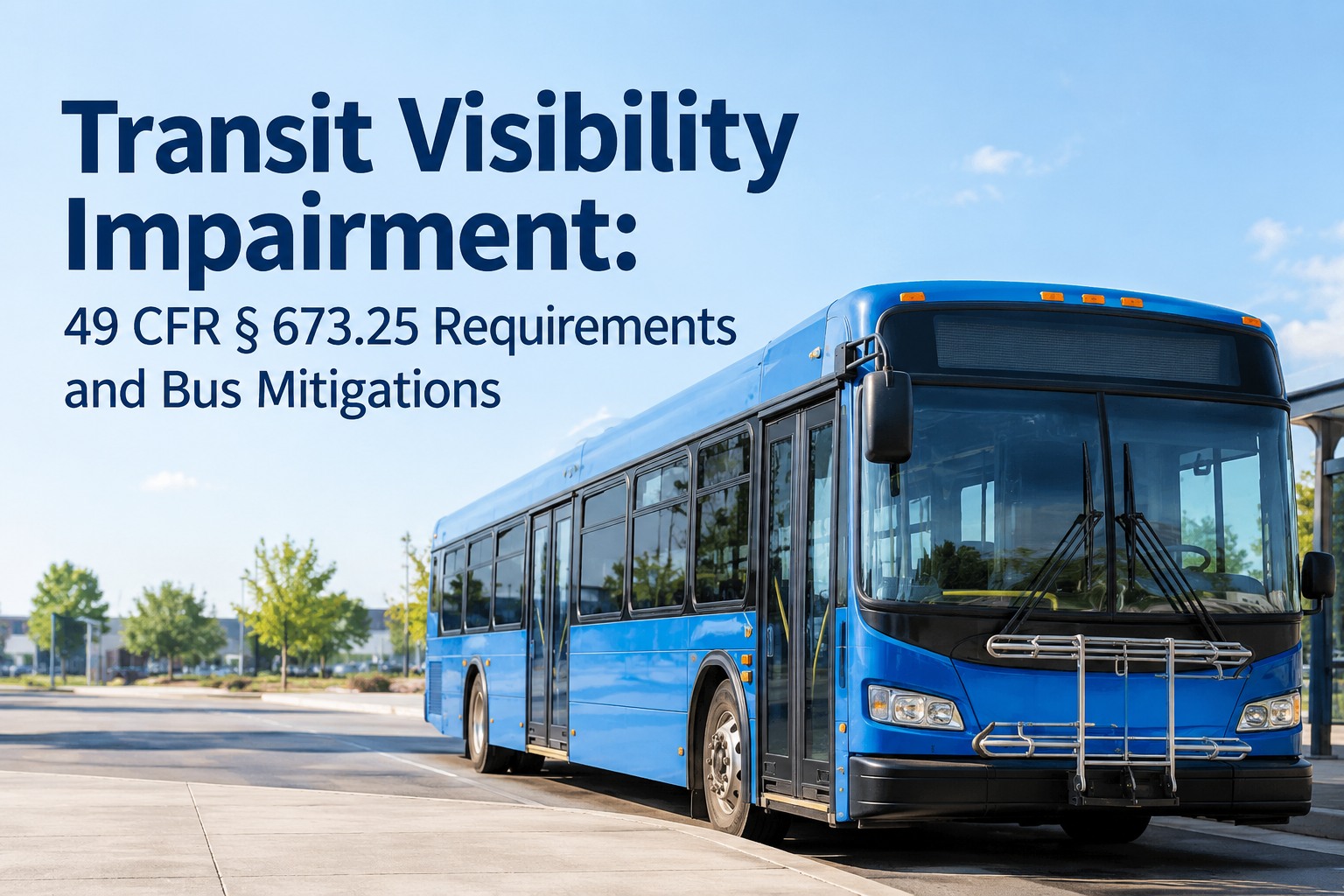
Transit Visibility Impairment: 49 CFR § 673.25 Requirements and Bus Mitigations
A practical compliance guide for transit safety directors, Public Transportation Agency Safety Plan (PTASP) compliance officers, and fleet maintenance leadership — who’s subject to the visibility-impairment mitigation rule, what mitigations qualify, and how to build the evidence chain FTA reviewers expect.
-
SUBJECT
Large urbanized area providers
FTA Section 5307 recipients in UZAs with population 200,000+
-
GENERAL PTASP
All other PTASP-covered providers
Subject to broader SMS and hazard-identification requirements, but not the specific (d)(3) consideration mandate
-
STATE-DRAFTED
Small providers (State-drafted plan)
State may draft the plan on the provider’s behalf unless the provider opts to draft its own
What 49 CFR § 673.25(d)(3) Actually Requires
The regulation, read plainly: when a large urbanized area provider’s Safety Committee identifies safety risk mitigations related to vehicular and pedestrian safety events involving transit vehicle visibility and operations, the provider and its Safety Committee must consider mitigations to reduce visibility impairments for transit vehicle operators that contribute to accidents — including retrofits to vehicles in revenue service and specifications for future procurements that reduce visibility impairments. That’s the actual language. Three things it does not say are worth stating explicitly, because vendors frequently imply otherwise.
Cameras are not mandated
The rule requires consideration of mitigations, not installation of any particular technology. Cameras are one option, not a required outcome.
Every transit agency is not subject to (d)(3)
The consideration requirement applies specifically to large urbanized area providers. Smaller providers have broader SMS obligations but not this specific mandate.
Installation alone is not compliance
Consideration must be documented through the Safety Risk Management process. Installing cameras without hazard-identification and risk-assessment records does not by itself satisfy the requirement.
The statutory chain traces to the Bipartisan Infrastructure Law at 49 U.S.C. 5329(d)(1)(I), codified through the PTASP Final Rule published April 9, 2024, and incorporated in the Agency Safety Plan at 49 CFR §§ 673.11(a)(7)(iv) and 673.25(d)(3), (5). Enforcement is real — the Federal Transit Administration (FTA) can withhold up to 25% of Section 5307 funding under 49 U.S.C. 5329, subject to written notice and reasonable cure period. Book a walkthrough to see how the mitigation decision maps to bus records.
The Safety Risk Management Flow that Ends in a Mitigation
Section 673.25 lays out the process every bus operator visibility mitigation must follow: hazard identification, safety risk assessment, mitigation identification. The visibility-impairment consideration at (d)(3) feeds into that broader flow, not a standalone requirement. The evidence FTA reviewers look for is not “did you install something” but “can you show the decision path that led there?”
- 1
Hazard identification
Identify visibility hazards from operator reports, incident data, near-misses, oversight guidance, safety assurance activities.
OUTPUT: Documented hazard list - 2
Safety risk assessment
Assess likelihood and severity of consequences for each identified visibility hazard. Prioritize per the agency’s risk assessment methodology.
OUTPUT: Prioritized risk register - 3
Mitigation identification & approval
Safety Committee considers mitigation options including retrofits and procurement specs. Accountable Executive approves and implements per § 673.11(a)(7)(iv).
OUTPUT: Approved mitigation record
Notice how the three outputs stack. FTA reviewers can request any of them. An agency that installed cameras but can’t produce the underlying hazard identification and risk assessment has installed hardware, not implemented a mitigation. That’s the compliance distinction. Book a walkthrough to see mitigation decisions attached to bus records.
Visibility Mitigation Options — Hazard, Mitigation, Evidence, Maintenance
The rule requires Safety Committees to consider mitigations — meaning the decision record needs to show what was evaluated and why one option was chosen. The matrix below covers the most common transit bus blind spots and other visibility hazards with mitigation approaches typically evaluated. Use it as an evaluation framework, not a checklist to complete.
- HAZARDMITIGATION OPTIONSEVIDENCE RECORDMAINTENANCE
- A-pillar blind spotMirror repositioning, A-pillar cameras with cab monitor, operator trainingRetrofit work order, installation photo, calibration recordLens cleanliness, mount integrity, monitor function checks
- Front-right corner obstructionConvex mirror, forward-right camera, revised mirror geometry in future procurement specProcurement specification amendment, retrofit record, before/after testAlignment verification, wiring inspection, image-quality checks
- Rear-view obstructionRear camera with cab monitor, additional convex mirrorsCamera install work order, monitor placement recordCamera housing cleaning, monitor brightness check, cable inspection
- Curb-side pedestrian zoneSide-mounted cameras, pedestrian detection sensors, operator awareness trainingRetrofit authorization, training completion recordsSensor calibration, camera field-of-view verification
- Windshield glare / weatherAnti-glare treatment, wiper improvements, defroster upgrades in procurement specProcurement spec update, retrofit work orderWiper condition inspection, defroster functional check
Look at the “maintenance” column. This is where most visibility mitigation programs quietly fail. A camera-monitor system installed in 2024 with a dirty lens or dead monitor by 2026 is no longer a mitigation — it’s a documented mitigation that isn’t working. FTA’s Safety Assurance requirements at § 673.27 include monitoring for mitigations that are ineffective, inappropriate, or not implemented as intended. Transit camera maintenance is compliance evidence, not an operational nice-to-have. Book a walkthrough to see camera defects flowing into work orders automatically.
Retrofit vs. Procurement Specification — Both Vectors Named in the Rule
The regulation explicitly names two mitigation vectors: retrofits to vehicles already in revenue service, and specifications for future procurements. These are different compliance workflows with different evidence trails — bus camera retrofit projects and future procurement specification updates typically run as parallel tracks in the same mitigation decision.
RETROFIT PATH
Vehicles in revenue service
- Identify affected vehicles by hazard type
- Approve retrofit specification via Safety Committee
- Generate work orders per bus
- Install, inspect, verify field-of-view
- Log completion on each vehicle asset record
- Add ongoing inspection to PM schedule
TYPICAL TIMELINE: 3-9 months for a mid-size fleet
PROCUREMENT SPEC PATH
Future orders
- Document visibility requirement in procurement spec
- Reference specific field-of-view, camera, or geometry criteria
- Include verification protocol in vehicle acceptance testing
- Confirm compliance at delivery
- Log acceptance results on the vehicle asset record
- Establish ongoing inspection cadence
TYPICAL TIMELINE: Next procurement cycle
The evidence FTA looks for is different on each path. On retrofit, they want the work order chain per bus. On procurement, they want the specification document with visibility language and acceptance-test records for delivered vehicles. A large UZA provider replacing 40 buses over five years but doing no retrofit on the remaining fleet has partial mitigation — defensible only if the risk assessment explicitly supports it. Book a walkthrough to see retrofit work orders tracked at the vehicle level.
The Evidence Chain — Worked Example, 40-Foot Transit Bus
A 180-bus urban transit agency identifies a recurring front-right pedestrian near-miss pattern on its 40-foot low-floor buses, tied to A-pillar geometry blocking sightlines during right turns. Twelve buses of the same model are affected. Here’s the evidence chain a proper mitigation decision produces.
- HAZARD REPORTOperator and incident data show 7 near-misses in 4 months, all front-right pedestrian visibility on 40-foot low-floor buses.
- RISK ASSESSMENTSafety Committee assesses likelihood as recurring, consequence as severe. Prioritized on risk register.
- MITIGATION EVALUATIONCommittee compares mirror repositioning, A-pillar camera-monitor retrofit, and operator training. Rationale documented.
- DECISION & APPROVALRetrofit A-pillar camera-monitor on all 12 affected buses. Approved by Accountable Executive per § 673.11(a)(7)(iv).
- WORK ORDERS12 work orders, one per bus. Retrofit specification attached. Technicians logged.
- INSTALLATION & VERIFICATIONInstall completed, field-of-view verified, before/after photos, calibration recorded per bus.
- ONGOING INSPECTIONCamera and monitor added to daily DVIR and 90-day PM. Defects generate work orders automatically.
- EFFECTIVENESS MONITORINGNear-miss frequency tracked 12 months post-retrofit. Committee reviews under Safety Assurance § 673.27.
Eight distinct records. When an FTA reviewer asks “show me your visibility mitigation for these 12 buses,” the agency should produce every link from the same system. The failure mode: hazard reports in one spreadsheet, mitigation decisions in a minutes folder, work orders in maintenance software, inspections in DVIR software, transit video evidence in a separate camera portal, monitoring in yet another dashboard. Recreating the evidence chain across five disconnected systems is where compliance costs actually accumulate. Sign up free to see the connected evidence workflow.
Six Compliance Failures Worth Knowing About
Every experienced PTASP compliance officer has a shortlist of failures they’ve either watched happen or barely avoided. These six show up most often in FTA reviews and State Safety Oversight audits of transit visibility programs.
- 01
Installing cameras without documenting the hazard
Purchase order and installation records exist, but no hazard identification or risk assessment justifies the mitigation. Hardware present, process missing.
- 02
Treating installation as proof of compliance
Assuming the mitigation is complete once equipment is on the bus. The rule requires ongoing monitoring under Safety Assurance § 673.27.
- 03
No documented alternatives comparison
Minutes show a mitigation was approved but not what alternatives were evaluated. The word “consider” in the rule implies alternatives were weighed.
- 04
Camera equipment falls out of maintenance
Dirty lenses, misaligned mounts, or dead monitors make the mitigation ineffective — but the equipment stays on the bus, creating a documented mitigation that no longer works.
- 05
Records scattered across disconnected systems
Minutes, work orders, DVIRs, and monitoring data live in separate tools with no shared vehicle asset key. Reconstructing the evidence chain per bus takes days.
- 06
Confusing FTA transit rules with FMCSA
FTA PTASP requirements at 49 CFR Part 673 are a separate regulatory regime from FMCSA commercial-motor-carrier rules. Applying FMCSA frameworks to PTASP compliance is a category error.
BusCMMS approaches transit safety risk mitigation as one part of connecting operational and maintenance data around each bus asset — retrofit work orders, camera inspections, defect reports, and mitigation effectiveness on the same vehicle timeline. This does not by itself create regulatory compliance; the PTASP process, Safety Committee decisions, and Safety Risk Management framework remain the agency’s responsibility. Connected records make the evidence chain reproducible per bus — turning bus maintenance compliance from a fire drill into a workflow. Book a walkthrough to see the evidence chain live.
This page is fleet-management and compliance-operational guidance — not legal advice. Regulatory interpretation, applicability determinations, PTASP design, evidence retention, and video privacy handling should be reviewed with your Chief Safety Officer, legal counsel, and PTASP or State Safety Oversight Agency. Verify all citations against current eCFR text and current FTA guidance before compliance decisions.
Does 49 CFR § 673.25 require transit agencies to install bus cameras?
No. The rule at § 673.25(d)(3) requires large urbanized area providers and their Safety Committees to consider mitigations to reduce visibility impairments for transit vehicle operators that contribute to accidents. Cameras and camera-monitor systems are one potential mitigation, not a required outcome. The mitigation implemented must be supported by hazard identification and risk assessment under the Safety Risk Management process. Vendors implying a universal camera mandate are misreading the regulation.
Which transit agencies must consider visibility-impairment mitigations under (d)(3)?
The requirement at § 673.25(d)(3) applies specifically to large urbanized area providers — FTA Section 5307 recipients in urbanized areas with population of 200,000+ — and their joint labor-management Safety Committees. Smaller PTASP-covered providers remain subject to broader Safety Management System and hazard identification requirements under Part 673 but not the specific (d)(3) mandate. Confirm your agency’s applicability with your PTASP program contact or State Safety Oversight Agency.
What visibility mitigations can a transit agency consider?
Common options evaluated by Safety Committees include mirror repositioning and convex mirrors, transit bus camera systems (A-pillar, forward-right, rear, side-mounted), pedestrian detection sensors, anti-glare windshield treatments, defroster and wiper improvements, operator training, and vehicle geometry changes specified in future procurements. Each mitigation must be supported by the agency’s documented risk assessment. The rule names two vectors — retrofits to vehicles in revenue service and future procurement specifications — and most large UZA providers run both concurrently.
What evidence should a transit agency retain to prove compliance?
A defensible evidence chain typically includes the hazard identification record, safety risk assessment, mitigation alternatives evaluation, Safety Committee decision, Accountable Executive approval, procurement spec amendments where applicable, retrofit work orders per bus, installation records, ongoing inspection results, camera defect reports, corrective work orders, and effectiveness monitoring under Safety Assurance § 673.27. Under 49 CFR 673.31, PTASP documentation carries a minimum three-year retention requirement.
How should transit agencies monitor whether a visibility mitigation is working?
Section 673.27 Safety Assurance requires transit agencies to monitor safety risk mitigations for effectiveness and identify mitigations that are ineffective, inappropriate, or not implemented as intended. Practical monitoring typically includes tracking pre- and post-mitigation incident and near-miss data for affected vehicles, verifying equipment remains functional through DVIR and PM inspections, generating work orders for camera and monitor defects, and periodic Safety Committee review. A mitigation documented on paper but degraded in the field is a finding waiting to happen.