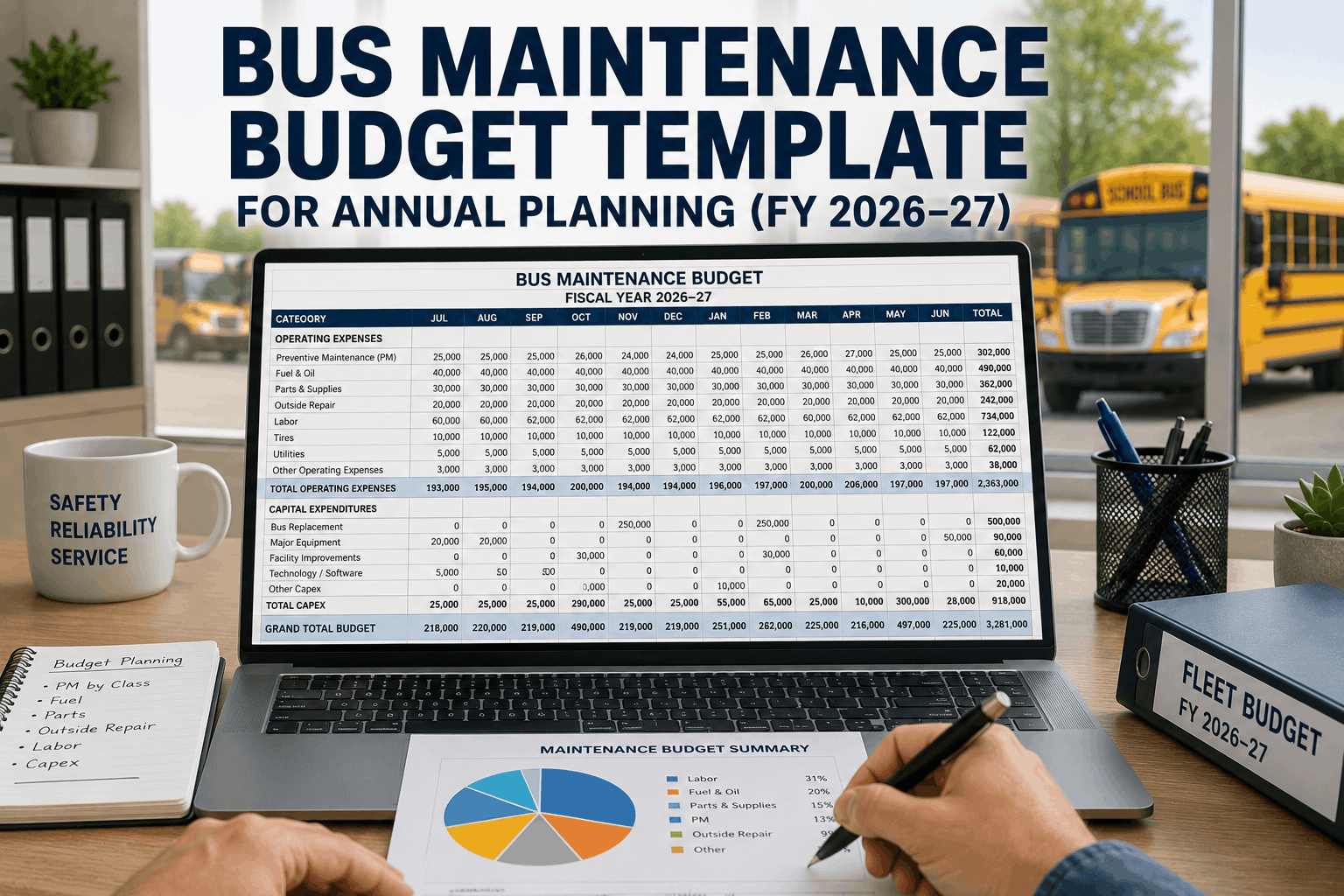
Building a comprehensive bus maintenance budget is the first step toward controlling fleet costs and avoiding emergency expenditures. The right bus maintenance budget template helps school districts, transit agencies, and charter operators plan annual spending by class, fuel, parts, outside repair, labor, and capital improvements. With a data‑driven fleet budget Excel or spreadsheet, you can forecast total cost of ownership, allocate preventive maintenance funds, and track actual vs. planned expenses month by month. This guide provides a free, actionable framework for your FY 2026–27 fleet budget planning—built specifically for bus fleets that run daily routes and demand high uptime.
Bus Maintenance Budget Template 2026
Bus Maintenance Budget Template for Annual Planning (FY 2026–27)
Free fleet budget Excel framework. Plan PM by class, fuel, parts, outside repair, labor, and capex. Designed for school districts, transit authorities, and private charter operators.
Why Every Bus Fleet Needs an Annual Budget Template
Without a documented fleet budget, maintenance spend becomes reactive—parts purchases surge, labor overtime spikes, and capital projects get postponed. A structured bus maintenance budget template forces an annual review of operational costs, identifies seasonal peaks, and aligns financial resources with PM schedules. In US school districts, transportation departments that adopt a formal budget spreadsheet reduce year‑end variances by 18–25%. Transit agencies using fleet financial planning tools report 15% fewer emergency repairs because scheduled work is fully funded. The template becomes a living document that connects bus PM budget allocations, outside repair accruals, and capex requests to actual mileage and age projections.
18–25%
Reduction in budget variance
15%
Fewer emergency repairs
100%
PM schedule funding alignment
12%
Lower total cost per mile
The biggest budgeting mistake is treating maintenance as a single line item. A proper bus maintenance budget template breaks spending into distinct classes: preventative maintenance, unscheduled repairs, tires, bodywork, and major component overhauls. When you track these individually, you can see exactly where your dollars go and where inflation or driver behavior is driving costs upward.
Key Budget Categories Every Fleet Template Must Include
Your bus fleet budget spreadsheet should separate fixed and variable costs. Fixed expenses include facility leases, insurance, and software subscriptions; variable expenses rise with mileage—fuel, tires, and brake jobs. The template must also include a provision for capital expenditures (capex) such as bus replacements or major retrofits. By categorizing spending this way, you can run what‑if scenarios: if mileage increases 10%, how does that affect the fuel and PM budget lines? BusCMMS directly imports your actual maintenance spend and allocates it to the same categories, giving you a real‑time budget vs. actual view.
PM by Class
Break down preventive maintenance costs by vehicle type (school bus, transit, motorcoach) and age.
Fuel & Fluids
Track diesel, DEF, and oil consumption trends against budgeted gallons and price assumptions.
Outside Repair
Budget for vendor overhauls, transmission work, and emergency roadside assistance.
Labor & Overtime
Allocate technician hours and overtime by skill level, factoring in peak seasons.
How to Project Fleet Maintenance Costs Accurately
| Cost Driver | Forecasting Method | Recommended Data Source |
|---|---|---|
| PM intervals | Mileage‑based scheduling | OEM manuals & BusCMMS PM engine |
| Part prices | 12‑month rolling average | Inventory purchase history |
| Fuel cost | Contracted price + 5% buffer | Fuel card reports |
| Outside repair | Historical spend + inflation | Closed work orders (BusCMMS) |
| Capex | Age/condition replacement plan | Fleet asset register |
The most accurate fleet budget Excel template uses a bottom‑up approach: start with expected mileage, then calculate PM events, estimate part consumption, and apply labor rates. Adjust for seasonality—school bus fleets often peak just before the academic year. BusCMMS automates this projection by pulling real maintenance history and generating a draft annual budget that you can refine in minutes, not weeks.
Sample Budget Allocation for a 50‑Bus School District
Using this donut breakdown, a transportation director can immediately see that labor and parts consume two‑thirds of the budget. The template helps identify where small percentage changes—like reducing overtime by re‑timing PMs—can free up thousands of dollars for other priorities.
We started using a detailed bus maintenance budget template two fiscal years ago. Before that, we constantly overspent on outside repairs because we didn't separate emergency from planned work. Now we allocate $42,000 less per year on emergency repairs and have fully funded our PM program. The template, combined with BusCMMS tracking, gave us the data to defend our budget requests to the school board. Our cost per mile dropped from $0.87 to $0.74 in 18 months.
Automate Your Fleet Budget with BusCMMS
BusCMMS links your actual maintenance spend directly to budget categories. Real‑time dashboards show where you stand against plan, and the built‑in PM scheduler feeds your budget projections automatically. Stop building spreadsheets from scratch—start with a smart, connected budget.
Bus Maintenance Budget FAQ
What is included in a bus maintenance budget template?
It covers PM by class, fuel, parts, labor, outside repair, and capital projects. It also includes a variance tracker for actual vs. planned spending.
How much should a school bus fleet budget per bus annually?
US school districts typically budget $6,500–$9,200 per bus per year depending on age and route type.
Can I use this template for transit bus fleets?
Yes. Transit agencies adjust line items for higher fuel and brake consumption and federal grant reporting.
How does BusCMMS improve budget accuracy?
It imports real repair orders and part costs, then auto‑categories them against your budget lines for live tracking.
What is the biggest budget mistake fleets make?
Treating maintenance as a single lump sum instead of breaking it into variable and fixed cost categories.
How often should I update my fleet budget?
Review monthly and adjust quarterly based on actual spend and any changes in route mileage or fuel prices.
Does the template handle multi‑year capital planning?
Yes, it includes a capex sheet for bus replacements and major component overhauls across a 5‑year horizon.
Where can I get help setting up my first budget?
Our support team offers free onboarding and budget review—just schedule a demo from the link above.
Take Control of Your Fleet Financial Planning
A solid bus maintenance budget template transforms scattered expense data into a clear, defensible spending plan. By categorizing every dollar—PM, fuel, parts, outside repair, labor, and capex—you can uncover savings, justify requests, and keep your buses on the road without surprise bills. Coupled with BusCMMS, your budget becomes a live management tool, not a static spreadsheet. Start building your FY 2026–27 budget today and move from reactive spending to proactive fleet financial control.