Consignment Parts Inventory for Bus Fleets: Pros & Cons
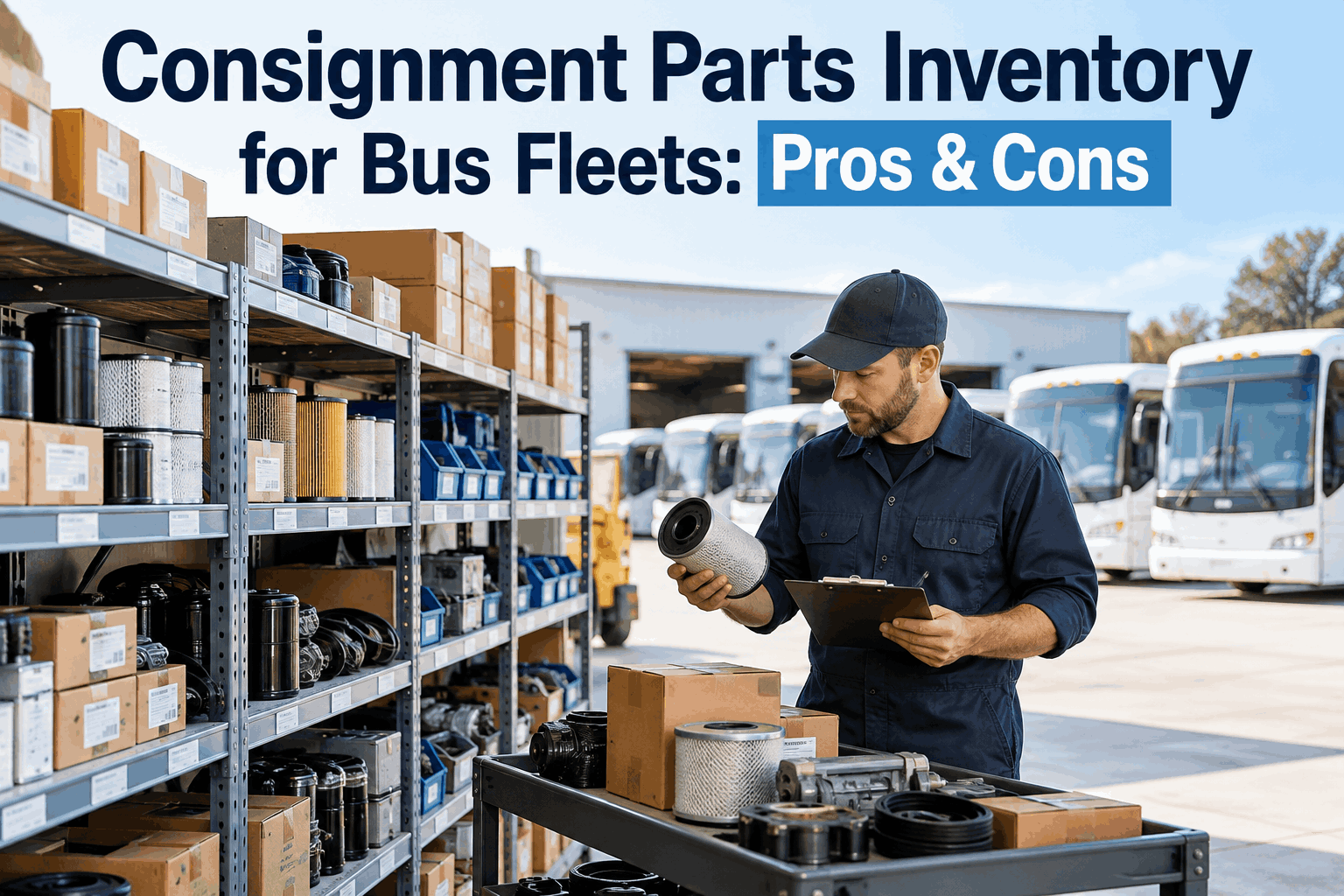
A bus shop can have thousands of dollars tied up in filters, brake components, electrical parts, belts, hoses, sensors, and other spares before a technician ever installs them. Consignment parts inventory changes that cash-flow model: selected stock can remain supplier-owned while it sits in the fleet's parts room, with the fleet paying when the part is consumed under the terms of its supplier agreement. The opportunity is attractive, but the process only works when ownership, usage, replenishment, counts, pricing, returns, and accountability are clearly controlled.
BUS SHOP PARTS CONTROL
The Part Is on Your Shelf. But Who Owns It?
Consignment can reduce cash tied up in selected spare parts while keeping frequently needed items close to the maintenance operation. The tradeoff is a tighter need for transaction accuracy and a supplier agreement that leaves no ambiguity about stock.
Ownership Stays With the Supplier Until the Agreed Consumption Event
In a typical consignment arrangement, the supplier places agreed parts at the fleet's location while retaining ownership until a defined event—commonly issue or consumption—creates the fleet's payment obligation. The exact transfer point, invoicing process, price, count procedure, loss responsibility, return rules, and replenishment method should be stated in the agreement rather than assumed.
Fleet-Owned Stock and Consignment Put Cash and Control in Different Places
FLEET-OWNEDBuy → Store → Use
$Cash committed before use
Fleet purchases stock before it is consumed.
Fleet owns the inventory in the parts room.
Unused stock remains fleet capital and inventory.
Fleet controls sourcing and stocking decisions directly.
VS
CONSIGNMENTStore → Use → Pay
$Payment triggered by agreed use
Supplier retains ownership before the transfer event.
Fleet gets local access to agreed stock.
Accurate issue records drive reconciliation and billing.
Supplier terms influence assortment and replenishment.
FLEET-OWNED EXAMPLE$40,000
Illustrative stock purchased up front
Working capital timingCash committed at purchase
CONSIGNMENT EXAMPLEPay as used
Subject to supplier agreement
03
THE FINANCIAL CASE
The Benefit Is Timing of Capital—Not “Free” Inventory
Consignment can reduce the amount of fleet cash committed to selected parts sitting on the shelf before use. That can be valuable for an operation trying to preserve working capital while maintaining access to predictable maintenance items. But supplier ownership does not eliminate cost. The fleet still pays for consumed parts, and the commercial terms may include pricing, service levels, minimum volumes, dedicated space, reconciliation requirements, or other obligations.
Finance question:How much capital would otherwise be tied up in the exact parts being considered for consignment, and what commercial terms are required in exchange?
04
SUPPLIER AGREEMENT
Define the Rules Before the First Consigned Part Reaches the Shelf
The agreement is the operating rulebook for the program. Maintenance, parts, procurement, and finance should understand the same transfer point and reconciliation process. Ambiguous ownership or billing rules can turn a working-capital initiative into an inventory dispute.
CONSIGNMENT STOCK AGREEMENTCONTROL POINTS
01Ownership transferDefine exactly when title and payment obligation move to the fleet.
02PricingState price basis, changes, discounts, credits, taxes, and invoice timing.
03Stock levelsAgree which SKUs, quantities, min/max levels, and replenishment responsibility apply.
04Counts & reconciliationSet count frequency, variance review, and transaction matching.
05Loss & damageAssign responsibility for missing, damaged, obsolete, or expired inventory.
06Returns & terminationDefine excess-stock removal, credits, program exit, and final reconciliation.
DO NOT LEAVE UNDEFINEDWho pays for a part that cannot be found during the physical count?
The answer should come from the agreement and the transaction record—not from a debate after a variance appears.
OwnerNamed
Count cycleDefined
Variance processDefined
Exit termsDefined
05
MIN / MAX STOCK
Consignment Still Needs Stocking Discipline
Supplier ownership does not justify filling every bin. The fleet and supplier still need rational stocking levels based on usage, lead time, service criticality, package quantities, storage constraints, and agreed replenishment frequency. Frequently consumed parts with predictable demand are often easier to manage than highly specialized items with uncertain use.
Every Shelf Withdrawal Should Become an Inventory Transaction
The weak point in many consignment programs is not receiving stock—it is recording consumption. If a technician takes a part without an issue transaction, the physical quantity falls while the system quantity remains unchanged. That creates count variances, delayed replenishment, invoice disputes, and uncertainty about the true cost of the repair.
1Identify PartSKU / bin / description
→
2Select Work OrderBus + repair event
→
3Enter QuantityUnits actually issued
→
4Reduce On HandSystem follows shelf
→
5ReconcileUsage supports settlement
CONSIGNMENT USAGE LOGWEEK 38
PARTBUS / WOQTYSTATUS
Oil Filter142 / #284171Recorded
Belt118 / #284261Recorded
Relay205 / #284312Recorded
Illustrative usage log
07
PROS & TRADEOFFS
Evaluate the Operating Model, Not Just the Cash Benefit
POTENTIAL ADVANTAGES
Working capital
Less fleet cash may be committed to selected inventory before consumption.
Local availability
Agreed stock can remain physically available at the maintenance location.
Replenishment support
Supplier participation can simplify replenishment when responsibilities are clear.
Demand visibility
Consistent usage records can improve conversations about actual stocking needs.
DECISION≠Cash alone
TRADEOFFS TO CONTROL
Supplier dependence
Availability and assortment can become more closely tied to one supplier relationship.
Transaction discipline
Unrecorded issues quickly undermine quantity and billing accuracy.
Commercial terms
Pricing, volumes, ownership, loss, and exit provisions require careful review.
Physical reconciliation
Supplier and fleet records need a defined process for resolving variances.
Where Consignment Is Easier—and Where More Analysis Is Needed
A fleet does not need to convert its entire parts room. A targeted program can focus on SKUs where demand and supplier support make the arrangement practical. The matrix below is a decision framework rather than a universal rule; procurement and finance should evaluate actual contract economics.
HIGHER USAGE →
STRONGER CANDIDATEFrequent use + dependable supplyFilters, common service items, selected repeat-demand parts
REVIEW TERMSFrequent use + limited supplier optionsAssess pricing, continuity, and dependency.
REVIEW NEEDLow use + dependable supplyCompare shelf value with lead-time risk.
MORE ANALYSISLow use + uncertain demandAvoid stocking simply because ownership is deferred.
SUPPLY / DEMAND FIT →
09
RECONCILIATION
Make Physical Count, System Quantity and Supplier Quantity Agree
Consignment creates two parties with a financial interest in the same shelf. That makes reconciliation a core control. Compare physical stock with the fleet's recorded on-hand quantity and the supplier's consignment record at the agreed interval. Investigate differences by reviewing receipts, issues, returns, transfers, damaged stock, and adjustments.
PHYSICAL COUNT47Units on shelf
=?
FLEET RECORD48System on hand
=?
SUPPLIER RECORD48Consigned balance
VARIANCE−1
Review issues, returns, damage and adjustments before settlement.
Launch With a Controlled SKU Set, Then Measure the Result
01BaselineMeasure current usage, purchases, on-hand value, stockouts, and supplier lead times.
→
02Select SKUsChoose parts with a clear operational and financial reason for consignment.
→
03Agree TermsDocument ownership, price, counts, loss, replenishment, returns, and exit.
→
04Control UsageIssue every consumed part to the appropriate work or maintenance record.
→
05ReviewCompare capital timing, availability, variances, price, and administrative effort.
PILOT QUESTIONDid the arrangement improve parts availability or capital efficiency without creating unacceptable cost, dependency, or inventory-control problems?
Questions to Answer Before Signing a Consignment Agreement
01Which SKUs?What usage and criticality justify local consigned stock?
02Who owns it?When does ownership and payment obligation transfer?
03At what price?How are price changes, credits, and invoices handled?
04Who replenishes?What min/max or service rules govern restocking?
05How is use recorded?What transaction links each part to maintenance activity?
06Who counts?How often are physical and system balances reconciled?
07Who owns variance?What happens with loss, damage, obsolete stock, or discrepancies?
08How do we exit?What happens to remaining stock when the program ends?
Consignment parts inventory can be a useful tool for a bus fleet that wants selected parts available without purchasing every unit before use. It is not automatically the lowest-cost model, and it does not replace inventory discipline. The strongest programs align the supplier agreement, physical shelf, work-order issue process, reconciliation routine, and financial record so every part has a clear owner and every consumption event has a traceable transaction.
FREQUENTLY ASKED QUESTIONS
Consignment Parts Inventory for Bus Fleets
What is consignment parts inventory?
Consignment parts inventory is stock physically held at the fleet's location while ownership remains with the supplier until a transfer event defined by the agreement. The fleet then pays according to the agreed consumption, billing, and reconciliation terms.
What is the main financial benefit of parts consignment?
The primary potential benefit is working-capital timing. For selected parts, the fleet may avoid paying for inventory before it is consumed. The full financial case should also consider pricing, contractual commitments, administrative effort, supplier dependence, and inventory accuracy.
Which bus parts are suitable for consignment?
There is no universal list. Fleets can evaluate parts based on usage frequency, lead time, service criticality, value, storage needs, supplier reliability, and contract economics. Predictable repeat-demand items may be easier to administer than highly uncertain stock.
How should a fleet control consigned inventory?
Use clearly identified stock locations, record every receipt and issue, connect consumption to the appropriate work order or maintenance record, perform agreed physical counts, investigate variances, and reconcile fleet records with supplier records.
What should a consignment parts agreement include?
The agreement should clearly address ownership transfer, pricing and invoicing, included SKUs and quantities, replenishment, physical counts, variance resolution, loss or damage, obsolete stock, returns, credits, service expectations, and termination or exit procedures.