Your Bus 47 rolls into the state inspector’s bay on a Tuesday morning. Everything checks out until the inspector taps a pushout window on the driver’s side and it does not budge. He pulls out his book, flips to the 49 CFR 396.3 tab and writes it up. That single stuck window is now a violation with fines that can reach $23,048 in 2026, an out-of-service order, and a documentation trail question about when your last emergency exit inspection actually happened. If you can produce a signed 90-day bus inspection checklist for the previous quarter, you probably survive. If you cannot, the finding compounds fast. This is the checklist that keeps your 90-day inspection cycle defensible for every emergency exit, pushout window, and marking light on every bus in your fleet.
The 90-Day Bus Inspection Checklist for Emergency Exits, Pushout Windows & Warning Lights
A quarter-by-quarter inspection routine grouped by exit component -- with the exact FMCSA requirements, reject triggers, and record-retention rules that pass a DOT audit.
- 4 cycles per year
- 14 months record retention
- FMVSS 217 exit standard
- $23,048 max penalty
Get this exact 90-day checklist auto-loaded into your fleet DVIR — scheduled, signed, and stored for the full 14 months FMCSA requires. Zero paper.
Built for bus fleets only. Not trucking software adapted.
Why the 90-Day Bus Inspection Rule Exists (and Why FMCSA Enforces It)
Every bus operating under DOT authority faces three overlapping inspection cycles. Drivers complete DVIRs under 49 CFR 396.11 at the end of every operating day. Annual inspections under 49 CFR 396.17 hit once every 12 months. And in the middle sits a quieter rule that trips up more fleets than either of the others -- 49 CFR 396.3(a)(2), which requires that pushout windows, emergency doors, and emergency door marking lights on buses be inspected at least every 90 days. That is four documented cycles per bus per year, on top of everything else.
The rule exists because emergency exits are the one system that has to work perfectly on the day it is actually needed. A stuck pushout window during a rollover is not a maintenance issue. It is a mass-casualty risk. FMCSA does not care that the exit worked at the annual inspection eleven months ago. The agency wants to see a signed inspection record from the last 90 days. Only 7% of motor carriers pass a full DOT compliance audit without a single violation, and missing 90-day records is one of the most common failure points. Book a demo to see 90-day inspection scheduling built into BusCMMS.
The 90-Day Bus Inspection Checklist for Emergency Exits (Exit by Exit)
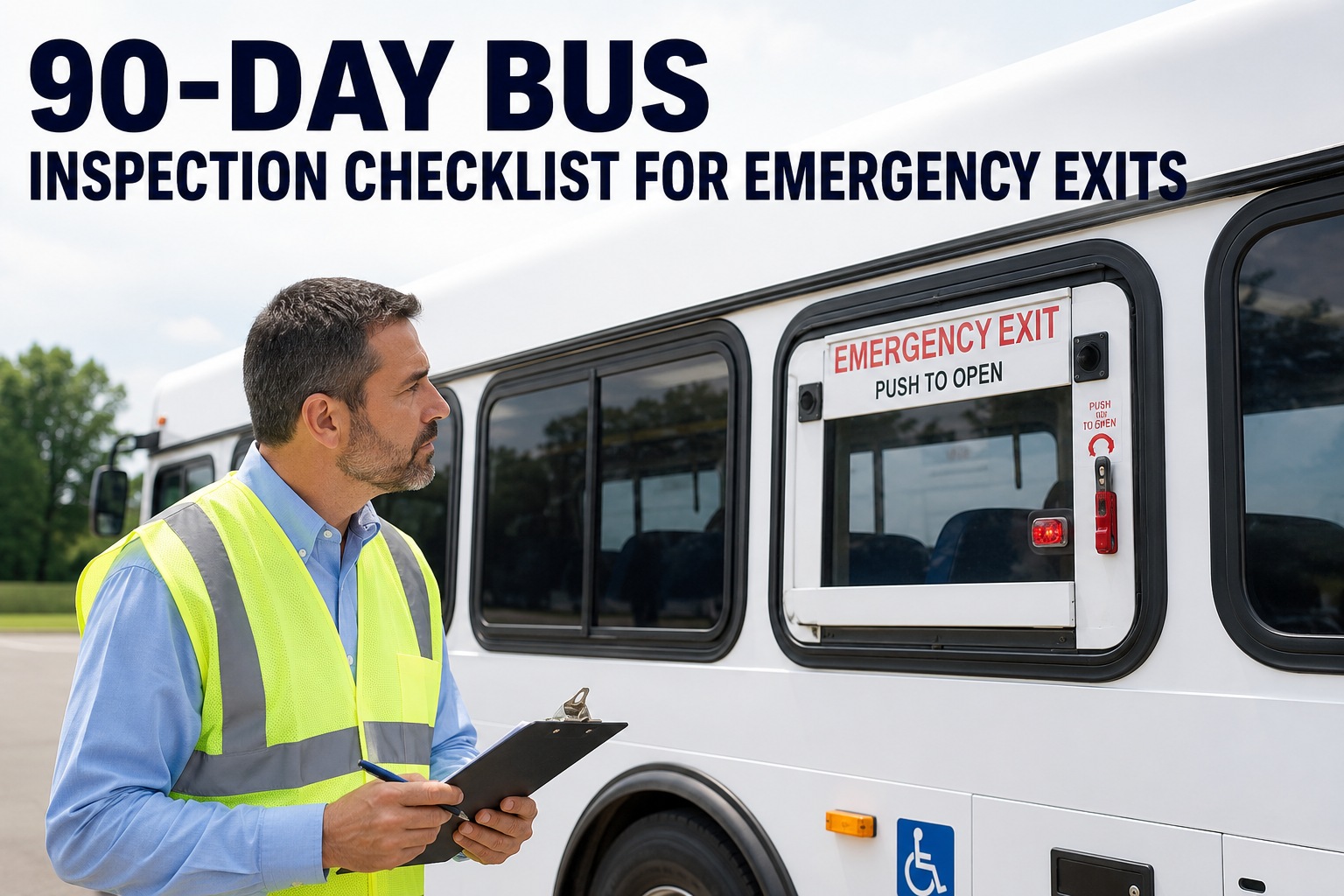
Every 90 days, a qualified inspector walks each bus with this list. The checklist below is grouped by the six exit zones marked in the diagram above. Every item is a real-world inspection point that maps back to FMCSA 396.3 and FMVSS 217. If any item lands as a reject, the bus does not roll until it is corrected and re-signed. Book a demo to see these zones inside a live digital 90-day inspection form.
Rear Emergency Door
FMVSS 217 · primary emergency egress- Opens fully from inside with less than 40 lbs of force at the release handle
- Emergency warning buzzer sounds when door opens with ignition on
- Hinges free of corrosion, no binding, no play at pivot points
- Weather seal intact, no daylight visible around the frame
- Handle rotates freely, latch engages fully on close
Reject if Buzzer silent, latch sticks, or force to open exceeds spec.
Side Emergency Door
FMVSS 217 · secondary egress on longer buses- Opens freely with no aisle obstruction blocking access path
- Warning buzzer wired and audible, ignition-linked
- Handles operate smoothly inside and outside
- Reflective marking around frame visible, not painted over
Reject if Access blocked, buzzer inoperative, or exterior handle seized.
Roof Escape Hatch
FMVSS 217 · overhead emergency egress- Opens to full ventilation position and locks in that state
- Emergency release operates from inside without a tool
- Weather seal intact, no water staining on interior headliner
- Instructional decal readable, arrows aligned with release direction
Reject if Release binds, decal unreadable, or seal shows leak history.
Pushout / Kick-Out Windows
49 CFR 396.3(a)(2) · primary target of the 90-day rule- Each latch releases with manufacturer-specified force
- Window pushes out cleanly without frame binding or hesitation
- Return-spring or hinge reseats window flush to weather seal
- Frame free of impact damage that could jam mechanism
- Bright red release handle visible, not obstructed by decals
Reject if Any window binds, latch seized, or handle marker obscured.
Emergency Door Marking Lights
49 CFR 396.3(a)(2) · explicitly called out by name- All marking bulbs illuminate when door is opened
- Lens intact, no cracks, no water intrusion in housing
- Correct color output per FMVSS 217 for each exit type
- Wiring harness secured, no exposed conductors or rubs
Reject if Any bulb dark, lens cracked, or wiring shows damage.
Reflective Signage & Instructions
FMVSS 217 · visibility & instruction placards- Every “Emergency Exit” label present at each exit per FMVSS 217
- Reflective material meets brightness under low light
- Operating instruction decals readable, no fading or peeling
- Directional arrows align with actual release motion
Reject if Any label missing, faded past legibility, or peeling.
Six zones, roughly 27 individual checkpoints, one signed inspection record per bus per quarter. On a 40-bus fleet that is 160 documented inspections annually just for this requirement -- and every one of them is subject to the 14-month record retention rule under 49 CFR 396.21. Book a demo to see how BusCMMS locks 90-day records into audit-ready storage.
The 4-Quarter Cycle: How the 90-Day Cadence Actually Plays Out
Ninety days is not a calendar quarter, technically -- it is a rolling 90-day interval per bus. But most transportation supervisors run the inspection on a quarterly rhythm anchored to the shop calendar because it is easier to schedule, easier to remember, and easier to audit. Here is how a well-run fleet organizes the four cycles across a year.
-
Q1Jan – Mar Winter Cycle
Post-holiday inspection. Watch for salt corrosion on hinges and marking-light housings from winter road treatments.
-
Q2Apr – Jun Spring Cycle
Pre-summer heat cycle. Test pushout window return springs and seal integrity before thermal expansion tests them for you.
-
Q3Jul – Sep Summer Cycle
Peak-heat cycle. Verify buzzers, wiring, and hatch seals under maximum thermal load before school-year start.
-
Q4Oct – Dec Autumn Cycle
Pre-winter cycle. Confirm marking lights and reflective signage are audit-ready before shorter days push visibility to the edge.
Fleets running a 40+ bus operation cannot inspect everything in the last week of each quarter. A staggered schedule -- roughly 3 to 4 buses per week -- spreads shop load and keeps the 90-day rolling requirement satisfied for every unit. That schedule is exactly the kind of workflow a bus-specific CMMS is built to run. Book a demo to see quarterly cycle staggering by bus and route.
The Real Cost of a Missed 90-Day Inspection
If the inspection is not documented, it did not happen. That is the auditor’s working assumption, and the penalty structure under current FMCSA rules is built around it. Here is what a missed 90-day cycle actually costs when FMCSA arrives with a 48-hour notice audit request.
-
$23,048
Operating Under an Out-of-Service Order
Maximum civil penalty in 2026 for moving a bus flagged out of service due to an emergency exit defect.
-
$15,420
Serious Compliance Violation
Per-incident maximum under current FMCSA rules for a documented emergency exit defect on an operating bus.
-
$1,584
Per Day · Missing Records
Applied for each day inspection records cannot be produced during a compliance review or audit.
-
CSA Score
Multi-Year Score Damage
Vehicle Maintenance BASIC score follows the fleet for years. Higher scores raise audit frequency and insurance premiums.
The math is bleak but the fix is simple. Track every 90-day inspection by bus, retain the signed record for 14 months, and produce it inside the 48-hour audit window. A shop running that on paper spreadsheets is one lost binder away from a compounding finding. Book a demo to see 14-month record retention live.
What a School Bus Shop Foreman Actually Tracks
I have been running a shop for eighteen years and the thing I stopped trusting first was memory. Not mine, not the techs. The 90-day comes up faster than you think when you have forty-two buses and half your team is chasing road calls. I keep one number in front of me all quarter -- how many 90-day inspections are due in the next fourteen days, by bus number. If it drops below what my shop can absorb, I know two weeks out. Not two days. That is the difference between a clean audit and a very expensive conversation.
His point is the whole reason a bus-specific CMMS exists. Manual spreadsheets, paper binders, and sticky notes on a whiteboard cannot show you what is due in fourteen days across forty buses at a glance. A dashboard can. And once that visibility exists, the 90-day rule stops being a compliance risk and becomes a scheduled shop task. Book a demo to see the 14-day due-list by bus.
How BusCMMS Makes the 90-Day Bus Inspection Checklist Impossible to Miss
Generic fleet software does not know the 90-day rule specifically calls out pushout windows and marking lights. A bus-specific CMMS does. Here is what changes the day a school district or transit agency moves this checklist off paper and into BusCMMS.
-
Auto 90-Day Scheduling
The system schedules the next inspection the moment the current one is signed. No spreadsheet, no missed cycle.
-
14 & 3-Day Alerts
Alerts land two weeks and three days ahead of the due date. Shop foreman sees the pipeline, not the panic.
-
Digital Signed Records
Tech signs the inspection on a tablet. Timestamped, driver-ID logged, and stored for the required 14 months.
-
Reject to Work Order
A flagged reject on any zone auto-generates a work order and pulls the bus from the next-day schedule.
-
Audit-Ready Export
Produce 90-day inspection records for any bus, any quarter, in one click. FMCSA-formatted, 48-hour audit ready.
-
Fleet-Wide Dashboard
See the 14-day due list, overdue count, and rejection rate across the whole fleet in one view.
BusCMMS reports that fleets moving 90-day cycles into its platform typically close their compliance gap within the first quarter and produce clean 14-month record histories on demand. Those are BusCMMS’s own reported figures from its bus-fleet customer base -- and they line up with what shop foremen describe when the calendar stops being their compliance system. Book a demo to see the 90-day compliance dashboard in action.
What does 49 CFR 396.3(a)(2) actually require every 90 days?
The rule requires that pushout windows, emergency doors, and emergency door marking lights on every bus be inspected at least every 90 days. It is separate from the daily DVIR under 49 CFR 396.11 and the annual inspection under 49 CFR 396.17. Each 90-day inspection must be documented and the record retained. Missing the cycle or the record is a violation on its own, even if the exits are functional.
How long do I have to keep 90-day bus inspection records?
Under 49 CFR 396.21, systematic inspection records must be retained for at least 14 months from the date of inspection. Practical audit workflow: every 90-day inspection record for every bus in the last 14 months must be producible on demand, typically within a 48-hour FMCSA audit request window. Paper systems routinely miss the window. Digital systems produce records in one click.
Does the 90-day rule apply to school buses and transit buses the same way?
Yes. 49 CFR 396.3(a)(2) applies to buses generally under FMCSA authority, which covers school buses used in interstate commerce, transit buses, motorcoaches, and charter buses. Intrastate school buses may face additional or parallel state DOT requirements. Some states (California, Indiana, New Jersey, Ohio, New York among others) also require semi-annual state inspections on top of the federal 90-day cycle for emergency exits.
What is the penalty for missing a 90-day emergency exit inspection?
Missing records alone can be cited at up to $1,584 per day. An emergency exit defect on an operating bus can be cited at up to $15,420 per incident under current FMCSA rules. Operating a bus after an out-of-service order is issued carries a maximum civil penalty of $23,048 in 2026. Beyond dollars, the fleet’s CSA Vehicle Maintenance BASIC score takes a multi-year hit that raises future audit probability and insurance premiums.
Can drivers perform the 90-day inspection, or does it require a mechanic?
The 90-day inspection is a systematic inspection under 49 CFR 396.3 and should be performed by a qualified inspector who is trained, familiar with the regulations, and has the tools to verify each item -- typically a shop technician rather than a driver. Drivers do a functional check of emergency exits as part of their daily DVIR, but that does not satisfy the 90-day requirement, which needs a full documented inspection of the specific components the rule names.