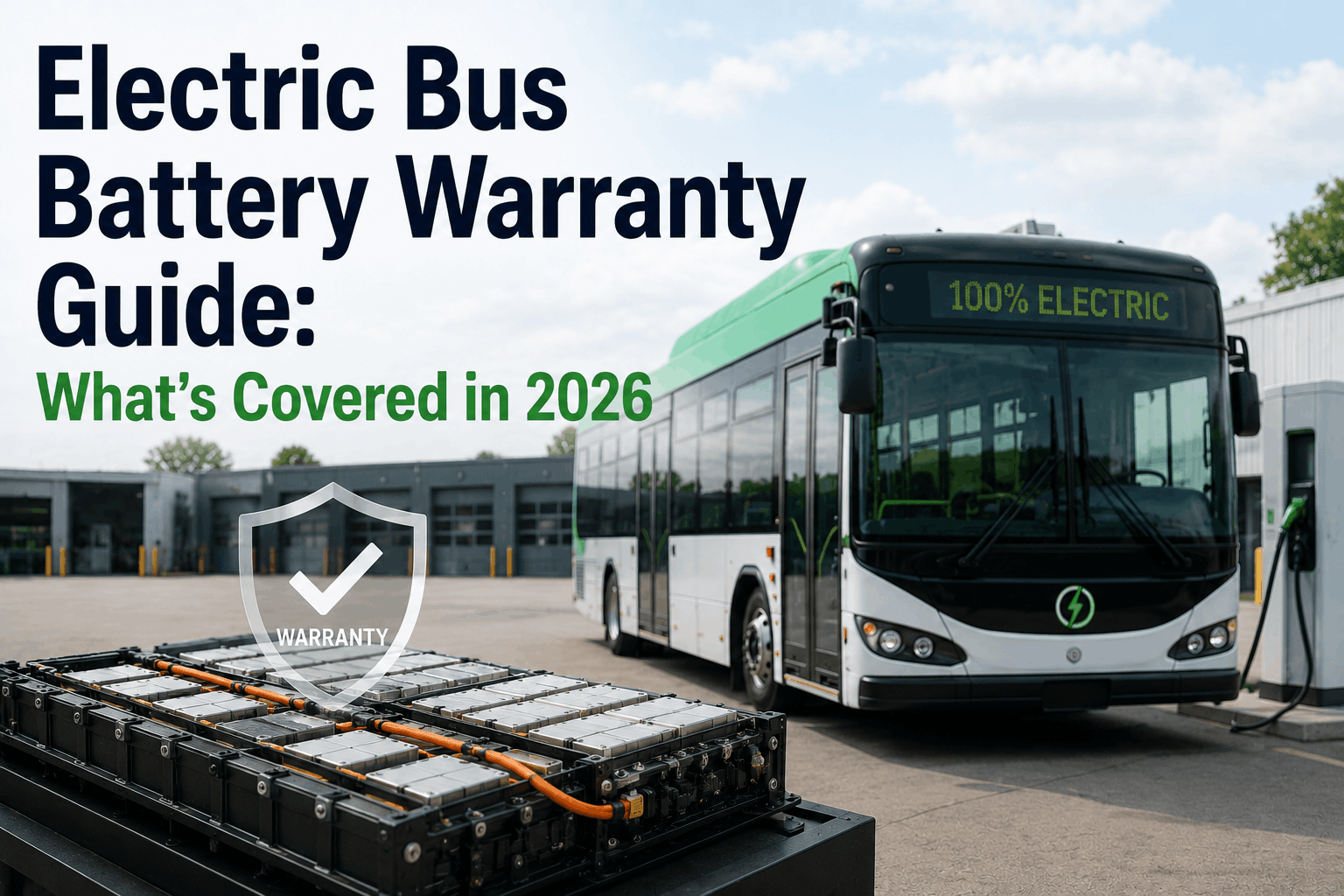
Electric bus battery warranties represent the most critical component of fleet electrification planning, yet many fleet managers lack clarity on coverage terms, degradation thresholds, and protection mechanisms. In 2026, battery warranty protocols have matured significantly, with major manufacturers offering comprehensive 8-12 year coverage protecting against capacity degradation, defects, and unexpected failures. Understanding warranty terms, degradation guarantees, coverage exclusions, and claim procedures is essential for risk assessment and total cost of ownership calculations. A properly structured battery warranty eliminates financial uncertainty regarding the most expensive electric bus component. This comprehensive guide examines electric bus battery warranties, coverage specifications, degradation guarantees, claim processes, and fleet protection strategies for 2026. BusCMMS fleet management software tracks battery health metrics, degradation trends, and warranty status providing essential documentation for warranty claim support and proactive maintenance scheduling.
Electric Bus Battery Warranty 2026
Complete guide to electric bus battery warranties, coverage terms, degradation guarantees, and warranty claim procedures protecting your fleet investment from unexpected battery replacement costs.
Typical Warranty Period
Capacity Retention Guarantee
Coverage Types
1 Standard Electric Bus Battery Warranty Terms and Coverage 2026
Industry-standard warranty parameters provide comprehensive protection: In 2026, major electric bus manufacturers—BYD, New Flyer, Proterra, and Gillig—offer 8-10 year battery warranties as standard. Extended warranties reaching 12 years are available for additional cost ($25,000-$50,000 per bus). Standard warranties cover the complete battery pack: individual cells, battery management system (BMS), cooling systems, and electrical connections. Warranties extend to fleet operators purchasing buses, not just original manufacturers. Fleet operators inherit full warranty coverage regardless of previous ownership, protecting secondary market purchases. Warranty terms specify coverage for manufacturing defects, cell failures, pack failures, and performance degradation below contractual thresholds.
Capacity retention guarantees specify minimum performance standards: Batteries naturally degrade 2-3% annually through normal cycling. Manufacturers guarantee capacity retention to specific percentages at warranty milestones: 90% at year 3, 85% at year 5, 75% at year 8, and 70% at year 10. If a battery falls below these thresholds before the specified year, warranty covers replacement or repair at manufacturer expense. These guarantees represent cumulative degradation across normal operational use. Accelerated degradation from defects, manufacturing flaws, or system failures triggers warranty replacement regardless of calendar year. Warranty covers degradation risk, not just defect risk, providing essential protection against unexpected replacement costs.
Warranty exclusions and limitations define coverage boundaries: Warranties exclude damage from accidents, improper maintenance, unauthorized modifications, or operator misuse. Using non-approved charging equipment, operating outside specified temperature ranges, or performing unauthorized electrical modifications voids warranty coverage. Warranties exclude normal wear and degradation beyond specified thresholds. A battery operating below 70% capacity in year 12 is not automatically covered if this falls within expected degradation ranges. Coverage requires documented evidence of defect or excessive degradation beyond normal expectations. Proper maintenance documentation, authorized service records, and fleet management tracking prove normal operational treatment, supporting warranty claims if disputes arise.
2 Battery Degradation Mechanisms and Warranty Coverage Thresholds
Understanding battery degradation mechanisms illuminates warranty coverage: Lithium-ion batteries degrade through multiple mechanisms: calendar aging (time-based), cycle aging (charge-discharge cycles), thermal stress, overcharging, over-discharging, and temperature extremes. Calendar aging causes 0.5-1% annual capacity loss through electrolyte decomposition and structural changes in electrodes. Cycle aging causes 1-2% capacity loss per 1000 full charge-discharge cycles. Most electric buses experience 200-300 annual cycles (2-3 per day on 5-day work week), totaling 2000-3000 cycles over 10-12 year lifespan. Combined, these mechanisms create cumulative 20-30% capacity degradation by year 10-12, with exact rates depending on operational profiles. Batteries operating on routes with frequent charge-discharge cycles degrade faster than batteries operating on steady-state routes. Ambient temperature exposure also affects degradation: batteries in hot climates (Southwest US, Texas) degrade 20-30% faster than temperate regions (Pacific Northwest, Midwest).
Warranty coverage adapts to regional and operational variations: Manufacturers recognize regional variations and adjust warranty coverage. Some manufacturers offer enhanced warranties for high-temperature regions recognizing accelerated degradation. Warranties covering degradation up to 75% capacity at year 10 assume temperate climate operations. Harsh climates or high-utilization routes might require extended warranties reaching year 12 or enhanced guarantees covering degradation to 70% capacity. Fleet managers in extreme climates should negotiate warranty terms during procurement, securing coverage aligned with local operating conditions. BusCMMS fleet management tracks degradation patterns by vehicle, route, and environmental condition, providing data supporting warranty negotiations and claim substantiation.
Thermal management systems extend battery life and preserve warranty coverage: Battery thermal management systems maintain optimal operating temperatures (35-45°C) maximizing lifespan and preserving capacity. Active cooling systems using liquid circulation extend battery degradation timelines and improve warranty coverage. Passive cooling systems cost less but provide less consistent thermal regulation. Buses equipped with advanced thermal management achieve 80%+ capacity at year 10; buses with basic systems achieve 75-78%. Thermal management investment ($15,000-$25,000 per bus) extends effective battery lifespan by 1-2 years and preserves warranty coverage, making it cost-justified for extended-life applications.
3 Warranty Coverage Types: Defect Coverage vs Degradation Guarantees
Defect coverage protects against manufacturing failures and unexpected failures: Defect coverage includes cell failures, internal shorts, terminal corrosion, cooling system failures, and battery management system malfunctions appearing within warranty period. Cell failures represent 3-5% of battery packs across typical fleets. These include internal shorts causing thermal runaway, manufacturing defects in electrode materials, or welding defects in battery terminals. Battery management system failures represent 2-3% of packs, causing inaccurate state-of-charge calculations, improper cell balancing, or charging system shutdown. Cooling system failures (pump failures, coolant leaks) represent 1-2% of packs. All these defects trigger warranty coverage resulting in component replacement, pack repair, or complete pack replacement at manufacturer expense. Defect coverage is straightforward: if component fails before warranty expiration, manufacturer replaces it.
Degradation guarantees protect against capacity loss beyond normal expectations: Degradation warranties guarantee minimum capacity percentages at specified years: 90% at year 3, 85% at year 5, 75% at year 8, 70% at year 10. If a battery measures below these thresholds before the corresponding year, warranty covers replacement at manufacturer expense. Degradation coverage is more nuanced than defect coverage because measuring capacity requires sophisticated testing. Fleet managers must conduct capacity testing to substantiate degradation claims. Testing involves controlled charge-discharge cycles measuring usable capacity compared to original specifications. Third-party testing facilities or OEM technical centers conduct testing ($2,000-$5,000 per test). Testing results documented with fleet logs, maintenance records, and usage data establish whether degradation claim is warranted. Buses with complete maintenance documentation and BusCMMS tracking typically experience smoother warranty claims because documentation proves normal operational treatment.
Transferable vs non-transferable warranty coverage creates secondary market distinctions: Some manufacturers offer transferable warranties extending to second owners; others restrict warranties to original purchaser. Transferable warranties increase used electric bus resale value by 10-15% because secondary purchasers inherit warranty protection. Non-transferable warranties reduce resale value because subsequent owners assume battery replacement risk if degradation occurs post-transfer. Fleet managers selling used buses before warranty expiration should clarify warranty transferability with manufacturers and include warranty status in sales marketing.
4 Battery Warranty Claim Procedures and Documentation Requirements
Warranty claim initiation requires comprehensive documentation and diagnostic testing: When fleet managers suspect battery defect or excessive degradation, claim process begins with contacting manufacturer warranty support with vehicle identification number (VIN), battery pack serial number, current mileage, and symptom description. Manufacturer conducts preliminary diagnostics reviewing battery management system logs. Battery logs record all charge-discharge cycles, temperature data, voltage/current patterns, and BMS alerts. These logs—typically spanning complete vehicle operational history—provide evidence of normal operation or signs of defect. Defects create characteristic log patterns (voltage imbalance between cells, thermal runaway alerts, charge-disconnect events) distinguishing defect-caused degradation from normal degradation. Manufacturer reviews logs determining whether defect is apparent or if additional testing is required.
Third-party diagnostic testing substantiates degradation claims: For capacity degradation claims, manufacturers typically require independent capacity testing confirming capacity below warranty threshold. Testing procedure involves removing battery pack from vehicle, connecting to specialized load testing equipment, and performing controlled charge-discharge cycles measuring usable capacity. Testing costs $2,000-$5,000 and requires 1-2 weeks. Results generate capacity report showing measured capacity as percentage of original specification. If measured capacity is below warranty threshold for the corresponding year, claim is approved. If capacity is above threshold, claim is denied and fleet operator bears testing cost. This incentivizes accurate record-keeping and BMS monitoring: fleets with complete operational records and real-time BMS monitoring typically prove claims successfully. Fleets with incomplete records struggle substantiating claims regardless of actual condition.
Warranty claim resolution timelines vary based on claim type and complexity: Defect claims identifying specific failed components typically resolve in 4-8 weeks. Manufacturer arranges component repair or replacement, schedules service, and covers all parts and labor. Fleet incurs minimal downtime if spare parts are available. Degradation claims involving testing require 8-12 weeks because independent testing must be completed and reviewed. Complex claims involving disputed capacity measurements might require additional testing or manufacturer review, extending timelines to 12-16 weeks. Fleet managers should factor warranty claim timelines into maintenance planning. Having spare battery packs available for emergency use minimizes downtime if claims extend beyond expected resolution.
5 Manufacturer Warranty Comparison: BYD vs New Flyer vs Proterra vs Gillig 2026
BYD offers industry-leading battery warranties and cost-competitive packages: BYD, world's largest EV bus manufacturer, offers 8-year standard battery warranty with optional 10-year extended coverage. Warranty covers capacity degradation to 75% at year 8 or 70% at year 10 (extended). BYD batteries are field-proven across 400,000+ electric buses globally. Degradation rates are well-documented: average capacity at year 8 is 78-80%, slightly above warranty minimum. BYD provides comprehensive battery management system diagnostics and predictive maintenance algorithms. BYD batteries typically cost 15-20% less than competitor equivalents due to manufacturing scale. BYD bus costs average $650,000-$700,000 with battery costs representing 30-35%. BYD dominance in Chinese market and expanding US presence (particularly California, Texas) provide proven support and spare parts availability.
New Flyer emphasizes North American support and extended warranty offerings: New Flyer, largest North American bus manufacturer, partners with Proterra and others for battery supply but offers 10-year standard warranties. Warranty covers capacity to 70% at year 10, more conservative than BYD but appropriate for demanding North American duty cycles. New Flyer buses cost $700,000-$750,000 with extended North American dealer networks. Service and support infrastructure is most developed in North America. New Flyer emphasizes warranty claim support, offering dedicated warranty managers for large fleet purchasers. Extended 12-year warranty options provide additional cost ($35,000-$50,000 per bus) but offer enhanced protection for fleets planning long operational lifecycles.
Proterra delivers performance-focused batteries and warranty innovations: Proterra specializes in high-performance electric bus batteries and proprietary battery management systems. Proterra offers 8-year standard warranty with 12-year extended options. Warranty covers capacity degradation to 75% at year 8, equivalent to competitors. Proterra differentiates through advanced BMS algorithms predicting degradation patterns enabling proactive maintenance scheduling. Proterra batteries integrated with fleet management platforms provide real-time degradation visibility. Bus costs exceed competitor averages ($750,000-$800,000) reflecting performance premium and integrated technology ecosystem. Proterra serves premium fleet segments prioritizing technology and performance over cost.
Gillig offers established warranty programs for West Coast fleets: Gillig, established bus manufacturer headquartered in California, offers 8-10 year battery warranties through various battery suppliers. Warranty terms vary by battery manufacturer but typically cover capacity to 75% at year 8. Gillig emphasizes regional support, particularly in California where significant electric bus adoption occurs. Warranty claims processed through regional service centers providing rapid resolution. Gillig buses cost $680,000-$730,000with competitive warranty protection and strong regional presence.
"When our first electric buses arrived in 2021, we had no understanding of battery warranties or degradation expectations. By year 4, a bus showed capacity degradation approaching warranty thresholds. Without complete maintenance records and BMS logs, we struggled substantiating warranty claims. Our experience highlighted the critical importance of documentation and real-time monitoring. We implemented BusCMMS fleet tracking for all subsequent electric bus purchases, capturing every maintenance event, charge cycle, and performance metric. When subsequent warranty claims arose, complete documentation enabled rapid approval and minimal dispute. Documentation transforms warranty claims from uncertain negotiations to straightforward processes. Our current fleet of 45 electric buses has experienced zero denied warranty claims because every bus is meticulously documented."
6 Battery Replacement Costs and Out-of-Warranty Financial Planning
Replacement battery pack costs represent significant out-of-warranty expense: When warranty expires and batteries require replacement due to capacity degradation below operational thresholds, replacement costs are substantial. New battery pack costs range $80,000-$120,000 installed, representing 12-18% of total bus cost. Labor for battery pack replacement is intensive: removal of old pack, electrical disconnection, reinstallation of new pack, system integration, and performance testing require 40-60 labor hours at $75-$150 per hour, totaling $3,000-$9,000 in labor. Total replacement cost reaches $83,000-$129,000 per bus. For a 50-bus fleet with average 3-4 buses reaching replacement age in year 10-12, out-of-warranty replacement costs total $250,000-$516,000. This represents significant capital requirement that prudent fleet managers should reserve for during operational years.
Financial reserve strategies mitigate out-of-warranty replacement costs: Fleets should establish reserve funds during warranty period capturing operational savings (fuel + maintenance) to fund future replacement costs. A single electric bus delivers $25,000-$35,000 annual operational savings compared to diesel. Over 8-year warranty period, cumulative savings total $200,000-$280,000 per bus. Reserving $100,000 per bus from operational savings creates funding for replacement costs in years 10-12. This strategy requires disciplined financial management: capturing savings in dedicated reserve accounts rather than general operating budgets. Fleet managers using BusCMMS financial tracking can establish reserve accounts tied to specific buses or fleets, providing transparency on available funds for future replacement costs.
Battery recycling and second-life markets create potential offset revenue: End-of-life batteries retain 60-80% capacity useful for stationary energy storage applications. Emerging battery recycling companies (Li-Cycle, Redwood Materials, Ecobat) purchase end-of-life packs at $8,000-$15,000 per pack. Second-life applications (microgrids, backup power, renewable energy storage) command premium prices ($15,000-$25,000) for operational packs. Fleet managers can offset replacement costs $8,000-$25,000 per pack by selling end-of-life batteries to recyclers or second-use operators. This reduces net replacement cost to $55,000-$105,000. As recycling infrastructure matures and second-life markets develop, replacement cost offsets should increase, further improving electric bus economics.
7 Fleet Management Practices Supporting Warranty Coverage and Battery Health
Comprehensive maintenance documentation establishes warranty eligibility and supports claims: Warranty coverage requires evidence of proper maintenance and normal operational treatment. Complete maintenance records—every service event, spare part replacement, diagnostic test—prove normal fleet operation. BusCMMS fleet management software captures maintenance events automatically: every repair ticket, scheduled maintenance completion, parts inventory, and technician notes. Digital documentation proves maintenance compliance far more effectively than paper records. When warranty claims arise, providing complete digital maintenance history accelerates claim approval. Manufacturers reviewing complete maintenance documentation approve degradation claims more readily than reviewing incomplete or missing records.
Real-time battery monitoring enables early detection of degradation and defects: Battery management systems log detailed operational data: individual cell voltages, pack temperature, charge state, current flow, and BMS alerts. Modern BMS systems store 2+ years of historical logs. Fleet management software integrating BMS data provides real-time visibility into battery health: capacity estimates, degradation trends, temperature patterns, and anomaly detection. Fleets monitoring real-time BMS data typically identify degradation or defects 6-12 months before capacity thresholds are breached, enabling proactive maintenance or warranty claims before critical failures occur. Early detection prevents unexpected failures causing service disruptions and positions fleets to manage maintenance proactively rather than reactively.
Proper charging practices extend battery life and preserve warranty coverage: Charging practices significantly affect battery longevity. Overnight slow charging using 30-50 kW chargers stresses batteries less than rapid charging using 150+ kW chargers. Charging to 100% state-of-charge every cycle accelerates degradation; optimal practice charges to 80-90% daily and achieves 100% charge 1-2 times weekly. Using approved charging equipment certified for bus battery specifications prevents electrical damage. Training drivers and charging technicians on proper charging techniques extends battery lifespan and preserves warranty coverage. Fleet managers establishing charging protocols (slow charging preferred, 80% daily charging, 100% weekly charging) and communicating these procedures to all staff extends battery life by 1-2 years and improves warranty probability.
8 Warranty Negotiation Strategies for Large Fleet Purchases 2026
Extended warranty terms can be negotiated during procurement for large purchases: When procuring 20+ electric buses, manufacturers often negotiate extended warranty terms as part of volume purchase agreements. Standard 8-year warranties can be extended to 10-12 years at reduced incremental cost ($20,000-$35,000 vs $35,000-$50,000 standard pricing). Negotiated warranties might include enhanced capacity guarantees (75% at year 10 vs 70% standard) or expanded coverage including secondary components. Large purchases also enable negotiation for dedicated warranty support managers, on-site spare battery packs, or priority claim processing. Fleet managers purchasing 30+ buses should budget warranty extension negotiations during procurement planning. Extended warranties significantly reduce out-of-warranty replacement risks and should be priority negotiating items.
Multi-manufacturer strategies diversify warranty risk and vendor leverage: Fleets purchasing electric buses from multiple manufacturers create healthy competition and negotiating leverage. Rather than committing entirely to single-manufacturer batteries, procuring buses from 2-3 manufacturers enables comparative warranty evaluation and performance tracking. If one manufacturer's batteries perform worse than competitor equivalents, future procurement shifts to better-performing vendors. Multi-manufacturer fleets identify performance patterns (capacity retention, defect rates, thermal stability) informing future procurement decisions. Manufacturer awareness of competitive evaluation incentivizes warranty term improvements and support excellence.
Electric Bus Battery Warranty FAQs
- Standard warranty is 8-10 years. Extended warranties reaching 12 years cost $25,000-$50,000 additional. Warranty typically covers capacity degradation to 75-80% at year 8 or 70% at year 10, ensuring minimum performance standards.
- Warranty covers manufacturing defects (cell failures, electrical shorts), battery management system failures, cooling system failures, and capacity degradation below specified thresholds. Coverage does not include damage from accidents, improper maintenance, unauthorized modifications, or operator misuse.
- Replacement battery packs cost $80,000-$120,000 installed. Labor for removal and installation adds $3,000-$9,000. Total replacement cost reaches $83,000-$129,000 per bus. Battery recycling or second-life sales can offset $8,000-$25,000 of replacement cost.
- Warranty transferability varies by manufacturer. Some manufacturers offer transferable warranties protecting second owners; others restrict warranties to original purchasers. Transferable warranties increase used bus resale value by 10-15%. Confirm transferability during procurement.
- Complete maintenance records, BMS operational logs, charge-discharge history, and diagnostic testing results substantiate warranty claims. Digital documentation through fleet management software proves normal maintenance and operational treatment. Incomplete records complicate claim approval and resolution.
- Defect claims typically resolve in 4-8 weeks. Degradation claims requiring capacity testing take 8-12 weeks. Complex claims with disputed measurements might extend to 12-16 weeks. Complete documentation accelerates processing and approval.
- Yes. Large fleet purchases (20+ buses) enable negotiation of extended warranties (10-12 years) at reduced incremental cost. Negotiated agreements often include enhanced capacity guarantees, dedicated warranty support, or spare battery availability. Warranty negotiation should be priority during procurement for large fleets.
- Proper maintenance and slow overnight charging (30-50 kW) deliver 2% annual degradation: 80% capacity at year 10, 75% at year 12. Rapid charging or improper charging practices accelerate degradation to 3-4% annually. Proper charging protocols extend battery lifespan and preserve warranty coverage.