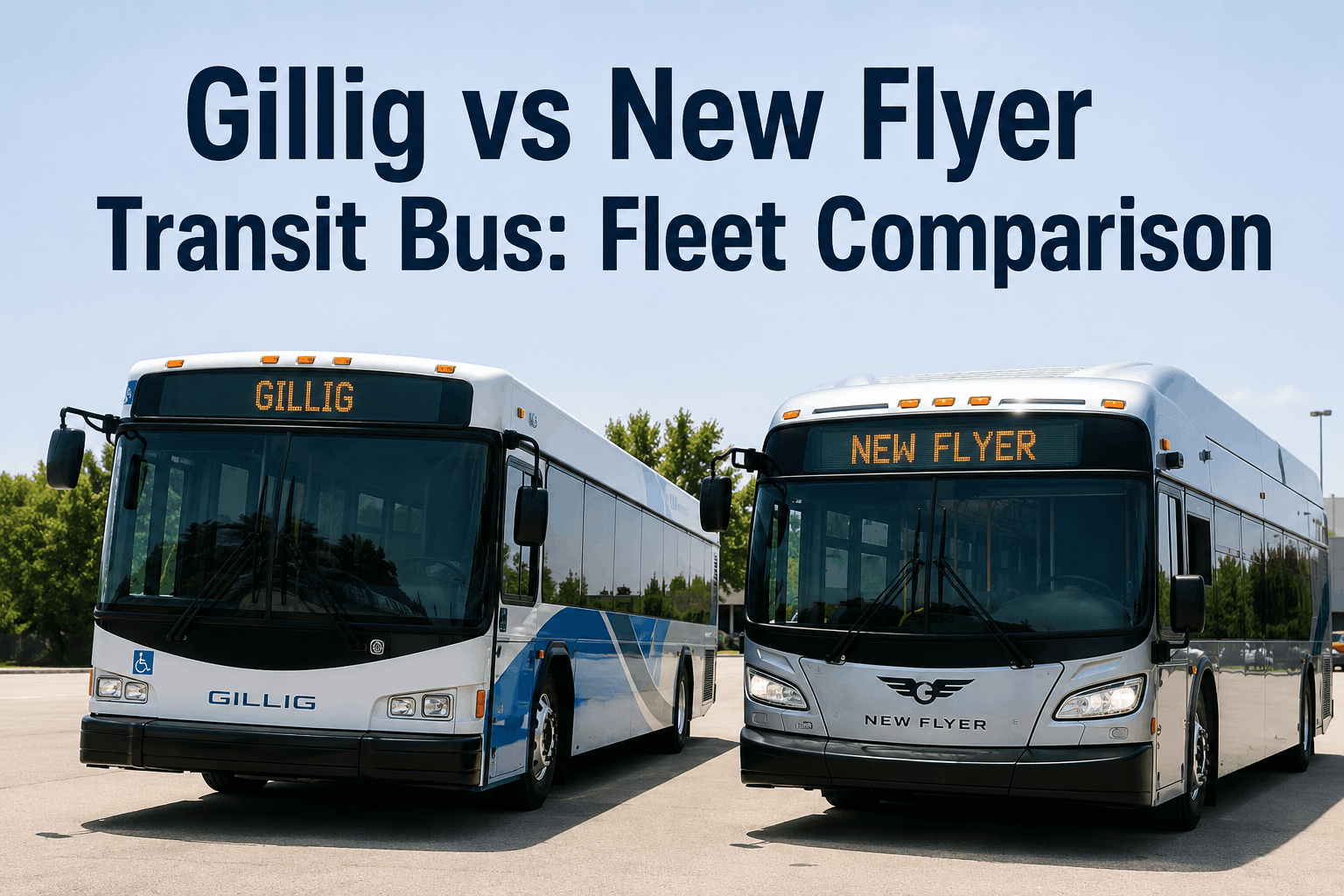
Gillig and New Flyer dominate North American transit procurement—together controlling over 70% of the region's fleet bus market. Yet fleet managers often choose between them without a clear framework for comparison. This guide evaluates both OEMs on durability, parts availability, EV options, lifecycle cost, and real-world reliability data from operating fleets, helping you make a data-driven procurement decision for 2026.
TRANSIT BUS PROCUREMENT · BUYING GUIDE · 2026
Gillig vs New Flyer: Choose the Right Transit Bus for Your Fleet
Compare durability, parts cost, EV readiness, and total lifecycle cost across North America's two largest transit bus manufacturers.
Both manufacturers have strong market positions, but they differ significantly in chassis design, parts ecosystem, and EV strategy. The choice depends on your fleet's primary operating environment and long-term electrification roadmap.
Gillig Strengths
Low Floor Design Leadership
High Value
Gillig's Low Floor platform offers superior accessibility and lower boarding times — industry-standard in urban transit with ADA compliance as baseline, not afterthought.
Parts Availability & Cost
High Value
Gillig parts ecosystem is mature and competitive. Common service items cost 8–12% less than New Flyer equivalents due to higher market saturation and supplier competition.
Fuel Efficiency
High Value
Diesel Gillig models achieve 5.8–6.2 MPG on urban routes — consistently outperforming New Flyer diesel by 0.3–0.5 MPG under identical duty cycles.
Residual Value
Medium Value
12-year-old Gillig buses retain 22–26% of original purchase price in secondary markets — 3–4 points higher than equivalent New Flyer models.
New Flyer Strengths
EV Platform Maturity
High Value
New Flyer's Xcelsior CHARGE platform has 8,000+ units in North American service — largest EV bus deployment footprint. Proven battery reliability over 5+ years of real-world operation.
Charging Infrastructure Support
High Value
New Flyer partners with charging networks and provides depot integration guidance — reducing deployment risk for agencies new to electrification.
Service Network Scale
High Value
New Flyer maintains 120+ authorized service centers across North America — faster emergency parts availability and same-day service access in major metros.
Feature Standardization
Medium Value
New Flyer's modular platform reduces custom engineering costs for fleet-specific configurations — shorter lead times on non-standard orders.
Key Technical Comparison: Gillig vs New Flyer
Specifications matter less than operational fit. The table below shows where each excels in real-world deployment scenarios.
Diesel Model (40 ft)
Gillig Low Floor: 5.9 MPG, $465K. New Flyer D40: 5.4 MPG, $458K. Gillig's fuel advantage = $2,100/year per bus savings.
Electric Model (40 ft)
Gillig BEB: 320-mile range, $785K. New Flyer Xcelsior CHARGE: 300-mile range, $775K. Similar capability, New Flyer price advantage on large fleets.
Warranty & Support
Gillig: 5yr/250K mi standard, 12yr frame. New Flyer: 5yr/250K mi standard, EV battery 8yr/500K mi. Battery confidence key to EV choice.
Parts Lead Time
Gillig: 2–4 weeks standard, 48-hour emergency. New Flyer: 2–3 weeks standard, 24-hour emergency via network. New Flyer advantage in urgent situations.
Fleet Standardization
Gillig: Modular but bespoke variants common. New Flyer: Standardized platforms reduce training and parts inventory burden significantly.
Customization Flexibility
Gillig: Higher custom engineering cost (+$18–25K) but exceptional design flexibility. New Flyer: Lower custom costs, faster builds on standard configs.
Total Cost of Ownership: 12-Year Lifecycle
Purchase price is only 35–40% of a transit bus lifecycle cost. Fuel, maintenance, parts, and residual value matter far more over 12 years and 500,000 miles.
Gillig vs New Flyer — 12-Year TCO (40 ft Diesel)
Based on 50,000 miles/year, urban duty cycle, $3.50/gallon diesel average
$465K
Purchase price (Gillig Low Floor)
$384K
12-year fuel cost (Gillig 5.9 MPG)
$95K
Maintenance + parts (Gillig)
$1.072M
Total 12-year TCO (Gillig)
Gillig vs New Flyer — 12-Year TCO (40 ft Diesel)
New Flyer D40HF comparison under identical operating conditions
$458K
Purchase price (New Flyer D40HF)
$418K
12-year fuel cost (New Flyer 5.4 MPG)
$102K
Maintenance + parts (New Flyer)
$1.159M
Total 12-year TCO (New Flyer)
"We evaluated both manufacturers for our 80-bus refresh program. Gillig's fuel efficiency and residual value created $94,000 in first-cycle savings, but New Flyer's service network became critical when we expanded operations across three states. We now run a mixed fleet."
— Fleet Manager, Major Metropolitan Transit Agency, 2025
Electric Bus Decision Tree: Gillig BEB vs New Flyer Xcelsior CHARGE
If 2026 procurement includes EV buses, the comparison shifts dramatically. Both manufacturers have production-ready platforms, but deployment readiness differs significantly.
Range & Battery Performance
EV SPECS
Gillig BEB delivers 320-mile range on 400 kWh battery. New Flyer Xcelsior CHARGE offers 300–310 miles on same capacity. Both suitable for 95% of North American transit routes without mid-day charging.
Charging Infrastructure Readiness
DEPLOYMENT
New Flyer provides depot charging design and integration support as standard. Gillig requires third-party engineering coordination — adds 4–6 weeks to rollout timeline.
Battery Warranty Coverage
RISK MITIGATION
Gillig BEB: 8yr/500K mi battery warranty. New Flyer Xcelsior: 8yr/500K mi + extended options to 12 years. Extended coverage critical for agencies risk-averse on battery replacement cost.
Maintenance Complexity
OPERATIONS
New Flyer EV buses have simpler thermal management systems — lower technician training burden. Gillig BEB requires more specialized cooling expertise, adding $15–20K annual tech certification costs.
Grant Funding & Incentives
FINANCIAL
Both manufacturers' EV buses qualify for FTA Section 5339 grants. New Flyer's larger deployed fleet means more case studies for grant applications — potential 5–10% funding advantage in competitive cycles.
Ready to Compare Transit Bus Options for Your Fleet?
Download our detailed TCO calculator and OEM comparison matrix — vendor-neutral, built by fleet procurement experts.
1. Fuel economy is your primary KPI. Gillig's efficiency edge saves $2–3K per bus annually on diesel models. Over 50+ vehicles, this compounds quickly.
2. Your routes are short-loop, urban. Low Floor design and rapid boarding reduce dwell time — critical for high-frequency routes where acceleration economics matter.
3. You operate in a region with mature Gillig support. California, Texas, and parts of the Northeast have dense Gillig networks. Parts availability beats national averages.
4. Customization is non-negotiable. If your fleet needs interior layouts that deviate from standard configs, Gillig's engineering flexibility justifies the premium.
5. Long-term asset resale matters. Gillig's residual value (22–26% at 12 years) beats competitors. If you sell buses rather than scrap them, Gillig maximizes end-of-life recovery.
When to Choose New Flyer — 5 Scenarios
1. You're deploying EV buses. Xcelsior CHARGE ecosystem is proven with 8,000+ units operating. Risk is lower, grant documentation is easier, and charging partners are established.
2. National service network is critical. Operating across multiple states? New Flyer's 120+ service centers mean 24-hour emergency support nationwide. Gillig cannot match this.
3. Standardization reduces operational complexity. Modular platforms with fewer variants mean lower training costs, easier parts inventory, and faster technician certification.
4. Fleet size exceeds 200 buses. New Flyer's volume discounts and standardized configs deliver better pricing at scale. Custom Gillig pricing becomes less competitive above 200-unit orders.
5. Charging infrastructure is already installed. If your depot already has chargers, New Flyer's plug-and-play integration approach saves integration costs that Gillig would require engineering to match.
How much can I save with Gillig on fuel costs over 12 years?
Gillig's 5–6% fuel efficiency advantage = $2,100/year per 40 ft diesel bus. Multiplied over 50 buses for 12 years: $1.26 million total savings. However, this assumes consistent fuel pricing and stable duty cycles — actual savings vary by region and route profile.
Are New Flyer EV buses worth the premium over diesel?
New Flyer Xcelsior CHARGE costs $310K more than diesel ($775K vs $465K). Break-even occurs at 7–9 years when fuel + maintenance savings offset the premium. Federal grants often cover 30–40% of EV premium, making ROI positive from year 1 in grant-eligible fleets.
Which OEM has faster parts availability?
New Flyer wins on emergency parts: 24-hour availability through 120+ service centers. Gillig standard lead time is 2–4 weeks. For fleets with critical uptime needs or multiple operating locations, New Flyer's network advantage justifies procurement consideration.
Can I run a mixed fleet of Gillig and New Flyer buses?
Yes, operationally it's common. However, mixed fleets increase parts inventory (10–15% higher holding costs), technician training burden, and reduce negotiating leverage for volume pricing. Most fleets standardize on one OEM after the first procurement cycle for these reasons.
What is the typical delivery lead time for each OEM in 2026?
Gillig: 14–18 months (chassis) + 4–8 weeks body build. New Flyer: 16–22 months (Xcelsior), 12–16 months (standard D40). EV buses take longer due to battery sourcing. Order in Q1 2026 for mid-2027 delivery.
Make Your 2026 Transit Bus Procurement Decision with Confidence
Compare total lifecycle cost, parts availability, and EV readiness side-by-side. Get vendor-neutral guidance from fleet procurement experts.