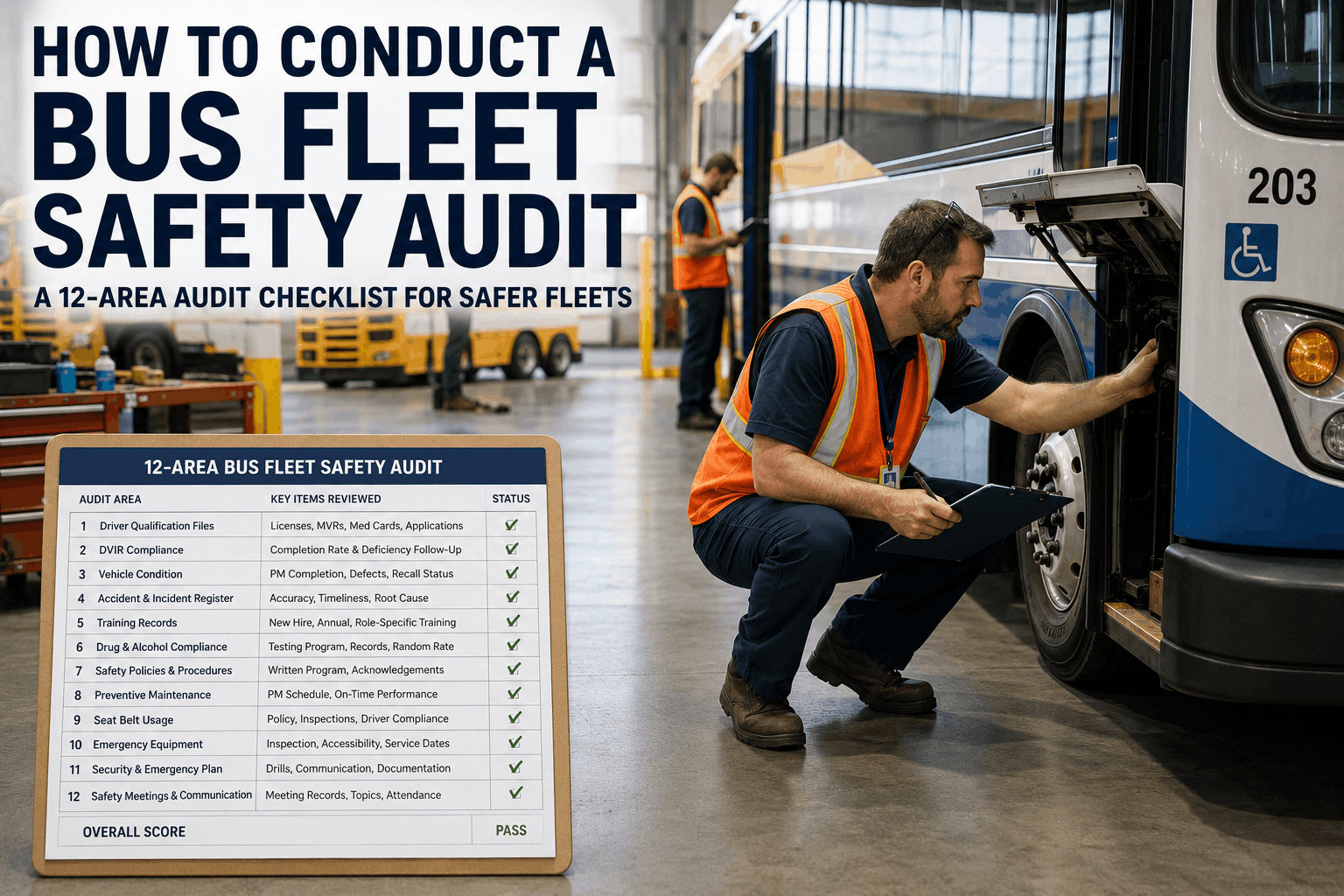
A bus fleet safety audit without a structured template is just a walkthrough with a clipboard — it finds the obvious deficiencies and misses the systemic ones. Regulatory inspectors, insurance underwriters, and school district safety officers all conduct structured audits against defined criteria. Your internal process should be just as rigorous. Sign Up Free and use BusCMMS to turn your audit findings into corrective action workflows automatically.
Run a 12-Area Fleet Safety Audit That Holds Up to Regulatory Scrutiny
BusCMMS tracks driver files, DVIR completion, accident registers, and training records — all auditable from a single dashboard with zero manual report assembly.
What a Bus Fleet Safety Audit Actually Covers
Most fleet operators assume a safety audit means inspecting vehicles. A complete audit covers 12 distinct areas spanning administrative records, driver qualifications, vehicle condition, operational procedures, and post-incident documentation. Missing any of these areas creates regulatory exposure — FMCSA safety investigators and state DOT auditors work through all 12. Start your free trial and build your audit scoring structure inside BusCMMS.
Area 1
Driver Qualification Files
CDL copy, medical certificate, motor vehicle record, pre-employment drug screen, road test certificate, and annual review. Every document must be current and complete for every active CDL driver in your fleet.
Area 2
DVIR Completion Rate
Driver Vehicle Inspection Reports must be completed pre-trip and post-trip for every vehicle, every day. Review the last 90 days of DVIR logs for completion rate, defect entries, and mechanic sign-off confirmations on noted defects.
Area 3
Accident Register
FMCSA requires a 3-year accident register listing every accident meeting recordable thresholds. Audit for completeness: date, location, description, fatality/injury/tow-away indicators, and whether post-accident drug/alcohol testing was completed within the required window.
Area 4
Safety Training Records
Document all safety training by driver, including hire date, initial training completion, and annual recurrent training. Auditors look for training gaps exceeding 12 months for active drivers and incomplete curricula compared to your written safety program.
Area 5
Vehicle Condition Inspections
Beyond DVIRs, conduct periodic structured vehicle condition assessments covering brake adjustment, tire tread and inflation, lights, emergency exits, fire suppression systems, and wheelchair lift operation where equipped. Document findings with photos.
Area 6
Drug & Alcohol Program
Audit your random testing pool completeness, consortium membership documentation, and post-accident test completion records. Verify that return-to-duty documentation exists for any driver who tested positive or refused testing during the audit period.
Safety Audit Scorecard: Your 12 KPI Areas
The scorecard below assigns a weighted score to each of the 12 audit areas based on regulatory penalty exposure and safety outcome data. Use this weighting when prioritizing corrective action — not all deficiencies are equal in consequence. BusCMMS scores each area automatically from live operational data.
Driver Qualification Files Highest Risk
Incomplete DQFs are the single most cited deficiency in FMCSA compliance reviews. An expired medical certificate for an active driver triggers an out-of-service order and potential carrier liability for every trip driven during the gap period. Audit every active driver quarterly at minimum.
Drug & Alcohol Compliance
Random testing program gaps, missed post-accident testing windows, and absent return-to-duty documentation are each individually cited as serious violations. Maintain a complete chain of custody for every test conducted and document every refusal with a supervisor statement.
Vehicle Maintenance Records
Maintenance records must show systematic inspection, repair, and lubrication schedules for every vehicle. Auditors look for PM intervals matching your written maintenance program, mechanic signatures on completed work orders, and documented repairs for defects noted on DVIRs.
Hours of Service Logs
For HOS-regulated operations, audit ELD data for drive time violations, off-duty period gaps, and supporting document matching. For exempt operations, document the exemption basis clearly. Auditors will test a random sample of 10–15% of your drivers' records during a compliance review.
Accident Register & Investigation
Every recordable accident must appear in your register within 24 hours. Audit for completeness of each entry and the existence of a corresponding accident investigation report, corrective action documentation, and post-accident drug/alcohol test result where required.
Safety Training Documentation
Training records must be retained for the duration of employment plus 3 years. Audit for training completion against hire dates, annual recurrent intervals, and specific curriculum requirements in your written safety program. Missing training records for active drivers indicate a systemic program gap.
Audit Scoring Performance: Where Fleets Typically Stand
DQF Completeness Rate
Industry Avg: 71%
Percentage of active drivers with fully complete, current qualification files. Most fleets have at least 20–30% of drivers with at least one expired or missing document at any given time without active tracking.
DVIR Completion Rate
Target: 100%
Every vehicle, every day. Any DVIR gap creates liability for operations during the uncovered period. Fleets without digital DVIR systems average 82% completion — missing roughly 1 in 5 required inspections.
Training Hours Compliance
Target: 8+ hrs/driver/yr
Annual safety and defensive driving training hours per active CDL holder. Fleets conducting quarterly rather than annual training have 40% fewer at-fault incidents — the data consistently supports more frequent, shorter sessions over annual full-day events.
Audit Score vs Benchmark
Target: ≥85/100
Composite safety audit score across all 12 areas. Fleets scoring below 70 on internal audits are statistically likely to receive a conditional or unsatisfactory rating during a formal FMCSA compliance review — the consequence is mandatory corrective action and enhanced monitoring.
Remaining 6 Audit Areas: Complete Your Coverage
Scroll for more →
| Audit Area | What to Check | Common Deficiency | BusCMMS Support |
|---|---|---|---|
| 7. Emergency Procedures | Written emergency procedures, driver training on emergency evacuation, emergency equipment on vehicles | Procedures documented but not trained — no driver acknowledgment signatures | Training acknowledgment logs |
| 8. Insurance Certificates | Current certificates of insurance, minimum liability coverage by vehicle class, endorsements | Expired certificates not updated after policy renewal — vehicle appears uninsured | Document expiry tracking |
| 9. Vehicle Registration | Current registration for every vehicle, USDOT number displayed, operating authority where required | Registration renewal missed for seasonal vehicles returned to service | Vehicle compliance alerts |
| 10. Fuel & Mileage Records | IFTA fuel tax records, odometer logs matching maintenance records, fuel receipt retention | Odometer readings in fuel logs not matching PM work orders — creates audit discrepancy | Integrated mileage tracking |
| 11. Passenger Count Records | Manifest records for charter operations, ridership logs for transit, capacity documentation | No manifest retention for completed trips — no evidence of compliance with capacity limits | Trip record management |
| 12. Safety Policy Documentation | Written safety policy signed by management, driver handbook acknowledgments, progressive discipline policy | Handbook not updated after regulation changes — drivers acknowledge outdated procedures | Policy version control |
Corrective Action: Turning Findings into Closed Items
An audit without corrective action tracking is just documentation of problems. Every finding must be assigned an owner, a deadline, and a verification method — and the closure evidence must be retained for the audit cycle that follows. BusCMMS converts audit findings into tracked corrective action work orders automatically, ensuring nothing is documented and forgotten.
Finding Documentation
Capture audit findings with severity, evidence photos, and regulatory basis
Owner Assignment
Assign corrective action owners with due dates and priority levels
Closure Verification
Verify and close findings with evidence attachments for audit trail
Trend Reporting
Track audit score improvement quarter over quarter across all 12 areas
Build Your Internal Audit Schedule
01
Monthly — High-Risk Areas
Review DQF currency, drug and alcohol testing compliance, and DVIR completion rates monthly. These three areas have the highest regulatory penalty exposure and the fastest-changing status — a medical certificate can expire any day of the month.
02
Quarterly — Operational Records
Audit maintenance records, accident register completeness, training documentation, and vehicle registration currency quarterly. These areas change more slowly but require enough review frequency to catch gaps before they become multi-month deficiencies.
03
Semi-Annual — Policy & Procedures
Review your written safety policy, driver handbook, and emergency procedures documentation semi-annually. Update content to reflect regulatory changes, fleet composition changes, or findings from your quarterly operational audits that reveal procedure gaps.
04
Annual — Full Audit Simulation
Conduct a full 12-area audit simulation annually using the same criteria and documentation requests a FMCSA compliance investigator would use. Score each area, identify the three lowest-scoring domains, and prioritize resources there for the next 12 months.
05
Post-Incident — Triggered Audits
Any recordable accident, FMCSA inspection with violations, or insurance carrier loss control audit should trigger an immediate focused review of the related operational area. Document the triggered audit separately from your scheduled cycle.
06
Continuous — BusCMMS Monitoring
Between scheduled audits, BusCMMS continuously monitors DQF expiration dates, PM compliance, and DVIR completion — alerting your safety manager to issues before they become audit findings. Set up alerts free today.
Frequently Asked Questions
How often should a bus fleet conduct an internal safety audit?
High-risk areas like DQF currency and drug testing compliance should be reviewed monthly. Full 12-area audits should be conducted at least annually, with quarterly reviews of operational records. More frequent review is always preferable — the goal is catching deficiencies before a regulatory inspector does.
What happens if FMCSA finds deficiencies during a compliance review?
Outcomes range from requiring corrective action within 45 days (satisfactory with deficiencies) to downgrading your safety rating to conditional or unsatisfactory (which can trigger enhanced monitoring, customer contract cancellations, and insurance premium increases). Carriers with unsatisfactory ratings face potential operations shutdown after notice and hearing.
Do school bus operations have to comply with FMCSA audit requirements?
School bus operations using vehicles designed to transport 16 or more passengers (including the driver) in interstate commerce are subject to FMCSA regulations. Many states also impose state-level school bus safety regulations that parallel or exceed federal requirements. Check your state DOT requirements in addition to federal FMCSA obligations.
What is the most common deficiency found in bus fleet safety audits?
Driver Qualification File deficiencies are the most commonly cited finding in FMCSA compliance reviews of bus operations. Expired medical certificates and missing annual review documentation account for the majority of DQF violations. Automated expiry tracking in BusCMMS eliminates this risk entirely.
Know Your Audit Score Before the Regulator Does
BusCMMS fleet operators conduct continuous self-audits against FMCSA criteria — catching and closing deficiencies before formal compliance reviews surface them.