Every bus fleet operator eventually faces the same strategic question: when does it make financial sense to stop outsourcing maintenance and build your own shop? For small fleets, outsourcing to local dealers or mobile mechanics often provides the lowest total cost. But as your operation scales past a certain threshold, the economics flip dramatically. In-house shops offer lower per-unit costs, faster turnaround times, and greater quality control. However, the initial investment in facility, equipment, staffing, and software can be substantial. This comprehensive guide helps American transit agencies, school districts, and private operators calculate their break-even point. Learn the true cost components of both models, identify the fleet size where in-house maintenance becomes more economical, and build a data-driven business case for your shop investment decision.
Maintenance Strategy 2026
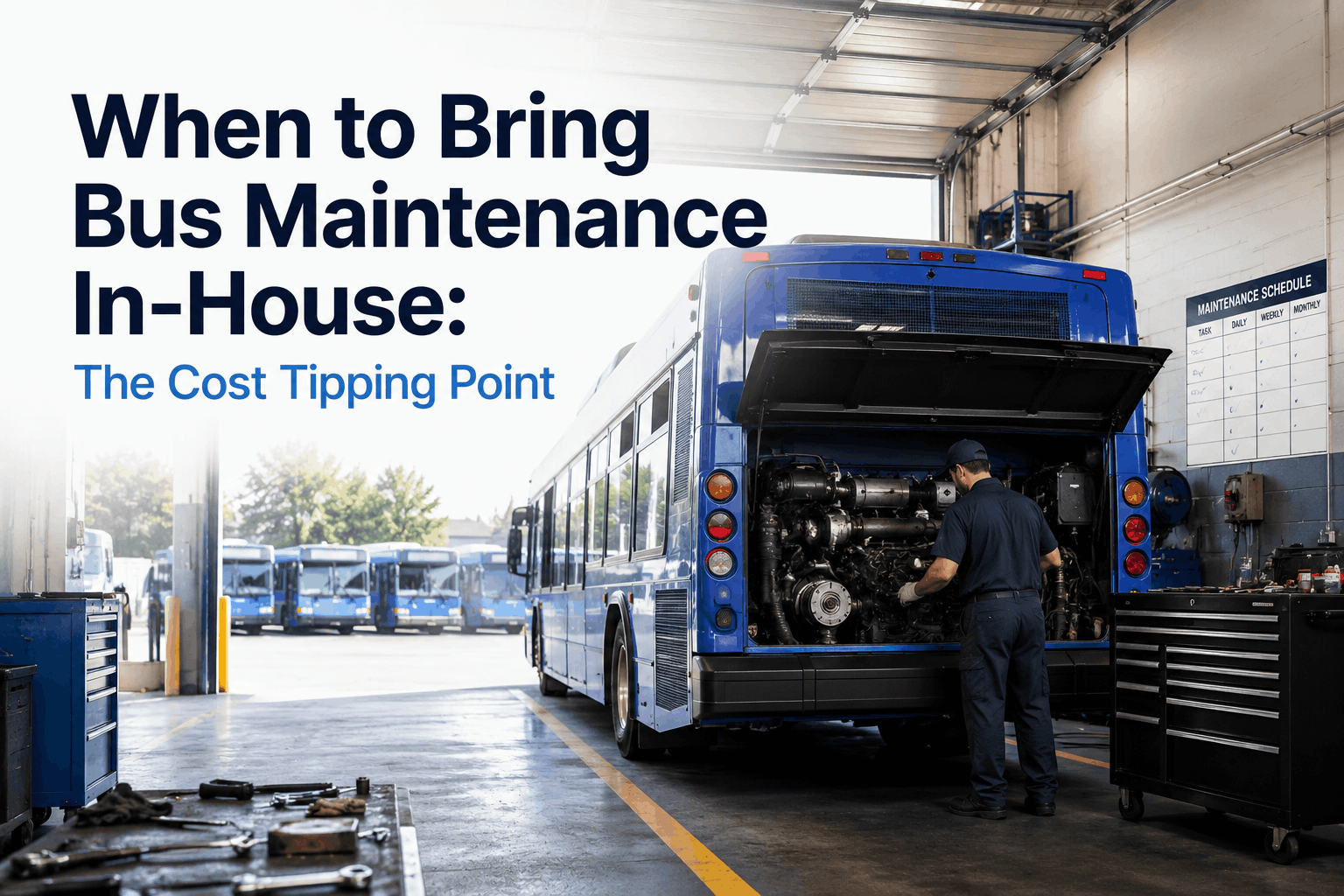
When to Bring Bus Maintenance In-House: The Cost Tipping Point
At what fleet size does an in-house shop beat outsourcing? See the 2026 break-even math, hidden costs, and the tipping point for American bus operators.
The Outsourcing vs In-House Decision Framework
Deciding whether to outsource or insource bus maintenance is not simply about comparing hourly labor rates. American fleet operators must consider facility costs, equipment investments, staffing availability, parts markup, quality control, and response time. The right answer depends on your fleet size, geographic location, bus age distribution, and access to qualified technicians. This framework helps you evaluate both models systematically.
25-35 Buses
Typical Tipping Point Range
20-30%
In-House Cost Savings Over 50 Buses
3-5 Years
Typical Payback Period
Cost Factor
Outsourced Model
In-House Model
Labor Rate
$150 to $250 per hour at dealers
$40 to $65 per hour for employed techs
Parts Markup
25 to 40 percent markup from vendors
Wholesale pricing, no markup on self
Travel Time Cost
Billed travel time for mobile service
No travel cost, shop on premises
Emergency Premium
Overtime rates for urgent repairs
Internal OT still cheaper than dealer
Quality Control
Limited visibility into repair quality
Direct supervision and accountability
Outsourced Maintenance: The True Cost Breakdown
When American fleets outsource maintenance, the visible hourly rate is only the beginning. Hidden costs multiply the total expense significantly. Understanding these components helps you calculate your current outsourcing cost accurately.
Dealer Labor Rate (National Average)
$165 per hour
Mobile Mechanic Rate
$185 to $225 per hour
Parts Markup (Typical)
30 to 40 percent
Diagnostic Fee Per Visit
$100 to $250
Travel Time Per Visit
1 to 2 hours billed
Emergency After-Hours Rate
$225 to $300 per hour
Annual PM Cost Per Bus (Outsourced)
$4,000 to $7,000
In-House Shop: Startup and Operating Costs
Building an in-house maintenance shop requires significant upfront investment. However, once established, per-bus operating costs drop substantially. American fleet operators should consider these cost categories when evaluating the in-house option.
Facility Costs
$50,000 to $200,000
Rent, utilities, insurance, security systems, and office space for American fleet shops
Equipment Investment
$75,000 to $250,000
Lifts, diagnostic tools, tire machines, fluid systems, and shop equipment for US operations
Staffing Costs (Annual)
$250,000 to $600,000
Technician salaries, benefits, training, and management for 2 to 5 mechanics
Parts Inventory
$50,000 to $150,000
Initial stock of common consumables, filters, belts, and high-failure components
Software and IT
$5,000 to $15,000 annually
CMMS like BusCMMS for work orders, parts tracking, and maintenance records
Annual PM Cost Per Bus (In-House)
$2,500 to $4,500
After facility and equipment costs are amortized over fleet life
The Tipping Point: Break-Even Analysis by Fleet Size
The following analysis shows the annual maintenance cost comparison between outsourced and in-house models at different fleet sizes. These figures represent national averages for American transit agencies and school districts.
Fleet Size
Annual Outsourced Cost
Annual In-House Cost
10 Buses
$50,000 to $70,000
$80,000 to $120,000
25 Buses
$125,000 to $175,000
$120,000 to $170,000
35 Buses
$175,000 to $245,000
$140,000 to $200,000
50 Buses
$250,000 to $350,000
$170,000 to $240,000
75 Buses
$375,000 to $525,000
$220,000 to $320,000
100 Buses
$500,000 to $700,000
$280,000 to $400,000
Hidden Factors That Shift the Tipping Point
Beyond direct cost comparisons, several qualitative factors influence whether American fleets should outsource or build in-house shops. These considerations can make in-house maintenance attractive at smaller fleet sizes or push the tipping point higher.
Factor 1: Geographic Isolation
Fleets in rural areas with limited dealer access face higher travel costs and longer wait times, making in-house shops attractive at 15 to 20 buses.
Factor 2: Bus Age Profile
Older fleets require more frequent repairs. In-house shops become cost-effective at smaller sizes when average bus age exceeds 10 years.
Factor 3: Technician Availability
In regions with severe mechanic shortages, outsourcing may remain necessary even at larger fleet sizes due to hiring challenges.
Factor 4: Multiple Bus Makes
Mixed fleets with different manufacturers may require dealer support for proprietary systems, favoring outsourcing for American operators.
Factor 5: Peak Season Demand
School districts with intense summer PM schedules may need in-house capacity even if annual costs slightly favor outsourcing.
Factor 6: Warranty Requirements
New buses under warranty often require dealer service for major repairs, delaying in-house break-even for American fleets.
Phased Approach: Building Your In-House Capability
Most American fleets do not switch from fully outsourced to fully in-house overnight. A phased approach spreads investment over time and allows you to test the model before full commitment.
Phase 1
Start with Preventive Maintenance Only
Bring oil changes, filter replacements, and inspections in-house while outsourcing major repairs. Requires minimal equipment investment for American shops.
Phase 2
Add Minor Repairs and Tire Work
Expand to brake jobs, belt replacements, and tire changes. Invest in lifts, tire machines, and diagnostic scanners for US fleet operations.
Phase 3
Incorporate Major Component Repairs
Bring transmission, engine, and differential work in-house. Requires advanced diagnostics and specialized training for American technicians.
Phase 4
Full In-House Capability
Complete the transition with all repairs performed internally. Outsource only highly specialized or warranty-required work for US fleets.
Calculating Your Unique Break-Even Point
Every American fleet has unique cost structures. Use this formula to calculate your specific break-even point based on local labor rates, facility costs, and fleet characteristics.
Break-Even Formula
(F + E + I) / (O - H) = N
Where F is facility annual cost, E is equipment annual cost, I is initial investment amortized, O is outsourced cost per bus, H is in-house cost per bus, and N is break-even fleet size
Sample Calculation
($75,000 + $25,000) / ($6,000 - $3,500) = 40 Buses
Fleet with $100,000 annual fixed costs, $6,000 outsourced per bus, $3,500 in-house per bus breaks even at 40 buses
5-Year ROI Projection
$500,000 to $1,000,000
Typical 5-year savings for a 50-bus American fleet after switching to in-house maintenance
Frequently Asked Questions About In-House vs Outsourced Maintenance
What is the minimum fleet size for an in-house shop to make sense?
For most American fleets, in-house maintenance becomes cost-effective between 25 and 35 buses, though geographic factors can shift this range lower or higher.
How many mechanics do I need for a 50-bus fleet?
American fleets typically require 2 to 3 full-time technicians for 50 buses, depending on bus age, daily mileage, and maintenance standards.
What equipment is essential for a bus maintenance shop?
Essential equipment includes a 2-post or in-ground lift, diagnostic scanner, tire machine, fluid evacuation system, and parts washer for US operations.
How do I find qualified bus technicians for an in-house shop?
Recruit from technical schools, offer competitive benefits, provide ongoing training, and use sign-on bonuses in competitive American markets.
Should I outsource major engine and transmission work?
Many American fleets outsource complex drivetrain repairs initially, bringing them in-house as technician skills and diagnostic equipment improve over time.
How does bus age affect the in-house decision?
Older fleets require more frequent repairs, making in-house shops break even at smaller fleet sizes compared to newer fleets under warranty.
What CMMS features are essential for in-house shops?
Essential features include work order management, PM scheduling, parts inventory tracking, and cost per mile reporting for American fleet shops.
Can a hybrid model work for mid-sized fleets?
Yes, many American fleets use a hybrid model, performing PM and minor repairs in-house while outsourcing major diagnostics and warranty work to dealers.