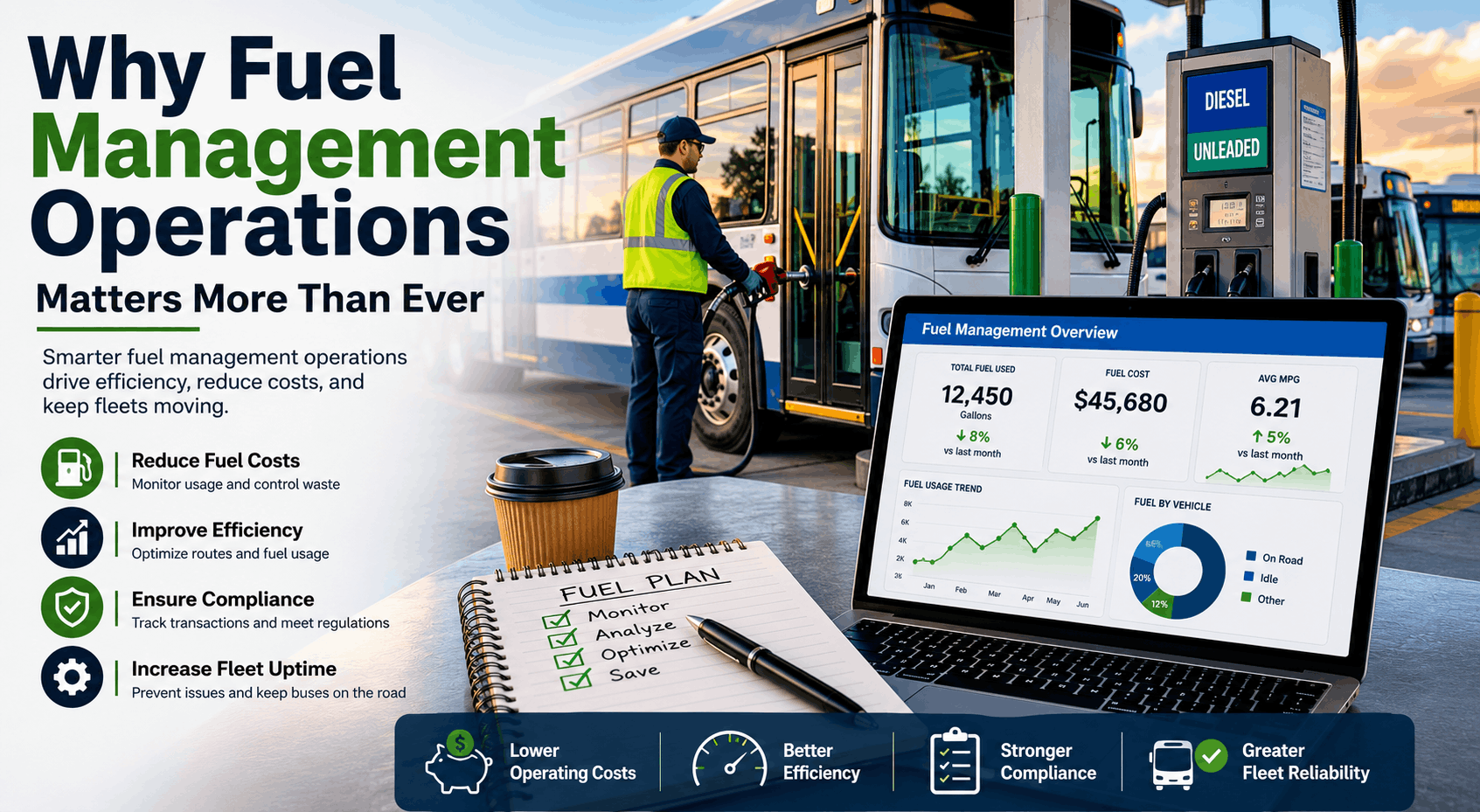
Fuel management operations have evolved from simple cost tracking to a strategic fleet function. For transit agencies, school bus fleets, and charter operators, fuel now connects directly to vehicle reliability, maintenance planning, driver behavior, environmental compliance, and budget performance. A fleet that only tracks total gallons purchased misses critical signals: a bus with sudden MPG drop likely has a mechanical issue. A driver with consistently low MPG needs coaching. A route with high fuel consumption may need redesign. Fuel operations that integrate with maintenance systems turn fuel data into a diagnostic tool. In 2026, effective fuel management operations means tracking fuel by vehicle, driver, route, and odometer; integrating fuel data with work orders; monitoring exceptions in real time; and using fuel analytics to predict maintenance needs. This page explains why fuel management operations matters more than ever and how fleets can use connected CMMS workflows to improve efficiency and reduce costs.
See how transit and school bus fleets use fuel management operations to improve compliance, efficiency, and vehicle availability.
Fuel management operations is the systematic process of tracking, analyzing, and optimizing fuel consumption across a fleet. It goes beyond fuel cost accounting to include vehicle-level MPG tracking, driver performance monitoring, route efficiency analysis, idle time reduction, exception detection (fraud, odometer errors, overfill), and integration with maintenance work orders. A mature fuel operations program answers four questions: Which vehicles are most fuel-efficient? Which drivers need coaching? Which routes consume the most fuel? What mechanical issues are causing fuel waste? Without fuel operations, fleets see only the total fuel bill. With fuel operations, fleets see the root causes of fuel consumption and take action to reduce it.
To manage fuel operations effectively, fleets must track specific metrics at the vehicle, driver, and route levels. Vehicle-level metrics: MPG per bus, fuel cost per mile, idle time percentage, fuel consumption trend over time, and sudden MPG drops that indicate mechanical issues. Driver-level metrics: MPG per driver (adjusted for route type), idle time per driver, and fuel consumption variance from fleet average. Route-level metrics: MPG by route, fuel consumption by time of day, and fuel cost per route mile. These metrics should be reviewed weekly and integrated with maintenance work orders and driver coaching programs.
Fuel operations is not separate from maintenance. Fuel consumption often changes before a breakdown happens. A sudden MPG drop can indicate tire pressure issues, brake drag, fuel injector problems, engine tuning issues, air filter restriction, or wheel bearing failure. When fuel data is connected to work orders, the maintenance team can investigate early instead of waiting for a road call. For example, if Bus 42 normally averages 7.8 MPG but drops to 6.1 MPG for two weeks, the CMMS should flag that trend and create an inspection task. The technician can check tire pressure, brakes, filters, engine codes, and fuel system performance. This turns fuel analytics into a preventive maintenance trigger.
Fuel operations improve when managers review the right KPIs on a consistent schedule. Weekly reviews catch problems before they become expensive. The dashboard should show MPG by bus (compare to fleet average), MPG by driver, idle time percentage, fuel cost per mile, exception alerts (MPG drop >15%, overfill, odometer mismatch), and fuel-linked maintenance work orders created in the past week. These KPIs should be shared with maintenance, operations, dispatch, and leadership. Fuel waste often crosses departments. Operations controls routes and idling. Maintenance controls vehicle condition. Finance tracks cost. A shared fuel dashboard keeps everyone aligned.
Most fuel operations failures are not caused by one major mistake. They come from small gaps repeated across weeks: missing odometer readings, no MPG tracking by driver, no idle monitoring, fuel data not integrated with maintenance, exceptions not reviewed weekly, and no action plan for low-MPG vehicles. These gaps make fuel waste invisible and allow mechanical issues to go undetected until breakdown. The fix is implementing a CMMS with integrated fuel tracking, MPG dashboards, driver scorecards, idle monitoring, exception alerts, and fuel-to-maintenance work order triggers.
Fuel management operations is strongest when fuel data is connected to vehicles, drivers, routes, odometers, and maintenance work orders. Fleets should treat every fuel event as an operational signal, not just a finance transaction. Key components include vehicle-level MPG tracking, driver performance monitoring, idle reduction, exception detection, and fuel-to-maintenance integration. When these components work together, fleets can reduce fuel costs 8-15%, improve MPG 10-20%, reduce idle time 20-40%, and catch mechanical issues before breakdowns.
Fuel management operations matters because fuel data now supports more than expense tracking. It helps detect mechanical issues before breakdown, coach driver behavior, optimize routes, reduce idle waste, prevent fraud, and explain operating costs to leadership. A CMMS turns fuel data into a connected fleet workflow by linking fuel transactions to vehicles, drivers, odometers, work orders, routes, and exception alerts. Transit and school bus fleets that improve fuel operations gain better visibility, lower waste, and stronger vehicle availability.