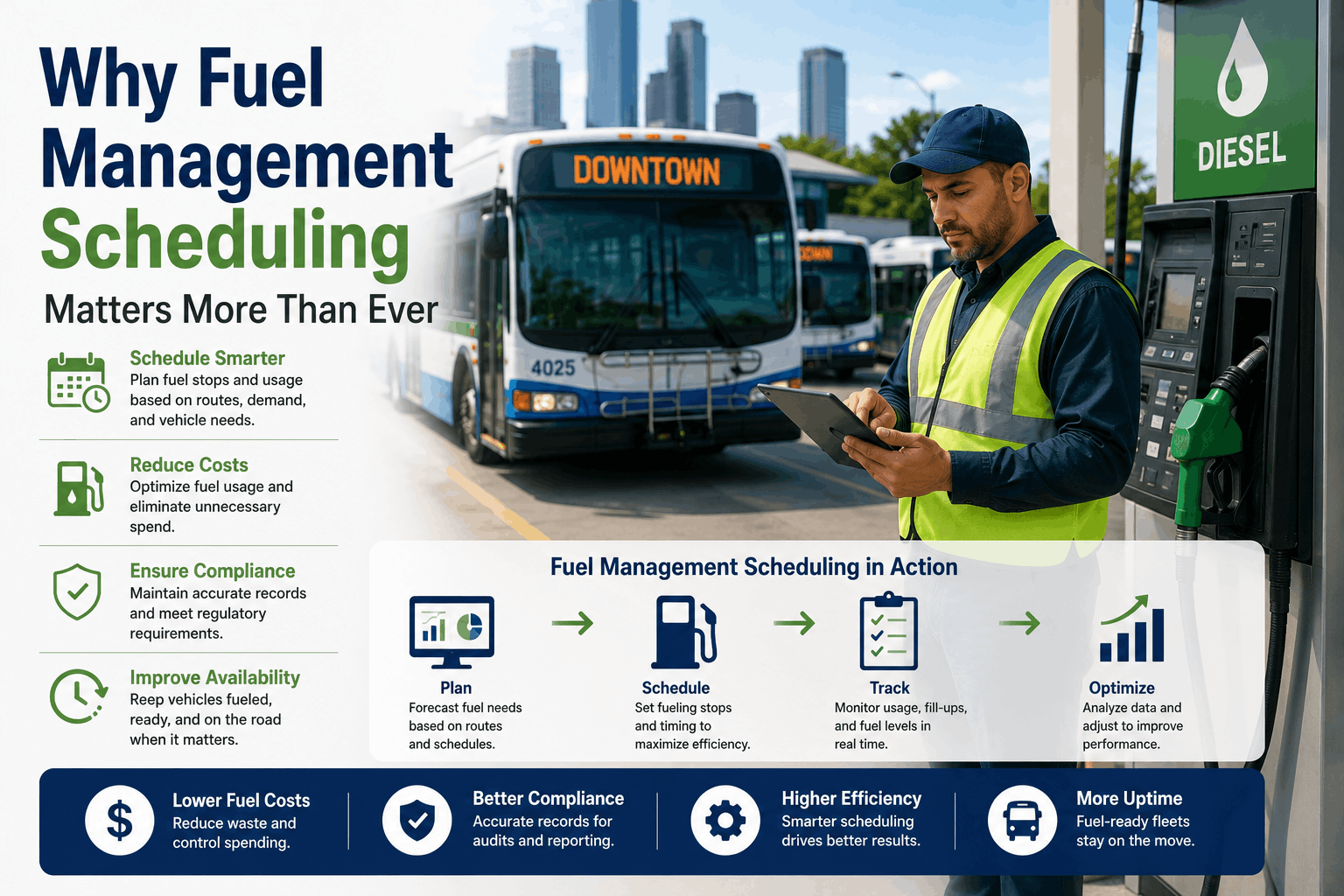
Fuel costs are the largest variable operating expense for transit and school bus fleets. Yet most fleets manage fuel as an afterthought — drivers fill up when needed, fuel cards are handed out without controls, and no one tracks fuel economy by bus or by driver. This reactive approach costs fleets 8-15% in unnecessary fuel spend annually. Fuel management scheduling changes this. It transforms fuel from an uncontrolled expense into a managed resource. By scheduling fuel purchases, tracking consumption by bus and driver, optimizing fueling locations, and integrating fuel data with maintenance, fleets can reduce fuel costs, improve compliance, and increase vehicle availability. This guide explains why fuel management scheduling matters more than ever in 2026 and how transit and school bus fleets can implement it.
See how transit and school bus fleets use fuel management scheduling to improve compliance, efficiency, and vehicle availability.
Fuel management scheduling is the systematic process of planning when, where, and how much fuel each bus receives. It integrates fuel card data, telematics, maintenance records, and driver assignments to create a complete fuel consumption picture. The schedule answers: Which buses need fuel today? Which fueling station offers the lowest price within route range? Is fuel economy consistent with expected MPG for this bus, driver, and route? Are there anomalies (excessive fuel purchases, off-route fueling, missing odometer readings) that indicate fraud or waste? Fuel management scheduling also includes proactive alerts: when a bus's MPG drops below baseline (indicating mechanical problem), when idle time exceeds policy limits, when fuel filters need replacement based on gallons consumed, and when fuel tax reporting is due. Without scheduling, fuel is an uncontrolled variable. With scheduling, fuel becomes a managed cost center.
Automated import of transaction data: date, location, gallons, cost, odometer, driver ID, vehicle ID.
Calculate MPG for every fill-up. Compare to baseline. Flag anomalies for investigation.
Track idle hours per bus, per driver. Set idle limits. Alert when exceeded.
Automate IFTA reporting by jurisdiction. Track off-highway fuel usage for tax credits.
MPG variance across a fleet is usually larger than expected. The graph below shows MPG for 50 transit buses on similar routes over one month. The best bus achieves 5.8 MPG. The worst bus achieves 3.9 MPG — a 33% difference. For a bus driving 30,000 miles annually at $4.00/gallon, the difference between 5.8 MPG and 3.9 MPG is $8,500 per year. Identifying and addressing the cause of low MPG (dragging brakes, underinflated tires, poor driver behavior, bad injectors) is the core value of fuel management scheduling.
Poor fuel management costs fleets in four hidden ways. First, MPG degradation from mechanical issues: underinflated tires (5-10% MPG loss), dragging brakes (10-20% loss), bad injectors (5-15% loss), clogged air filters (2-5% loss). These losses go undetected without MPG tracking. Second, excessive idling: a bus idling 30 minutes daily wastes $365-730 annually in fuel alone, plus engine wear. Third, fuel fraud: 3-7% of fuel spend is lost to personal vehicle fueling, card sharing, and billing errors. Fourth, missed fuel tax credits: off-highway fuel usage (gen sets, heaters) qualifies for tax refunds. Most fleets miss 2-5% of eligible credits. A 200-bus fleet spending $1.5 million annually on diesel loses $120,000-$225,000 to these four hidden costs. Fuel management scheduling eliminates or significantly reduces each.
MPG tracking flags sudden drops, indicating mechanical problems. Repair saves fuel and prevents breakdowns.
Idle time monitoring with driver alerts reduces idle fuel consumption 20-40% within 3 months.
Exception alerts flag overfill, off-hours fueling, out-of-route stations, and odometer anomalies.
Integrate fuel cards with your CMMS to automatically import every transaction — no manual entry, no missed data.
Calculate MPG for every fill-up. Compare to bus baseline, fleet average, and driver historical performance.
Set exception alerts for MPG drops exceeding 15%, overfill (gallons > tank capacity), off-hours fueling, and out-of-route stations.
Monitor idle time by bus and driver. Set idle reduction policy (5-minute maximum). Alert when exceeded.
Track fuel economy by driver. Share reports weekly. Gamify with MPG leaderboards and recognition.
Schedule fuel filter replacements based on gallons consumed, not calendar. Integrate with PM system.
Automate IFTA reporting. Track fuel purchases by jurisdiction and miles driven per jurisdiction.
Review fuel exception reports weekly. Investigate every anomaly. Document findings and corrective actions.
The most valuable fuel management scheduling insight is the link between fuel economy and maintenance. A sudden MPG drop is often the first indicator of a mechanical problem — before the driver notices anything wrong. By integrating fuel data with maintenance systems, fleets can automatically flag buses needing inspection when MPG drops below baseline. Examples: MPG drop of 15% over 3 fill-ups → generate inspection work order for brakes, tires, and engine systems. MPG drop of 25% over 2 fill-ups → immediate shop inspection required. Idle time increase → driver coaching or DPF regeneration needed. This integration shifts maintenance from reactive (fix after breakdown) to predictive (fix before failure). The fuel data becomes a diagnostic tool, not just a cost accounting line item.
Check tire pressure, brake drag, air filter restriction, fuel filters. Schedule within 7 days.
Immediate shop inspection. Check wheel bearings, injectors, turbo, emissions system.
Pull bus from service. Inspect brakes, engine, transmission. Probable serious mechanical issue.
Review idle patterns with driver. Check for DPF regen issues. Schedule training if needed.
What is fuel management scheduling?
How much can fuel management scheduling save my fleet?
How does MPG tracking help maintenance?
What is a good MPG target for buses?
How does idle monitoring save fuel?
Does BusCMMS include fuel management features?
Fuel management scheduling transforms fuel from an uncontrolled expense into a managed resource. The benefits are substantial: 8-15% fuel cost reduction, 20-40% idle time reduction, fraud detection, and integration with maintenance for predictive repair alerts. The investment in fuel management software typically pays for itself in 3-8 months. For a 200-bus fleet spending $1.5 million annually on fuel, that's $120,000-$225,000 in annual savings. Implement fuel card integration, MPG tracking, idle monitoring, exception alerts, and IFTA automation. Review MPG by bus weekly. Investigate every anomaly. Link fuel data to maintenance work orders. The result is lower costs, higher reliability, and better compliance.