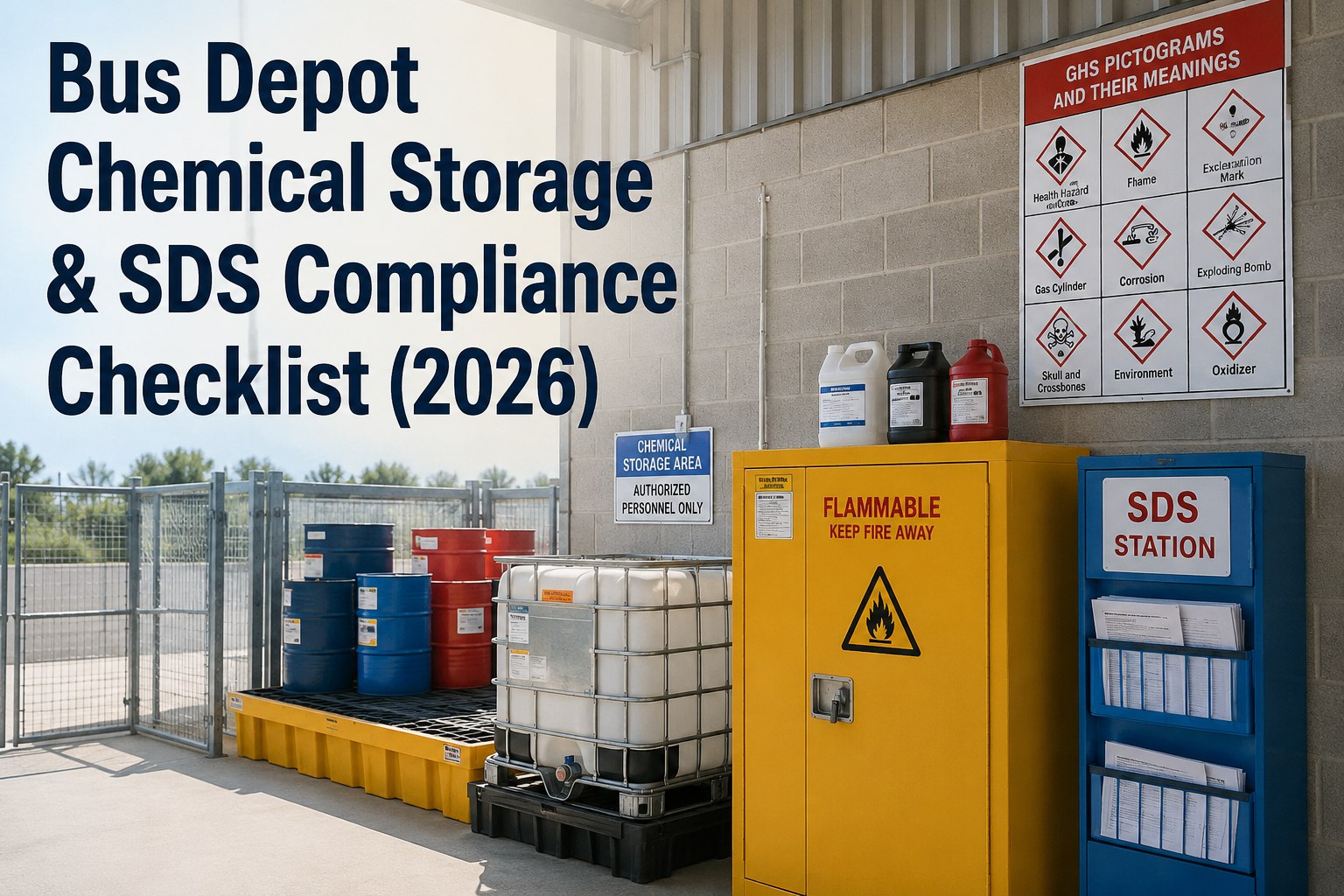
OSHA's HazCom 2024 rule sets a May 19, 2026 deadline (extended 4 months from January 19) for updated SDS documentation on every substance in your shop. HazCom is the second-most-cited OSHA standard in the country -- 2,888 violations in FY2024 and 2,546 in FY2025 -- and every violation on a bus depot costs up to $15,625, willful violations up to $156,259, and repeats the same. This is the 2026 bus depot chemical storage and SDS reconciliation checklist: the 5 chemical categories on every depot, secondary containment math, GHS pictogram guide, and the 10 audit points OSHA inspectors flag most often. See BusCMMS track SDS + chemical inventory per depot → book a 20-min demo.
Bus Depot Chemical Storage & SDS Checklist
The 5 chemical categories every bus depot stores, secondary containment math, 9 GHS pictograms, and the 10 audit points OSHA inspectors flag most often.
Mixture SDS Deadline
Multi-ingredient products (most bus depot chemicals) must have updated SDS by this date. Extended 4 months.
Retrain Employees on New Labels
Any new GHS Revision 7 label showing up in the shop triggers immediate retraining. Cannot wait for annual refresh.
The 5 Chemical Categories on Every Bus Depot
Each category has its own storage rules, its own SDS trail, and its own inspector focus.
A typical bus depot stores between 40 and 120 distinct hazardous chemicals across the shop, wash bay, body area, and battery room. Every one of them needs a current SDS on file, a proper GHS label on the container, and a storage location that respects incompatibility rules under IFC Table 5003.9.8. The list breaks down into 5 categories -- each with its own inspector focus and its own storage arrangement.
Fluids & Fuels
- Engine oil (new + used)
- Antifreeze / coolant
- DEF (32.5% urea)
- Allison TES 668/295/389
- Brake fluid (DOT 3/4)
- Hydraulic + power steering
- Diesel fuel
Solvents & Cleaners
- Brake cleaner (chlorinated + non)
- Parts cleaner (Safety-Kleen)
- Carburetor cleaner
- Degreaser (industrial)
- Penetrating oil / WD-40
- Contact cleaner (electrical)
Batteries & Compressed Gas
- Lead-acid batteries (sulfuric acid)
- Lithium-ion modules (EV buses)
- Acetylene (welding)
- Oxygen (welding)
- Argon / CO2 (MIG)
- Nitrogen (tire inflation)
Body Shop Materials
- Paints + primers
- Body filler
- Thinners + reducers
- Adhesives (RTV + threadlocker)
- Isocyanate hardeners
- Solvent-based sealers
Consumables & Lubricants
- Chassis grease
- Wheel bearing grease
- Silicone lubricant
- Wire-pulling lubricant
- Anti-seize compound
- Dielectric grease
Category 5 is where most bus depots fail the SDS audit. Low-hazard does not mean no-hazard from a compliance standpoint. See BusCMMS log SDS + chemical inventory per depot → book a demo.
The Secondary Containment 10% Rule (Do the Math)
Miscalculating containment volume is the #1 chemical storage citation on bus depot audits.
The federal secondary containment rule sounds simple until you have to size the actual containment pallet or berm on the shop floor. Under 29 CFR 1910.106, containment must hold **10% of the total container volume OR 100% of the largest single container -- whichever is greater**. Most bus depots do not do the math and end up with pallets that pass an eyeball test but fail an inspector's tape measure.
Common Bus Depot Oil Storage
Whichever Is Greater
If a fire sprinkler system is installed, sumps must be at least 4 inches deep. Steel or approved compatible plastic only. Containment must be checked for cracks, corrosion, and residual liquid at each PM cycle -- inspector tests capacity by pointing to the largest container.
Sizing containment to the largest single container is the single most common bus depot chemical storage fix. Do the math once, size the pallet right, pass the audit. See BusCMMS verify containment sizing per depot → book a demo.
The 9 GHS Pictograms Every Tech Should Recognize
Every shipped container has one or more of these. Every secondary container needs the same pictogram transferred.
GHS pictograms are the visual language of chemical hazard identification. Nine standardized diamond-framed symbols cover every hazard class the shop will encounter. Recognizing these at a glance is what lets a tech reach for the right PPE, the right spill kit, and the right storage cabinet without having to open the SDS every time.
Flame
Flammable, self-heating, self-reactive, pyrophoric, organic peroxide. Fuels, solvents, brake cleaner.
Flame over Circle
Oxidizer. Compressed oxygen for welding, sodium nitrate. NEVER co-locate with flammables (20 ft min).
Exploding Bomb
Explosive, self-reactive, organic peroxide. Rare in bus depot but possible with certain aerosols.
Corrosion
Skin corrosion, serious eye damage, metal-corrosive. Battery acid, sodium hydroxide.
Skull & Crossbones
Acute toxicity (severe). Certain isocyanates, some pesticides. High-severity respiratory protection required.
Health Hazard
Carcinogen, respiratory sensitizer, reproductive toxicity, target organ. Diesel exhaust, isocyanates.
Exclamation Mark
Skin/eye irritation, mild acute toxicity, narcotic effects. Common with degreasers, mild solvents.
Gas Cylinder
Compressed gas. Acetylene, oxygen, argon, CO2, nitrogen. Must be secured upright and chained.
Environment
Aquatic toxicity. Used oil, antifreeze, cleaners. Storm drain proximity is regulated.
Missing pictograms on secondary containers is the #2 most common bus depot HazCom citation after missing SDS. Every spray bottle. Every jug. Every squirt can. Sign up free and log GHS labels per container →
The 10-Point OSHA Audit Checklist
Every violation below appears in real bus depot HazCom audits. Fix all 10 before the next inspection.
- 01
SDS on file for every chemical, updated to GHS Rev 7
Every chemical from every vendor -- including contractor-supplied. Host employer is responsible under 1910.1200. Binders older than 5 years fail immediately.
- 02
Every secondary container labeled with GHS pictograms
Spray bottles, squirt cans, transfer jugs. Product name + pictogram + signal word minimum. Faded labels replaced immediately.
- 03
Secondary containment holds 10% or largest container
Do the math. If a 275-gallon tote is the largest, containment must hold at least 275 gallons -- not 10% of total inventory. Sumps 4" deep if sprinklered.
- 04
Oxidizers separated 20 ft from flammables
Per IFC Table 5003.9.8. Oxygen cylinders 20 ft from acetylene. Pool chemicals not in solvent cabinets. Approved barrier acceptable in place of distance.
- 05
Flammables stored in 29 CFR 1910.106-rated cabinets
Fire-rated cabinet with mechanical ventilation, spill containment, grounded and sealed. 60 gallons Class I/II max per cabinet.
- 06
Written HazCom program on file
Chemical inventory list, SDS procedures, label management, training program, non-routine tasks, multi-employer procedures. Required documentation.
- 07
Employee training records complete
Every exposed employee trained at initial assignment, when new hazards introduced, and when new GHS Rev 7 labels appear. Records show name, date, topic covered.
- 08
Battery spill kit + eyewash within 10 seconds
Neutralizer, absorbent, PPE, disposal bags. Eyewash tested weekly, tepid water within 10 seconds of battery work area. Test log posted.
- 09
DEF stored separately from petroleum products
DEF cross-contamination with oil or diesel destroys SCR catalysts on downstream buses. Dedicated pump, dedicated funnels, dedicated storage area.
- 10
Aisles clear + exits unobstructed
The simplest and most common citation. Drums stacked in walking paths, exits blocked by parts inventory, chemical carts left in aisles overnight.
Ten audit points. Each one costs up to $15,625 if flagged. Willful or repeat findings cost up to $156,259. See BusCMMS run the 10-point audit automatically → book a demo.
Where BusCMMS Fits Your HazCom Program
Six ways the SDS binder becomes a digital compliance asset instead of a dusty folder no one can find.
Digital SDS Library Per Depot
Every SDS stored and searchable per depot, accessible on any device during any shift. No more binder-hunting when the inspector walks in.
Chemical Inventory Per Location
Every chemical logged with quantity, location, and current SDS revision. GHS Rev 7 update status tracked per product.
Container Inspection Checklists
Secondary container label checks, expiration dates, and physical condition logged at each PM. Faded labels surface for immediate replacement.
Containment + Spill Kit Verification
Secondary containment condition and spill kit stock verified against a scheduled inspection template. Eyewash test log tracked automatically.
HazCom Training Records
Every employee's training history logged with topic, date, trainer, and outcome. New-label retraining triggered automatically when SDS updates.
May 19 2026 SDS Deadline Tracker
Every product in inventory flagged for GHS Rev 7 SDS status. Vendor follow-ups scheduled for anything still on legacy documentation.
OSHA walked in for what they called a general schedule inspection. Two hours in, they had cited us for 11 HazCom violations. Missing SDS on our new brake cleaner, four unlabeled secondary spray bottles, secondary containment on the oil tote that was sized to hold 60 gallons when the tote itself is 275, and our HazCom training record for two mechanics who had started that year. $47,000 in proposed penalties. We settled at $28,000 after our attorney worked it down. Six months later we moved SDS management and chemical inventory into BusCMMS. Every product flagged for GHS Rev 7 update status, every secondary container tracked with label condition, every training record on file. Next inspection was a routine follow-up nine months after that. Zero HazCom findings. That is the entire ROI story.
$47K in proposed HazCom penalties. $28K settled. Zero the next time. See the delta →
Frequently Asked Questions
What is the May 19, 2026 HazCom deadline?
OSHA's HazCom 2024 final rule aligns the Hazard Communication Standard with the Globally Harmonized System of Classification and Labelling of Chemicals Revision 7. It introduces a new hazard class for desensitized explosives, revised criteria for flammable gases and aerosols, updated Safety Data Sheet sections, new small-container labeling provisions, and non-animal testing methods for skin corrosion and irritation. The original substance deadline was January 19, 2026, but a January 2026 Federal Register notice extended it by four months. The current deadline for chemical manufacturers, importers, and distributors of single-ingredient substances to classify to the updated criteria and ship products with updated labels and SDS is May 19, 2026. The mixture deadline (multi-ingredient products, which is what most bus depot chemicals actually are) was similarly extended to November 19, 2027. Employers do not have a specific compliance date but must retrain employees when new GHS Revision 7 labels appear in the workplace and must update the workplace SDS binder as new documentation arrives. Bus depots ordering from multiple vendors will see revised labels arrive throughout 2026 and 2027 as each manufacturer transitions.
What secondary containment does a bus depot need for chemical storage?
Federal secondary containment sizing under 29 CFR 1910.106 requires containment to hold either 10% of the total container volume in the storage area OR 100% of the largest single container -- whichever is greater. This is the calculation most bus depots miscalculate. A typical shop storing four 55-gallon drums of fresh oil, two 55-gallon drums of used oil, and one 275-gallon tote of antifreeze has 605 gallons total. Ten percent equals 60.5 gallons. But the largest single container is the 275-gallon tote. The required containment is 275 gallons -- not 60. Sizing to 10% is the most common secondary containment violation. If a fire sprinkler system is installed in the storage area, sumps must be at least 4 inches deep to catch flammable liquid discharge during a fire. Containment pallets and berms must be steel or an approved compatible plastic material, checked for cracks, corrosion, and residual liquid at each PM cycle. Inspectors verify sizing by pointing to the largest container and asking the depot to demonstrate containment capacity matches or exceeds it -- so know the number before the inspection.
What are the 9 GHS pictograms and which apply to bus depots?
The nine GHS pictograms are: Flame (flammable, self-heating, pyrophoric, organic peroxide) -- covers fuels, solvents, brake cleaner, and most aerosols. Flame Over Circle (oxidizer) -- covers compressed oxygen for welding and pool chemicals; must never co-locate with flammables within 20 feet per IFC Table 5003.9.8. Exploding Bomb (explosive) -- rare in bus depots but possible with certain aerosols and organic peroxides. Corrosion (skin corrosion, serious eye damage, metal-corrosive) -- covers battery acid and any strong base. Skull and Crossbones (severe acute toxicity) -- covers certain isocyanates in body shop paint. Health Hazard (carcinogen, respiratory sensitizer, reproductive toxicity, target organ) -- covers diesel exhaust exposure and isocyanates. Exclamation Mark (skin or eye irritation, mild acute toxicity, narcotic effects) -- covers most degreasers and mild solvents. Gas Cylinder (compressed gas) -- covers acetylene, oxygen, argon, CO2, and nitrogen cylinders on the depot; all must be secured upright and chained. Environment (aquatic toxicity) -- covers used oil, antifreeze, and cleaners with storm drain regulation implications. Bus depots typically deal with 6 of the 9 across the shop, wash bay, body area, and battery room. Every secondary container must display the same pictograms as the original manufacturer label -- missing pictograms on spray bottles and transfer jugs is the second most common HazCom violation after missing SDS.
What are the most common OSHA HazCom violations at bus depots?
HazCom is the second most-cited OSHA standard in the country -- 2,888 violations in FY2024 and 2,546 in FY2025. Ten violations appear repeatedly in bus depot audits. First, missing SDS -- the most-cited HazCom violation, often on new chemicals introduced without a documentation update. Second, unlabeled secondary containers such as spray bottles and transfer jugs without GHS pictograms. Third, secondary containment sized to 10% of total when the largest container rule requires a larger capacity. Fourth, oxidizers stored within 20 feet of flammables (pool chemicals next to cleaning solvents is the classic example). Fifth, flammables stored outside a 29 CFR 1910.106-rated fire cabinet. Sixth, no written HazCom program on file -- required documentation that includes chemical inventory, SDS procedures, label management, training program, non-routine tasks, and multi-employer procedures. Seventh, incomplete employee training records that cannot show every exposed employee has been trained. Eighth, missing or expired battery spill kit or non-tested eyewash within 10 seconds of battery work areas. Ninth, DEF stored with petroleum products (cross-contamination destroys SCR catalysts and is a chemical incompatibility issue). Tenth, blocked aisles and obstructed exits -- the simplest citation and the most common. Each violation runs up to $15,625 for serious findings, $15,625 to $156,259 for willful, and up to $156,259 for repeat findings.
How does BusCMMS help manage HazCom compliance across a bus depot?
BusCMMS maintains a digital SDS library per depot with every SDS stored and searchable, accessible on any device during any shift -- solving the binder-hunting problem when an OSHA inspector walks in. Chemical inventory is logged per location with quantity, storage area, and current SDS revision status, and every product carries a GHS Revision 7 update status flag so items still on legacy documentation surface with automatic vendor follow-up before the May 19 2026 deadline. Container inspection checklists run at each PM cycle -- secondary container labels, expiration dates, and physical condition are logged, so faded labels surface for immediate replacement rather than waiting to be caught at audit. Secondary containment condition and spill kit stock are verified against a scheduled inspection template, and the weekly eyewash test log runs automatically. Every employee's HazCom training history is logged with topic, date, trainer, and outcome -- and when an SDS updates for GHS Revision 7, new-label retraining is triggered automatically for anyone with exposure to that chemical. One 96-bus 3-depot Southeast school district reported settling $47,000 in proposed HazCom penalties down to $28,000 during a routine OSHA inspection that flagged 11 violations, then reported zero HazCom findings during the follow-up inspection nine months after moving SDS management, chemical inventory, and training records into BusCMMS.