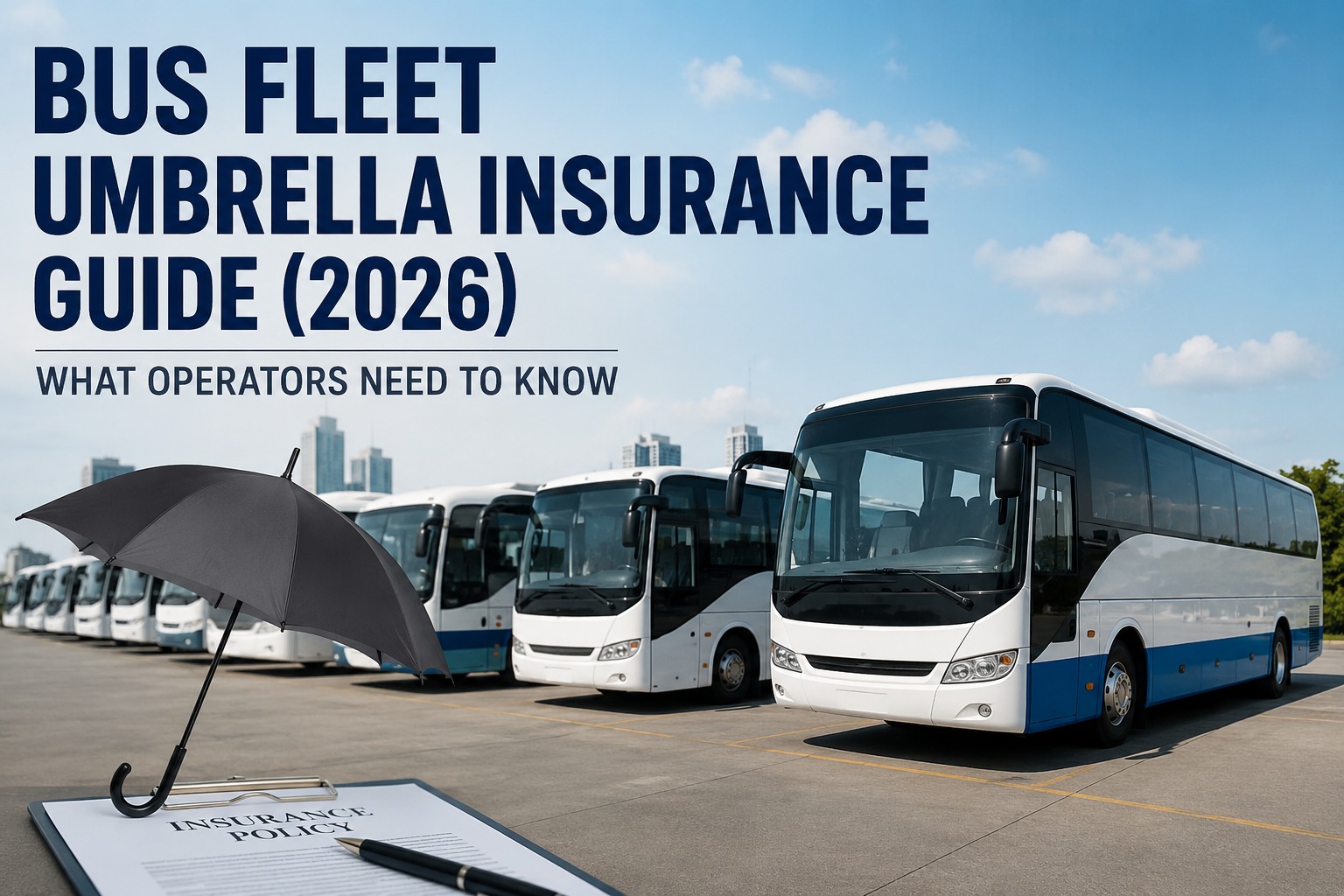
One serious crash. Two claimants above $5 million each. Your $5M primary policy is exhausted before the case even opens. Bus fleet umbrella insurance is the layer that stands between one bad day and the end of your operation. This guide covers the layers, the limits contracts actually require, the $10M+ nuclear-verdict math, and the renewal traps that catch operators off guard. Book a demo to see how a CMMS strengthens your fleet's insurance renewal package.
Bus Fleet Umbrella Insurance: The 2026 Coverage Guide for Operators
Liability layers, contract-required limits, nuclear-verdict math, and what actually strengthens your renewal
- $5MFMCSA min, 16+ seats
- $23.8MMedian nuclear verdict
- 89$10M+ verdicts in 2023
- Excess Layer$10M – $25MContract-driven, high-verdict states
- Umbrella Policy$5M – $10MSits above primary auto/GL
- Primary Auto Liability$1M – $5MFMCSA-required base
- General & Garage Liability$1M CSLYard, shop, non-vehicle claims
Why the $5M FMCSA Minimum Isn't Enough Anymore
Every fleet manager knows the FMCSA rule: any for-hire bus with 16 or more seats needs $5 million in public liability coverage. That number was set decades ago. In 2026, one multi-claimant crash on an interstate can burn through $5 million before the settlement talks even start. According to Marathon Strategies, 89 nuclear verdicts (jury awards over $10 million) were handed down in 2023 alone -- a 27% jump from the year before -- with a median award of $23.8 million.
The Gap Nobody Wants to Explain to the Board
A $10M verdict on a $5M primary policy leaves the operator personally responsible for the other $5M. Not the insurer. Not the state. The operator. That gap has ended more small-fleet operations than any single mechanical failure ever will.
This is why bus fleet umbrella insurance stopped being optional. By 2026, most bus operators carry umbrella limits in the $2M–$10M+ range, and increasingly higher for fleets running interstate charter or contract routes. Nuclear verdicts jumped 27% in 2025, and umbrella premiums for transportation firms rose 12–30% in the same window -- both insurers and juries have moved, and operators who haven't updated their coverage tower are the ones exposed.
Umbrella vs. Excess Liability: The Difference That Costs You Claims
Most operators use "umbrella" and "excess" as interchangeable words. Insurance policies do not. The difference matters at claim time -- and if your broker didn't walk you through it, this section is the conversation you should have had.
True Umbrella Policy
Sits above multiple primary policies (auto, general liability, employer's liability). Can broaden coverage beyond what the underlying policies allow.
- Covers: Multiple underlying policies at once
- Can fill gaps: Yes, in some cases
- Broader wording: Sometimes covers what primary excludes
- Best for: Fleets with auto + garage + GL exposure
Excess (Following-Form) Policy
Sits above one specific primary policy. "Follows form" -- meaning it uses the same coverage terms and exclusions as the policy below it.
- Covers: One underlying policy's limits
- Can fill gaps: No — only extends existing limits
- Narrower wording: If primary excludes it, excess excludes it
- Best for: Layering high limits above a strong primary
In practice, most large bus fleets use a combination: a true umbrella above the primary auto and GL policies, then following-form excess layers stacked on top when contract-required limits climb into $10M, $25M, or higher territory. That combination gets your tower to $10M+ without paying umbrella premiums on every layer above. Book a demo to see how BusCMMS documents your safety program for lower renewal quotes.
What Contracts Actually Require in 2026
Umbrella limits used to be a "what feels right" number. Now they're a "what the contract demands" number. School districts, universities, event promoters, and government agencies all set minimum coverage limits in their transportation contracts -- and if you can't produce a certificate of insurance at that limit, the contract goes to someone who can.
Home-to-school contracts. Larger districts and after-school activity routes push toward the $10M end.
Interstate charter minimum. Florida statute pushes motorcoach operators to $10M excess minimum.
FTA-funded contract routes. Higher for high-population urban service and multi-state operations.
Athletics and event routes trend higher. Universities routinely require named-insured status too.
Fortune 500 event bookings, casino runs, and airport shuttle contracts. $25M common on large accounts.
DoD base transportation, federal agency contracts. Additional insured and waiver of subrogation standard.
The pattern is unmistakable: contract-required limits have roughly doubled since 2020. If your renewal quote is coming back at $5M and every proposal you're bidding on requires $10M, you're going to lose the contract on paper before the vehicles ever roll. Book a demo to see how BusCMMS tracks certificate-of-insurance dates against active contracts.
What an Umbrella Actually Costs
Here's the surprising part: for what it protects, umbrella coverage is one of the cheapest lines of insurance you'll ever buy per dollar of limit. Transportation-industry rates typically land in the $2,500–$5,000 per million range for smaller fleets, climbing on high-limit programs. Compared to the primary auto premium on the same bus, an extra $5M in umbrella often costs less than one bus's annual physical damage coverage.
These are directional 2026 ranges -- your quote depends on fleet size, loss history, state, driver MVRs, and safety program documentation. But relative to the exposure, the math is straightforward: $14,000 per year to protect against a $10M verdict is not a hard board conversation. Being underinsured by $5M when the verdict lands? That's the conversation that ends careers. Book a demo to see how tracked safety data can bring your umbrella quote down.
The Renewal Package: What Underwriters Actually Score You On
Two fleets of identical size, same routes, same state. One gets a 12% renewal increase. The other gets 34%. The difference isn't luck -- it's the renewal submission package. Underwriters price bus fleet umbrella insurance on documented risk, not intuition. If you can prove your safety program, your quote drops. If you can't, they assume the worst.
- 01
PM compliance rate per bus
Underwriters want proof preventive maintenance is completed on schedule, not skipped. Anything under 90% raises the quote.
- 02
DVIR pass-through rate and defect resolution time
Every documented pre-trip inspection lowers your risk profile. Fast defect closure proves you don't run known-defective buses.
- 03
Driver MVR review cadence and CDL tracking
Regular MVR checks and expired-CDL alerts are underwriting green flags. Missed license expirations are quote-killers.
- 04
3–5 year loss runs with root-cause notes
Losses happen. What underwriters want to see is a root cause and a documented corrective action. Silence looks like negligence.
- 05
Telematics data — harsh braking, speeding, idle time
Fleets that share telematics data get better rates. It proves driver behavior is monitored and corrected, not just recorded.
- 06
Contract limits stacked against actual coverage
Underwriters look at gaps between what your contracts require and what you carry. Mismatches raise the whole account's risk profile.
Notice what all six have in common: they're data problems, not vehicle problems. A fleet running a modern CMMS can pull each of these reports in minutes. A fleet running spreadsheets and paper DVIRs spends weeks assembling the same package -- and often can't produce it at all. Sign up free and start building the renewal package your underwriter will actually reward.
How BusCMMS Strengthens Your Insurance Renewal
A CMMS built for buses isn't just a maintenance tool -- it's a documentation engine for exactly the safety story underwriters want. Every PM, every DVIR, every fault code, every driver certification lives in one system with timestamps and history. When renewal time hits, the underwriter package is one export away instead of three weeks of scrambling.
PM Compliance Reports
Per-bus compliance rate exportable in one click. The underwriter's #1 requested document.
Digital DVIR Archive
Every pre- and post-trip inspection timestamped, driver-signed, retained. Audit-ready on demand.
CDL & Cert Expiration Alerts
MVR review cadence and license expiration tracked automatically. No missed dates on renewal.
Incident & Corrective Action Log
Every incident logged with root cause and the action taken to prevent recurrence. Underwriter gold.
Contract COI Tracking
Certificate-of-insurance limits mapped to active contracts. Instantly see coverage gaps by client.
Telematics Integration
Samsara, Geotab data flow in automatically. Harsh-braking and speeding trends per driver.
BusCMMS reports its customer fleets typically see smoother renewal conversations and stronger loss-run documentation within their first year, based on company-reported outcomes. The software doesn't lower your premium by itself -- your safety record does. The software makes sure the underwriter actually sees it.
The Broker's View
The lesson every experienced fleet operator eventually learns: your umbrella premium is a story your paperwork tells. When the paperwork is clean, current, and easy to export, the story is short and the premium is reasonable. When the paperwork is a shoebox of DVIRs and a spreadsheet nobody has updated in six months, the story writes itself the wrong way.
What is bus fleet umbrella insurance and how does it work?
Bus fleet umbrella insurance is a liability policy that sits above your primary commercial auto, general liability, and employer's liability policies. When a claim exhausts the primary policy's limits, the umbrella pays the remaining amount up to its own limit. So a fleet with $5M primary auto and a $10M umbrella has $15M in total available liability coverage for a covered claim. A true umbrella can cover multiple underlying policies at once and may broaden coverage beyond what the primary allows, while a following-form excess policy only extends the limits of one specific underlying policy without changing the terms.
How much umbrella coverage does a bus fleet need in 2026?
Most bus operators carry umbrella limits in the $2M–$10M+ range in 2026, but the right number depends on contracts and jurisdiction. School district home-to-school contracts typically require $5M–$10M. Charter and motorcoach operators face $5M–$10M standard, with Florida statute pushing motorcoach excess to $10M minimum. Transit-agency FTA-funded routes commonly require $10M–$25M. Corporate and government contracts frequently require $10M+ with $25M common. With nuclear verdicts (jury awards over $10M) hitting a record 89 cases in 2023 and median awards at $23.8M, coverage that felt adequate five years ago often isn't anymore.
What is the difference between umbrella and excess liability insurance?
A true umbrella policy sits above multiple underlying policies (commercial auto, general liability, employer's liability) and can sometimes broaden coverage or fill gaps the underlying policies exclude. An excess or following-form excess policy sits above one specific primary policy and uses that policy's exact terms and exclusions -- if the primary excludes a loss, the excess excludes it too. Most large bus fleets combine both: a true umbrella above the primary layer for breadth, then following-form excess layers stacked on top when contract-required limits climb into $10M, $25M, or higher.
How much does bus fleet umbrella insurance cost?
Transportation-industry umbrella rates typically fall in the $2,500–$5,000 per million range for small to mid-sized fleets in 2026, though premiums vary significantly by fleet size, state, loss history, driver MVRs, and safety-program documentation. A $5M umbrella often costs $8,000–$12,000 annually; $10M lands around $14,000–$20,000. High-limit programs ($25M+) run $30,000+. Umbrella premiums for transportation firms rose 12–30% in 2025 as nuclear verdict activity climbed. Fleets that document strong PM compliance, DVIR completion, driver monitoring, and incident corrective actions get meaningfully better renewal quotes than fleets that can't produce that data.
How does a CMMS like BusCMMS help with fleet insurance renewals?
Underwriters price bus fleet umbrella insurance on documented risk, and every safety data point they want lives in a CMMS: PM compliance per bus, DVIR completion rates and defect resolution time, driver CDL and medical card expiration tracking, incident logs with root cause and corrective action, telematics data on harsh braking and speeding, and certificate-of-insurance limits mapped against active contracts. BusCMMS exports these reports in one click for renewal submissions, replacing weeks of manual spreadsheet work. The software doesn't lower premiums by itself -- your safety record does. The system makes sure the underwriter actually sees it.