Most bus fleets maintain every component the same way: one blanket PM schedule, every part serviced on the same calendar whether it needs it or not. That over-maintains the parts that rarely fail and under-protects the ones that strand buses. Reliability-centered maintenance bus programs flip that — they match the maintenance strategy to each component's actual failure behavior, so effort goes where reliability is really won.
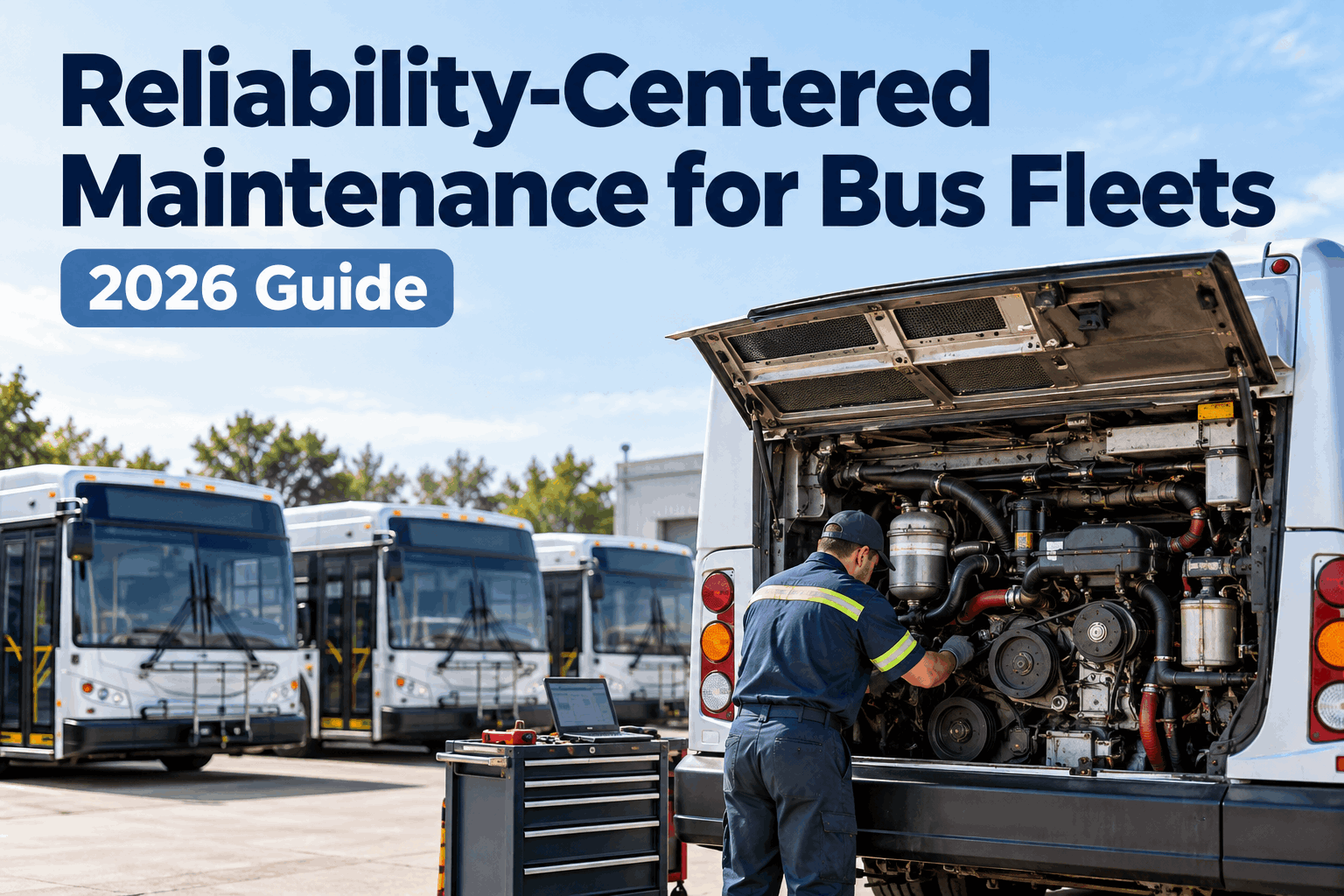
Reliability-Centered Maintenance for Bus Fleets: 2026 Guide
Stop servicing every component on one blanket schedule. RCM matches the right maintenance strategy to each part's failure behavior — so you cut waste and downtime at once.
Blanket PM vs. Reliability-Centered Maintenance
Traditional PM treats every component as equally deserving of the same calendar service. RCM starts from a different premise: not all parts fail the same way, so not all should be maintained the same way.
- Logicsame schedule for everything
- Low-risk partsover-maintained — wasted labor
- Critical partsunder-protected — still fail
- Basistradition and the calendar
- Logicstrategy matched per component
- Low-risk partsrun-to-failure — effort saved
- Critical partswatched closely — protected
- Basisfailure data and consequence
RCM isn't "do more maintenance" — it's do the right maintenance. Some parts get less attention (a cheap, non-critical item you run to failure), and the freed-up effort goes to the components that actually down buses.
RCM is the disciplined layer on top of a solid preventive program — it builds on the fundamentals in our bus fleet maintenance strategy guide. Book a demo to see strategy matched per component.
The RCM Questions That Decide Each Component's Strategy
RCM works by asking a short chain of questions about each significant component. The answers route it to the right maintenance response — the classic logic behind the discipline.
What does it do?
Define the component's function and the performance you expect from it — you can't judge a failure without knowing the job it's supposed to do.
How does it fail?
Identify the ways it can fail and what causes each — a component often has several failure modes, and each may need a different response.
Does the failure matter?
Weigh the consequence — safety, a stranded bus, or a minor annoyance. Consequence, not just likelihood, decides how much effort a failure earns.
What's the right response?
Choose the strategy that fits: watch its condition, service it on time, let it run to failure, or redesign the problem out entirely.
Question 3 is the one blanket PM skips entirely. A failure that just annoys a driver and one that strands a bus full of students are not the same — and shouldn't get the same maintenance effort.
Answering "how does it fail" well means reading your failure history — the same data behind MTBF and MTTR analysis feeds directly into RCM decisions. Sign up free and run the RCM logic on your fleet.
The Four Maintenance Strategies RCM Assigns
RCM's output is a strategy per component, drawn from four options. The right one depends on how critical the part is and how it fails — here's when each fits.
Run-to-failure
For cheap, non-critical parts that fail harmlessly and are quick to replace. Planned PM would cost more than just fixing it when it breaks.
Time-based PM
For parts that wear predictably with age or mileage. A fixed interval works because the failure clock is steady — classic scheduled service.
Condition-based
For critical parts that give warning signs. Monitor condition — wear, readings, telematics — and act when it degrades, not on a calendar.
Redesign / fix
When a part keeps failing no matter what, the answer isn't more maintenance — it's changing the part, the spec, or how it's used.
The mix is the point. A real RCM program has all four running at once — run-to-failure on the trivial stuff, condition-based on the critical stuff — instead of forcing every part onto the same schedule.
Condition-based is where most reliability gains hide, and it leans on the same signals as good predictive maintenance — RCM decides which parts deserve that treatment. Book a walkthrough to assign strategies by component.
How to Apply RCM to a Bus Fleet
You don't need a consultant and a year to start. Four steps bring RCM thinking to a bus fleet using data you likely already have.
Rank Components by Criticality
Sort your major components by what a failure costs — safety first, then downtime. Focus RCM effort on the critical few, not every nut and bolt.
Study How Each Actually Fails
Pull the failure history for your critical components — how often, how, and with what warning. This data is what tells you which strategy fits.
Assign the Right Strategy
Route each component to run-to-failure, time-based, condition-based, or redesign based on its criticality and failure pattern — then build the PM to match.
Measure and Refine
Track whether reliability improved and adjust — RCM is a living program that gets sharper as more failure data comes in, not a one-time setup.
Start with step 1 and don't boil the ocean: a handful of critical components drive most of your downtime. Get their strategies right first and you capture the bulk of RCM's benefit fast.
RCM is really an evolution of a strong PM foundation — if you're still building that, start with building a bus fleet PM program first, then layer RCM on top. Sign up free and start with your critical components.
The BusCMMS Analytics That Power Reliability-Centered Maintenance
RCM runs on data: criticality, failure history, and the ability to set a different strategy per part. BusCMMS holds all three and makes per-component maintenance practical instead of a spreadsheet project.
Component Criticality Ranking
Rank parts by failure consequence, so RCM effort focuses on the critical few that actually down buses.
Failure-History Analysis
See how each component actually fails — frequency, mode, and warning — the data that decides its strategy.
Per-Component PM Strategy
Set run-to-failure, time-based, or condition-based per part, so each component runs on its own correct strategy.
Condition & Usage Triggers
Fire maintenance on mileage, hours, or condition — not just the calendar — so condition-based parts get serviced when they need it.
Reliability Metrics
Track MTBF, downtime, and cost per component, so you can prove a strategy worked and refine the ones that didn't.
Telematics Integration
Feed fault codes and usage from Samsara, Geotab, and others into condition-based triggers for real-time RCM.
A generic tool runs one PM schedule; a bus-built platform lets each component run its own RCM strategy from real data — BusCMMS is typically live in 2–4 weeks, turning failure history into a per-part maintenance plan.
A Maintenance Director's Take
Key Takeaways on Reliability-Centered Maintenance
RCM is one idea: match the maintenance to the component, using data. Five things to act on.
Not one schedule
Blanket PM over-serves some parts, under-serves others.
Consequence decides effort
A failure that strands a bus earns more than an annoyance.
Four strategies, mixed
Run-to-failure, time-based, condition-based, redesign.
Start with the critical few
A handful of components drive most downtime.
It's data-driven
Failure history decides each part's strategy.
Match maintenance to each component and the same labor buys more reliability — less waste on the safe parts, more protection on the critical ones. Book a walkthrough to build RCM for your fleet.