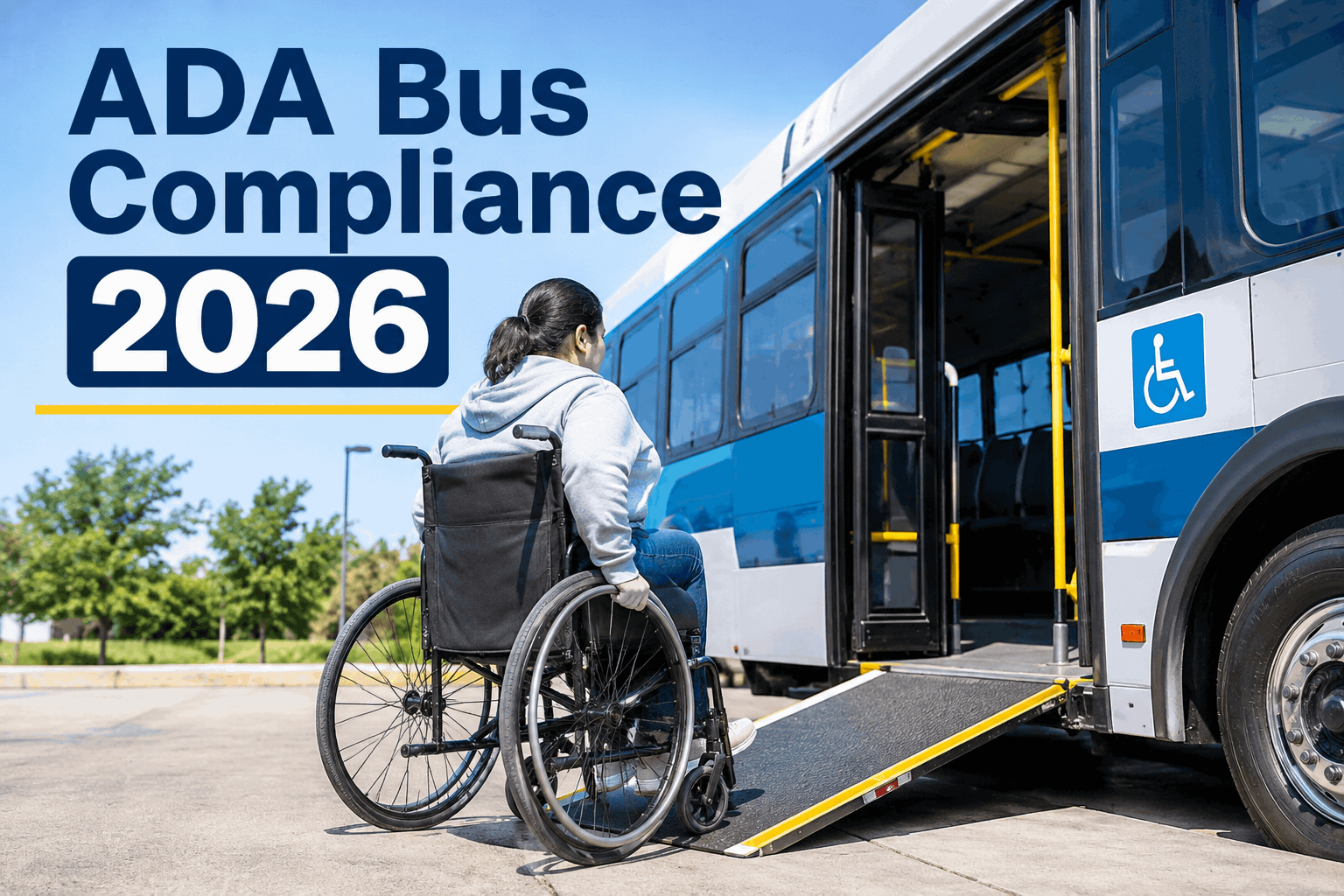
ADA compliance on a bus fleet is not a one-time vehicle specification check. A wheelchair lift that worked at delivery still has to work in service, securement equipment must be ready when needed, and an accessibility defect needs a documented response. You can see how BusCMMS organizes accessibility-related inspections and repair records in a demo.
ADA Rule Changes in 2026: What Bus Fleets Should Know
The practical priority for fleet teams remains clear: keep accessibility features operative, identify failures promptly, repair them without avoidable delay, and preserve a traceable maintenance record. Separate current requirements from rulemakings that are still proposed.
49 CFR Part 37 service and maintenance obligations, plus applicable vehicle specifications in Part 38.
DOT has listed a proposed rule to consider updated accessibility standards. A timetable entry is not an effective final rule.
Check lifts, ramps, securement systems, accessible controls, signage and reporting procedures now.
First, What Actually Changed for 2026?
The phrase “ADA rule changes 2026” can make it sound as though a new set of bus accessibility duties automatically took effect on January 1. Fleet managers should be more precise. The U.S. Department of Transportation has listed rulemakings that would update transportation disability regulations, including a proposal to adopt revised accessibility standards for buses and vans based on updated U.S. Access Board guidelines. The 2026 Unified Agenda identifies this item as being in the proposed-rule stage, with a planned notice-of-proposed-rulemaking timetable. That status does not, by itself, create a new compliance deadline or replace the requirements already in force.
For day-to-day maintenance, the existing rules remain operationally important. Under 49 CFR §37.161, public and private transportation providers must maintain accessibility features in operative condition, repair damaged or inoperative features promptly, and take reasonable steps to accommodate people who would otherwise use a feature that is out of order. For public entities, §37.163 adds specific requirements for regular and frequent lift checks and operator reporting. These are not optional just because a broader standards update is being considered.
Maintain accessible features
Applies to public and private transportation providers. Accessibility equipment must remain usable, and failures require prompt repair and reasonable accommodation.
Check vehicle lifts
For public entities, establish regular and frequent checks sufficient to determine whether lifts are operative, and ensure operators report failures promptly.
Vehicle accessibility specifications
Applicable technical specifications govern accessible buses and vans, including relevant boarding and mobility-aid provisions.
Important distinction: this article is an operational overview, not legal advice. Confirm the current text, applicability and effective dates with the relevant agency or qualified counsel before changing procurement or service policy. Start a free BusCMMS account to organize your maintenance records.
The Accessibility Equipment a Fleet Should Inspect
A useful ADA maintenance program starts with an accurate equipment inventory. The exact features vary by vehicle design and service type, but a fleet register should identify the accessibility equipment installed on each bus and the checks that confirm it is ready for use.
Wheelchair lift or ramp
Check deployment, stowing, movement, interlocks, controls, visible damage, unusual noise and safe operation according to the equipment maker's procedure.
Wheelchair securement system
Inspect belts, straps, anchors, floor fittings and occupant restraints for wear, missing components, damage and correct engagement.
Priority seating and signage
Check that designated areas, signs, labels and passenger information remain present, legible and unobstructed.
Accessible controls and communication
Verify applicable stop-request, announcement, visual or audible information and other accessibility-related features fitted to the vehicle.
Use the bus manufacturer's maintenance instructions and your applicable operating requirements to define the actual inspection method and frequency. A generic checklist is a starting point, not a substitute for vehicle-specific procedures.
A Lift Failure Needs a Defined Response, Not Just a Repair Ticket
The key compliance risk is not simply that a component can fail. It is that the organization does not detect the failure, communicate it, make the required service decision or follow through on the repair. For public entities, §37.163 sets out specific lift-related requirements. When a lift is found inoperative, the general rule is to remove the vehicle from service before the next service day and repair the lift before returning it to service. A limited exception applies when no spare vehicle is available and removing the bus would reduce service: the permitted period is no more than five days for areas of 50,000 or less population, or three days for areas over 50,000. The regulation contains further conditions, so do not use this summary as a substitute for checking the full provision.
The workflow should also capture the reasonable steps taken to accommodate passengers who would otherwise rely on the unavailable feature. The specific response depends on the service and circumstances. A maintenance system can preserve the operational record, but it does not make the service decision or determine legal compliance for the agency.
A useful record answers five questions: which bus, which feature, when it failed, what action was taken, and who verified the repair? Book a demo to see how BusCMMS connects defects with work orders and vehicle history.
What to Put in an ADA Maintenance Record
A checkbox marked “lift checked” is not enough to reconstruct what happened after a failure. Make each record specific enough that a supervisor can follow the issue from discovery through repair and return to service.
Lift control does not complete the deployment cycle. Vehicle operator reports issue to fleet maintenance.
Issue logged, supervisor notified, service decision documented and work order assigned.
Technician records diagnosis, parts used, repair performed and post-repair operational check.
Repair verified by authorized staff; date, time and responsible person retained with the vehicle history.
Depending on the fleet's process, supporting documentation may include operator reports, inspection results, photographs, technician notes, parts details, vendor invoices, repeat-failure history and evidence of the post-repair check. Retain records under the organization's applicable recordkeeping policy and funding or oversight requirements.
How BusCMMS Fits Into an ADA Maintenance Program
BusCMMS is a maintenance-management tool, not an ADA certification platform or a legal compliance authority. Its role is to help the maintenance team keep the vehicle-level work organized and visible. Fleets can use its core maintenance workflows to support the recordkeeping side of an accessibility program.
Digital inspections and defect capture
Include the relevant lift, ramp, securement and accessibility-feature checks in the vehicle inspection process. Record a defect against the bus instead of leaving it in an informal message.
Work orders and repair follow-through
Convert reported defects into assigned maintenance work. Track status, technician notes, parts and completion details so unresolved work remains visible.
Preventive maintenance and service history
Organize recurring maintenance tasks and retain completed service records against the vehicle. Use the history to identify repeat issues and review whether checks are being completed.
The fleet remains responsible for deciding which legal requirements apply, defining suitable inspection intervals, responding to inoperative equipment, providing required passenger accommodations and maintaining any records required by its policies or regulators. Book a demo to map your accessibility maintenance workflow in BusCMMS.
A 30-Day Accessibility Maintenance Review
Use a short review to find gaps between the written procedure and what actually happens in the shop. The goal is not to create a new compliance claim; it is to make the existing maintenance process easier to follow and evidence.
Build the equipment register
List each bus, its accessibility features, equipment identifiers, manuals and known recurring issues.
Review inspection and reporting
Check how operators report failures, who receives the report and how regular lift checks are recorded.
Test the repair handoff
Sample recent defects. Confirm work assignment, service decision, accommodation notes, repair evidence and closeout.
Close process gaps
Update responsibilities, forms, escalation paths and maintenance schedules. Brief drivers, technicians and supervisors.