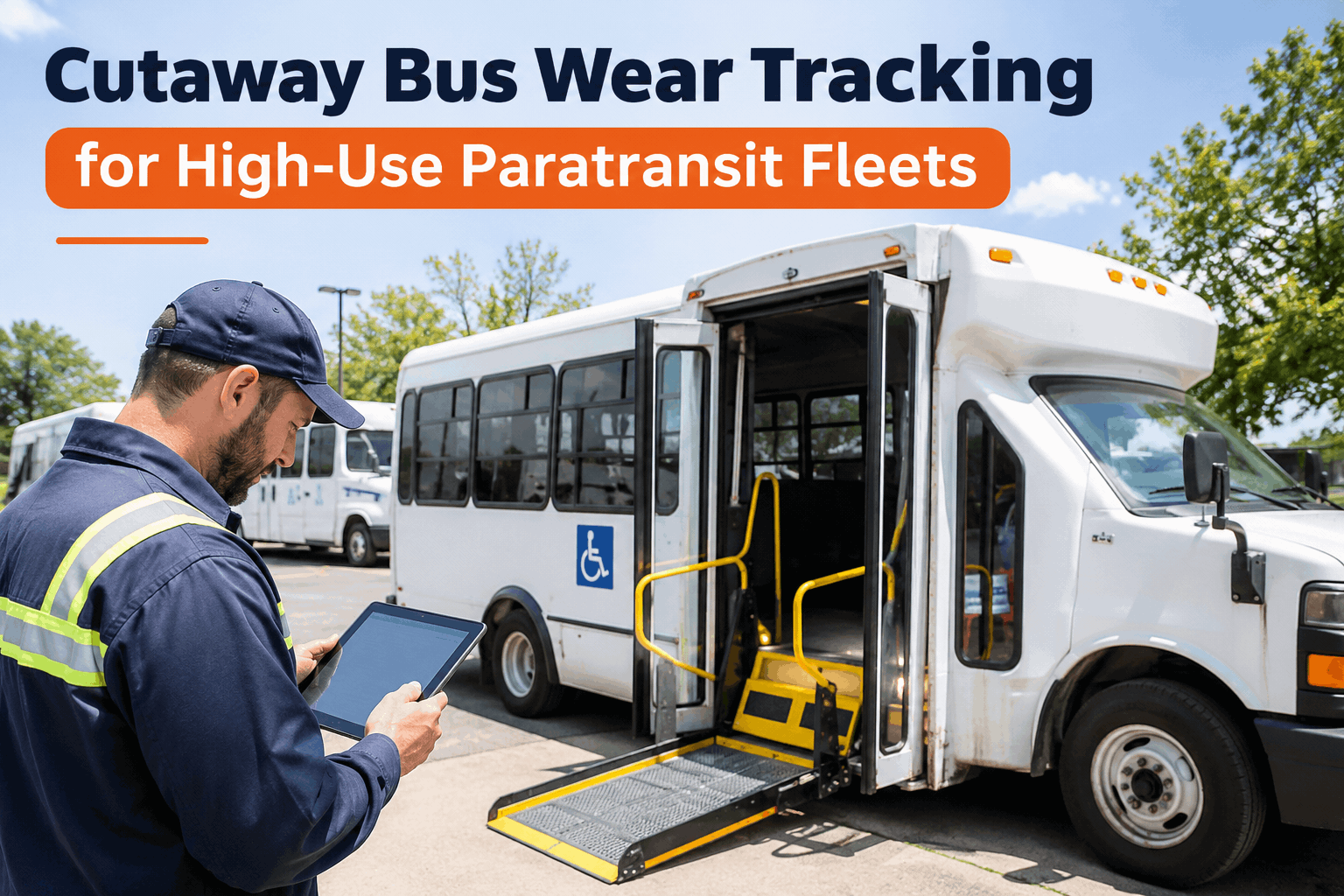
Your cutaways run the hardest duty in the fleet — a lift cycling a dozen times a shift, a door opening at every stop, a chassis loaded all day. That wears the same parts over and over, and the third lift failure on one bus looks like bad luck instead of the pattern it is. Real cutaway bus wear tracking is how you catch the repeat offender before it strands a rider. You can see how recurring wear gets tracked by vehicle in a demo.
Cutaway Bus Wear Tracking for High-Use Paratransit Fleets
Doors, lifts and chassis take the brunt of heavy daily paratransit service. Here is how to track recurring wear by vehicle and catch the repeat failures before they catch you.
Why High-Use Cutaways Wear Differently Than the Rest of the Fleet
A cutaway on heavy paratransit duty is not just racking up miles — it is racking up cycles. And cycles, not odometer readings, are what wear out the systems that strand a rider. Three reasons this fleet needs its own eye.
Cycles, not just miles
A lift and door wear by how often they operate, not how far the bus drove. A low-mileage bus on a dense route can be high-wear.
The same parts, again
Heavy duty means the same components fail repeatedly. Without tracking, each repair looks isolated instead of a pattern worth acting on.
A stranded rider is the cost
When a lift or door fails mid-route on a paratransit run, a rider who depends on it is stuck. The stakes are higher than a late bus.
High-use wear is predictable — but only if you are tracking it by vehicle so the pattern is visible before the failure.
The High-Wear Systems to Watch on a Cutaway
Heavy paratransit duty concentrates wear in a handful of systems. Track the condition and repair frequency of each per vehicle, and the ones trending toward failure announce themselves early.
Electric entry door
Wears from: opening and closing at every stop, all day.
Watch for: slow or hesitant operation, worn hinges, failing motors or switches.
Wheelchair lift
Wears from: repeated full cycles under passenger load every shift.
Watch for: hydraulic leaks, slow travel, interlock faults, platform play.
Chassis & brakes
Wears from: constant stop-and-go while loaded near the vehicle's rating.
Watch for: faster brake wear, pulling, early suspension sag.
Steps & boarding area
Wears from: every boarding and alighting, shift after shift.
Watch for: worn step treads, loose handrails, floor and threshold damage.
Each of these is a system where the same defect tends to come back — which is exactly why a per-vehicle record of what failed and when turns guesswork into a plan, the same way it supports paratransit lift and vehicle maintenance. You can sign up free and log each system's condition against its bus.
The Repeat Offender: When a Defect Comes Back
The single most useful thing wear tracking tells you is this: a part that has failed on the same bus three times this quarter is not bad luck. It is a signal — the component, the installation, or the duty cycle needs a different answer than another identical repair.
Looks like a one-off
A lift fault, a worn door hinge. Fix it, move on — reasonable the first time.
Starts to look familiar
Same part, same bus, weeks later. Without a record, the tech may not even know it is a repeat.
Now it is a pattern
Tracked history makes it obvious: this component is a chronic failure on this vehicle, and another patch is not the fix.
Change the approach
Upgrade the part, adjust the duty, or plan a rebuild — a decision you can only make if the repeats were visible.
That jump from "another repair" to "this is a pattern" only happens when the history is recorded against the vehicle. You can book a demo and see how repeat defects surface on a bus's record.
Your Cutaway Wear-Tracking Checklist
Run this against how you track your high-use cutaways today. Each item is a gap that lets recurring wear hide — and each is something a bus-built system turns into a tracked, per-vehicle record you can actually act on.
- Defects logged against the specific busEvery fault tied to a vehicle, so repeats on one bus stand out from the fleet.CRITICAL
- High-wear systems inspected on a cycleDoor, lift, chassis and steps checked regularly — the parts that fail first.CRITICAL
- Repeat repairs are visible, not hiddenHistory shows when the same part fails again, so a pattern gets caught early.TRACK
- Defects become tracked work ordersA found problem opens a job, so it is fixed and recorded, not deferred and lost.TRACK
- Wear tracked by use, not just odometerA dense, low-mileage route can be high-wear — account for the real duty cycle.TRACK
- Full maintenance history per vehicleA continuous record that tells you which bus is the chronic repeat offender.TRACK
The two critical items — defects tied to the bus and high-wear systems on a cycle — are what make the repeats visible; book a demo and we will set wear tracking up around your busiest cutaways.
How BusCMMS Makes Cutaway Wear Visible
Surfacing recurring wear is exactly what a purpose-built bus CMMS does — it captures every defect and repair against the vehicle, so the patterns a busy shop would otherwise miss become obvious.
Defect logging by vehicle
Every fault recorded against its bus, so recurring wear on a specific vehicle is easy to spot instead of buried in the fleet total.
Repair history & work orders
Each defect becomes a tracked work order and lands in the vehicle's history, so repeat repairs on the same part are plainly visible.
PM scheduled around real use
Preventive maintenance triggered by mileage, hours or calendar, so the high-wear systems get attention matched to how hard the bus works.
One place to see which cutaway is wearing fastest and which part keeps coming back. To set it up around your fleet, book a demo and bring your busiest buses.
A Fleet Maintenance Lead's Take
Key Takeaways on Cutaway Wear Tracking
Strong cutaway bus wear tracking is about seeing the pattern before it becomes a breakdown. Four things to carry back to the shop.
Cycles wear, not miles
A lift and door wear by use — a low-mileage bus on a dense route is high-wear.
Watch the four systems
Door, lift, chassis and steps absorb the duty cycle and fail first.
A third failure is a signal
Repeat repairs on one bus mean the real problem is not another patch.
Track it by vehicle
Per-bus history is what turns scattered repairs into a visible pattern.
Track wear by vehicle, watch the systems the duty cycle hits hardest, treat a repeat failure as the signal it is, and keep the history per bus — and the chronic problems on your high-use cutaways stop being surprises and start being decisions you make on your schedule. For riders who count on that lift working, that is the difference that matters.