Your coach has two engines that need maintenance, but only one of them has an odometer. The APU — the auxiliary power unit keeping the cabin climate, lavatory and outlets running while the main engine is off — wears by the hour, not the mile, and a PM schedule built on chassis mileage sails right past it. That is how an APU quietly racks up hours until it fails on an overnight charter with a full coach aboard. Motorcoach APU maintenance tracking means giving that second engine its own hour-based clock. You can see how APU engine hours and service drive their own schedule in a demo and stop letting the auxiliary unit fall through the cracks.
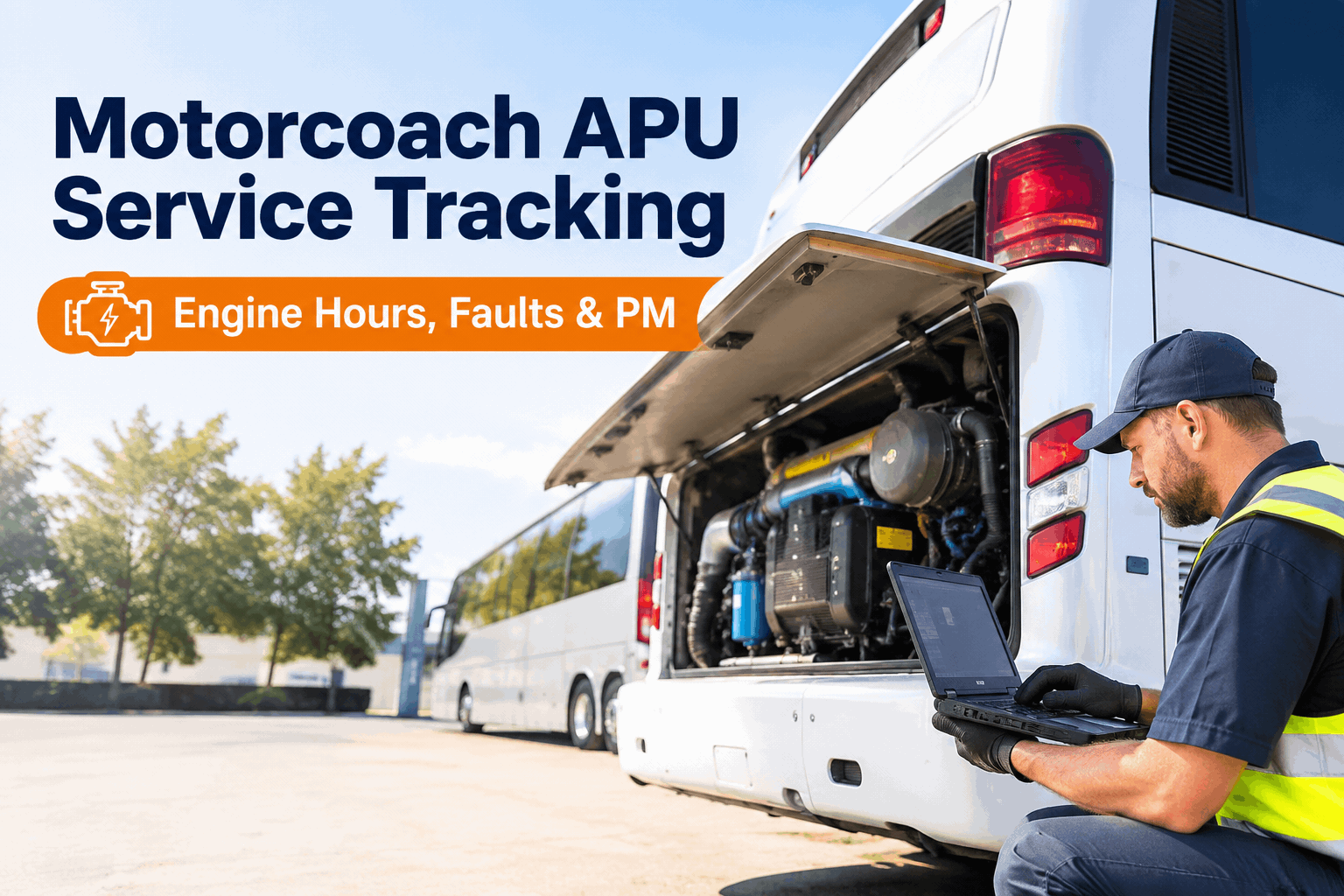
Motorcoach APU Service Tracking: Engine Hours, Faults & PM
A coach runs on miles; its auxiliary power unit runs on hours. Here is how to track APU service by engine hours, catch faults early, and keep its maintenance history tied to each coach.
Why the APU Falls Through the Cracks
Most coach PM is scheduled by mileage — it is simply more convenient than tracking hours. That works fine for the chassis. It fails completely for a unit that runs while the coach sits still.
No miles, plenty of hours
An APU can run all night at a hotel while the coach moves zero miles. Mileage-based PM never trips, but the engine hours keep climbing toward a due service.
It's a second engine
The APU has its own oil, filters, belts and cooling — a whole maintenance profile separate from the main engine, and easy to forget it needs its own plan.
Failure hits comfort hard
When the APU dies on an overnight trip, the climate and power a full coach depends on go with it. It is a comfort and reputation failure, not just a repair.
The fix is simple in principle: track the APU by its own engine hours, on its own schedule, the same way you track the coach by miles.
What an APU Needs Serviced — on the Hour Clock
An auxiliary power unit is a small engine and generator, and it needs the same kinds of care — just measured in run-hours. These are the items that come due on an APU's hour-based schedule. Always follow your specific APU maker's intervals.
Oil & oil filter
The core service, due on run-hours — many APUs call for an oil and filter change on a set hour interval.
Fuel & air filters
Fuel filter replacement and air cleaner service on their own hour intervals keep the unit breathing and fueled cleanly.
Coolant & cooling
Coolant replacement and a check of the cooling system — APUs are notoriously hard on radiators in harsh conditions.
Belts & valve lash
Drive belts inspected and replaced, and periodic valve-lash adjustment at the longer hour intervals the maker specifies.
Each of these rides on hours the odometer cannot see, which is exactly why the APU needs a meter-based schedule of its own. You can sign up free and set each APU service on its hour interval.
From Fault to Fixed: Tracking APU Problems
Scheduled service keeps an APU healthy; fault tracking catches what comes up between services. A driver reports the APU cut out overnight — that report should become a record, a repair, and a line in the unit's history, not a comment that evaporates.
Fault reported
The driver logs an APU issue — won't start, cut out, overheating, a warning on the panel — against that coach.
Work order opens
The fault becomes a corrective work order assigned to a technician, with the APU's current hours on record.
Parts & repair logged
The fix and the parts used are recorded against the unit — so a recurring fault and its cost both become visible.
History per coach
It all lands in that coach's APU record, building the service and fault history you plan and budget from.
That trail is what turns a repeating APU gremlin from a mystery into a pattern you can act on. You can book a demo and see an APU fault move from report to logged repair.
Your APU Maintenance Tracking Checklist
Run this against how you handle APUs today. Each item is a gap that lets the auxiliary unit drift out of service life unnoticed — and each is something a bus-built system turns into a scheduled, per-coach record.
- APU hours tracked separately from milesThe unit's run-time on its own meter, not buried in the chassis odometer.CRITICAL
- Service intervals set by hour, per APUOil, filters, coolant and belts scheduled on the maker's hour intervals.CRITICAL
- Hour readings captured regularlyCurrent APU hours logged so the next service triggers at the right time.TRACK
- Faults become corrective work ordersA reported APU problem opens a tracked job, not a note lost on a clipboard.TRACK
- Parts used recorded against the unitFilters, belts and components logged, so APU cost and recurring issues show up.TRACK
- Full APU history kept per coachA continuous record of service and faults for each unit, ready to plan around.TRACK
The two critical items — hours tracked separately and intervals set by hour — are what put the APU on a real schedule; book a demo and we will set up APU tracking around your coaches.
How BusCMMS Tracks APU Service by Engine Hours
Scheduling by a meter other than the odometer is exactly what a purpose-built bus CMMS does — so the APU gets a real, hour-based maintenance plan and a complete record, tied to the coach it rides on.
Meter-based PM scheduling
Set APU service by engine hours while the chassis runs on miles — each on its own meter, triggering the right service at the right time.
Fault capture & work orders
Driver-reported APU faults become corrective work orders with parts and labor tracked against the unit.
Parts records & APU history
Every service, part and fault kept in the coach's APU history — so cost, recurring issues and service due dates are all visible.
One place where the second engine finally gets tracked like the first. To set it up around your fleet, book a demo and bring your APU details.
A Shop Supervisor's Take
Key Takeaways on APU Service Tracking
Motorcoach APU maintenance tracking comes down to one idea: a second engine needs a second clock. Four things to carry back to the shop.
Hours, not miles
The APU wears by run-time; mileage-based PM never sees it coming due.
It's a real engine
Oil, filters, coolant, belts — a full service profile of its own.
Track faults to history
Report, work order, parts, record — so recurring issues surface.
Follow the maker's hours
Use your APU manufacturer's exact hour intervals, tracked per unit.
Put the APU on its own hour meter, schedule its services by run-time, track every fault through to a logged repair, and keep the history per coach — and the auxiliary unit stops being the part nobody watches and becomes a managed asset like any other. For a coach that sells comfort on long trips, a reliable APU is part of the product. Give it the clock it runs on.