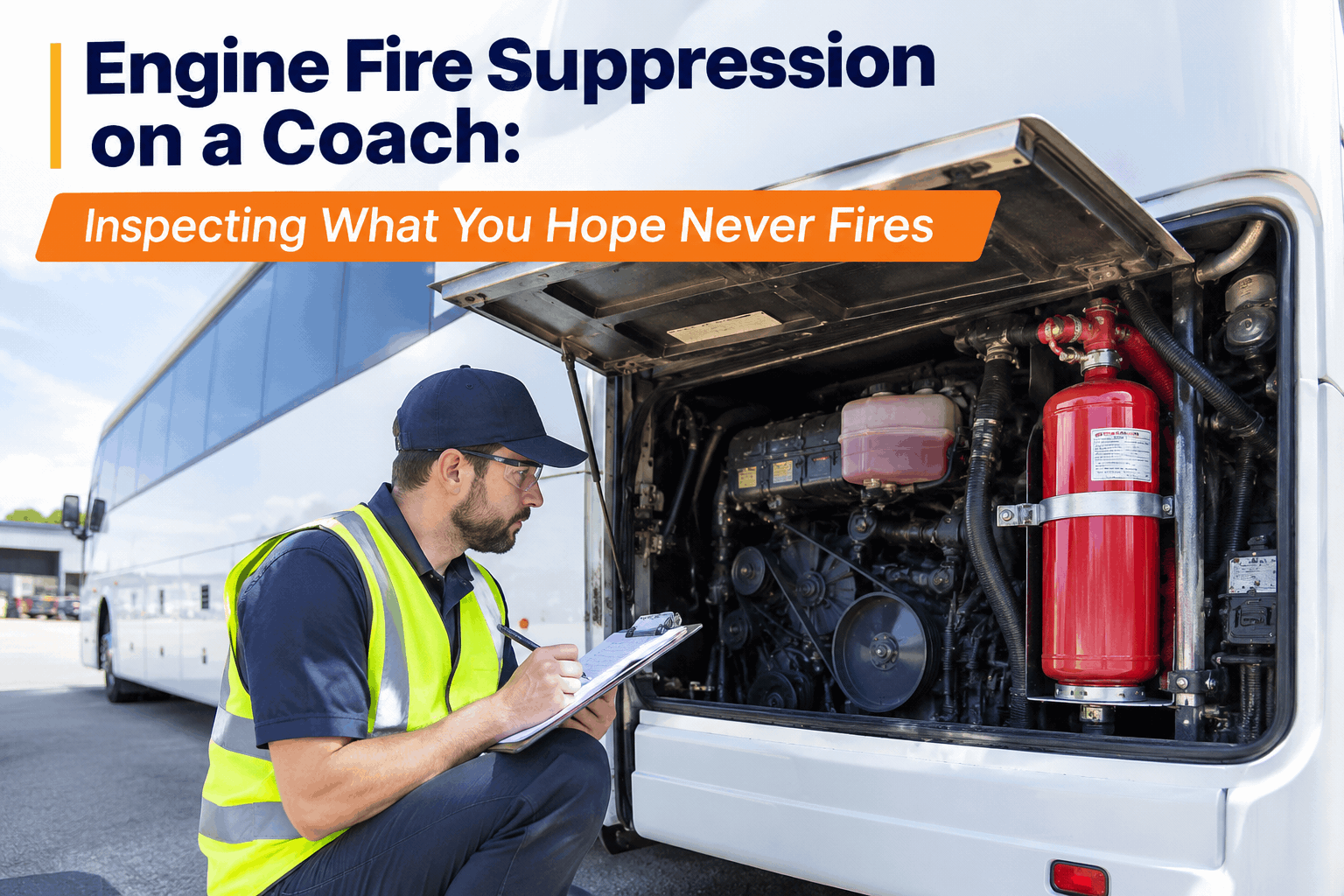
An engine fire on a coach gives you seconds, and the suppression system in that engine bay is the one device you install hoping it never activates. But a system you never fire is one you can forget to maintain — until the day it has to work and doesn't. Motorcoach fire suppression is only protection if it's proven ready, and that proof comes from an inspection schedule you actually keep. You can see how suppression inspections get scheduled and documented per coach in a demo.
Engine Fire Suppression on a Coach: Inspecting What You Hope Never Fires
A suppression system only protects if it works the instant it's needed — and you can't test that by firing it. Here is the inspection cadence that keeps it proven ready, and how to never miss one.
Why a Suppression System Is So Easy to Neglect
Every other system on the coach tells you when it needs attention — a warning light, a noise, a performance drop. A fire-suppression system that is quietly failing looks exactly like one that is perfectly fine. That silence is the danger.
No feedback until it's too late
You only find out a suppression system failed at the exact moment you needed it to work. There is no second chance and no do-over on an engine fire.
It lives where fires start
The engine compartment is hot, dirty and full of fuel, oil and heat — the environment most likely to start a fire, and hardest on the device meant to stop one.
A full coach is on board
A motorcoach fire puts dozens of passengers at risk. The suppression system buys the seconds that get everyone off safely — if it fires.
The only way to trust a system you can't fire to test is to inspect it on schedule and document every check — the records are the readiness.
What's in the System — and What to Watch
An engine fire-suppression system is a few parts working together, each with its own failure mode. Knowing what each does makes the inspection meaningful instead of a box-tick.
Detection
Heat sensors or detection wire that spot a fire fast and trigger the system — the first link in the chain.
Watch: sensors undamaged, wiring intact and routed clear, no snags or chafing.
Agent cylinder
The pressurized tank holding the suppression agent — dry chemical or another agent — that floods the compartment.
Watch: pressure gauge in the green, cylinder secure, seals and tamper indicators intact.
Nozzles & distribution
The piping and nozzles that carry the agent to where fire is most likely, covering the compartment.
Watch: nozzles clear and unblocked, aimed correctly, lines undamaged.
Control panel & manual release
The driver's display showing system status, plus the manual actuation button to fire it by hand.
Watch: panel shows ready/no-fault, manual release accessible and unobstructed.
Some systems self-monitor and flag a fault on the panel, but a warning light is not a substitute for a logged, scheduled inspection of the hardware — the same inspection discipline behind any coach and shuttle fleet maintenance program. You can sign up free and record each component's check against the coach.
The Inspection Cadence, Tier by Tier
Manufacturers build the schedule to escalate — frequent, simple checks by your own people, deeper certified service less often. Each tier catches what the lighter ones can't. Always follow your system maker's exact intervals; this is the shape of it.
Operator glance
A quick look as part of the pre-trip — panel status normal, no obvious damage or fault light. Seconds, every day.
Operator check
A closer look at cylinder pressure, visible components and connections — the owner-level inspection the manufacturer specifies.
Authorized technician service
A trained technician inspects and services the system to the maker's standard — the deeper check your operators can't perform.
Periodic major maintenance
Longer-interval service — often at two, six and twelve years — covering cylinder and component overhaul or replacement per the manufacturer.
The hard part isn't any single tier — it's never missing one across a fleet of coaches, each on its own clock. You can book a demo and see every tier scheduled and tracked per coach.
Your Fire-Suppression Readiness Checklist
Run this against how you manage suppression today. Each item is a gap that could leave the system unproven when it matters most — and each is something a bus-built system turns into a scheduled, documented, per-coach record.
- Every inspection tier scheduled per coachDaily, monthly, semiannual and periodic intervals tracked on each vehicle's clock.CRITICAL
- Cylinder pressure checked and loggedGauge in the green confirmed and recorded, not just glanced at and forgotten.CRITICAL
- Daily checks captured on the DVIRThe operator's pre-trip glance recorded, so a fault is caught and documented.SCHEDULE
- Faults open a work orderA panel fault or failed check becomes a tracked repair, not a note that gets lost.SCHEDULE
- Technician service tied to the right techSemiannual and periodic work assigned to an authorized technician and recorded.SCHEDULE
- Records ready for a CSA or DOT reviewA dated inspection and service history per coach, retrievable when an auditor asks.SCHEDULE
The two critical items — every tier scheduled and cylinder pressure logged — are the heart of a ready system; book a demo and we will set your suppression cadence up around your fleet.
How BusCMMS Keeps Suppression Proven Ready
A fire-suppression system is a scheduled-inspection-and-records problem — precisely what a purpose-built bus CMMS handles. It holds the cadence, captures the checks, and keeps the proof.
Tiered PM scheduling
Daily, monthly, semiannual and multi-year suppression intervals scheduled per coach, so no tier slips through on any vehicle.
DVIR & defect capture
Operator daily checks captured on digital DVIRs, and any fault opens a tracked work order routed to the right technician.
CSA/DOT-ready records
A dated inspection and service history per coach, so proving the system was maintained is a quick pull, not a scramble.
One place that keeps the device you hope never fires provably ready. To set it up around your fleet, book a demo and bring your suppression system details.
A Safety Officer's Take
Key Takeaways on Motorcoach Fire Suppression
Motorcoach fire suppression protects only if it is proven ready — and proof lives in the inspection record. Four things to carry back to the shop.
Silence is the risk
A failing suppression system looks fine — only inspection reveals it.
The cadence escalates
Daily and monthly by operators, semiannual and periodic by technicians.
Records are the readiness
You can't fire-test it, so the documented check is your only proof.
Never miss a tier
Across a fleet, scheduling per coach is what keeps every tier on time.
Treat the suppression system as a scheduled, documented safety device — keep every inspection tier on its clock, capture the daily checks, fix faults fast, and hold the records — and the one piece of equipment you hope never fires will be ready the moment it must. Always follow your manufacturer's exact intervals; the discipline that keeps them is what turns a device into protection.